



ACL Digital
March 25, 2026
5 Minutes read
AI-Driven Product Engineering: How Embedded Intelligence is Transforming the Product Lifecycle
AI is no longer confined to cloud analytics or data science platforms. It is increasingly being embedded directly into devices, sensors, and edge systems—transforming traditional products into intelligent systems capable of learning, adapting, and optimizing in real time.
For product manufacturers and OEMs, this shift is redefining how products are designed, developed, deployed, and maintained. Embedded intelligence enables continuous data-driven decision-making across the product lifecycle, driving faster innovation, improved reliability, and new service-based business models.
As industries move toward connected ecosystems, software-defined products, and autonomous systems, AI-driven product engineering is becoming a strategic differentiator.
The Rise of Embedded Intelligence in Product Engineering
Embedded intelligence refers to the integration of AI and machine learning models directly within embedded systems, enabling devices to analyze data and make decisions locally without relying entirely on cloud infrastructure.
Advancements in AI accelerators, edge processors, and optimized ML frameworks have made it possible to run sophisticated models within resource-constrained environments.
Key technology drivers include:
- Edge AI chipsets and neural processing units (NPUs)
- TinyML and lightweight inference models
- AI-enabled microcontrollers
- Real-time sensor fusion and adaptive control systems
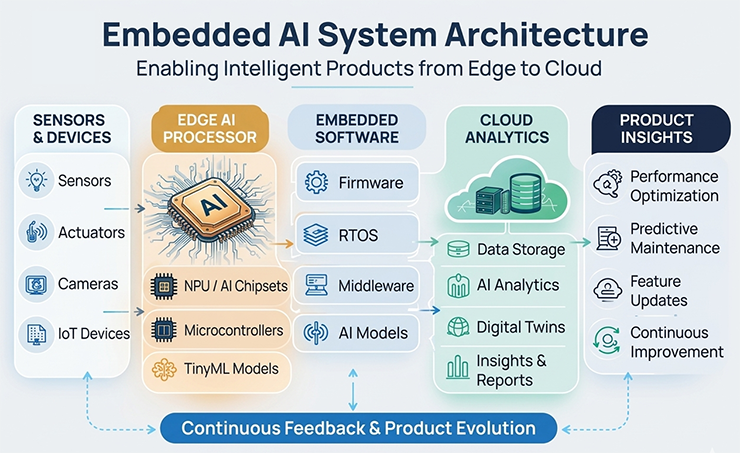
These innovations allow products to move beyond automation and deliver context-aware intelligence directly at the edge.
Embedded AI is being widely adopted across industries such as industrial automation, automotive and mobility, smart consumer electronics, healthcare devices, and energy and utilities. Learn more about this evolution in our blog on Edge AI in Embedded Product Engineering.
Transforming Product Design with AI-Assisted Engineering
AI is significantly improving how products are designed and engineered.
Engineering teams can now use AI to analyze design constraints, simulate performance, and generate optimized architectures before physical prototypes are built.
AI-assisted design capabilities include:
- Generative design for hardware components
- AI-assisted PCB layout optimization
- Simulation-driven design validation
- Automated requirements analysis
- Intelligent design verification
These capabilities reduce engineering iterations and enable organizations to accelerate development cycles while improving product performance and efficiency.
AI-Powered Development and Testing Acceleration
Product development cycles are increasingly complex due to growing software stacks, connectivity requirements, and regulatory standards. AI is helping engineering teams automate and optimize development and testing processes.
Key use cases include:
- Intelligent Test Automation: AI algorithms analyze system behavior to automatically generate test cases and identify edge-case scenarios that traditional testing methods may overlook.
- Predictive Debugging: Machine learning models analyze logs, system telemetry, and code patterns to detect potential faults early in the development cycle.
- Hardware-in-the-Loop (HIL) Optimization: AI-driven analytics improve validation environments by identifying performance bottlenecks and system anomalies during integration testing.
Intelligent Products in Operation: From Devices to Adaptive Systems
Once deployed, AI-enabled products can continuously learn and adapt based on real-world operating conditions. Embedded intelligence enables devices to detect anomalies in real time, adapt performance based on user behavior, optimize energy consumption, and self-calibrate or self-diagnose potential issues.
Examples include:
- Industrial equipment performing predictive maintenance – You can also explore how AI-driven predictive maintenance is being implemented in real-world scenarios in our case study on connected industrial monitoring solutions.
- Smart energy systems dynamically balancing power usage
- Consumer devices adapting to user preferences
- Automotive systems enabling advanced driver assistance features
This shift transforms products into adaptive systems capable of continuous optimization.
Continuous Lifecycle Intelligence Through Connected Data
One of the most significant impacts of embedded intelligence is the ability to create closed-loop feedback across the product lifecycle.
Operational data collected from deployed devices feeds back into engineering workflows to improve future product generations.
This creates a continuous innovation loop:
- Product design
- Deployment
- Real-world performance monitoring
- AI-driven insights
- Product optimization
Technologies enabling this lifecycle intelligence include digital twins, edge-to-cloud analytics platforms, connected device telemetry, and AI-driven fleet management systems that provide continuous insights into product performance and operational behavior.
Organizations leveraging these capabilities can reduce downtime, improve product reliability, and deliver continuous product improvements.
Emerging Trends Shaping AI-Driven Product Engineering
Several technology trends are accelerating the adoption of embedded intelligence in product engineering.
- Software-Defined Products: Hardware is increasingly becoming programmable and upgradeable through software updates, enabling continuous feature evolution.
- TinyML and Ultra-Low Power AI: Running AI models directly on microcontrollers is enabling intelligent capabilities in extremely low-power devices.
- Edge AI and Federated Learning: Devices can train models collaboratively without sharing raw data, improving privacy and security.
- AI-Driven Digital Twins: Virtual representations of physical products allow engineers to simulate performance, analyze operational data, and predict potential failures.
Key Challenges in AI-Driven Product Engineering
Despite its potential, integrating AI into product engineering introduces new technical challenges:
- Managing AI workloads within constrained hardware environments
- Ensuring real-time performance and reliability
- Model lifecycle management and updates
- Cybersecurity and AI safety considerations
- Compliance with regulatory and safety standards
Addressing these challenges requires strong expertise in embedded systems, AI engineering, cloud platforms, and product lifecycle management.
Conclusion: Engineering the Next Generation of Intelligent Products
Embedded intelligence is transforming the way products are engineered and operated. AI-driven product engineering enables organizations to move beyond traditional development approaches and build systems that continuously evolve through real-world data and intelligence.
As industries increasingly adopt connected ecosystems and autonomous technologies, the ability to integrate AI seamlessly across the product lifecycle will become a defining capability for product manufacturers.
Organizations that embrace AI-driven product engineering today will be better positioned to build smarter, adaptive, and future-ready products that deliver long-term value.
About ACL Digital
ACL Digital is a leading product engineering and digital transformation partner helping OEMs build intelligent, connected products. With expertise across embedded systems, edge AI, silicon engineering, IoT, and cloud platforms, the company supports the complete product lifecycle, from design and development to deployment and optimization. ACL Digital enables organizations to accelerate innovation, improve product performance, and bring next-generation solutions to market faster.
Transform your products with embedded intelligence. Connect with ACL Digital’s engineering experts to explore how AI-driven product engineering can accelerate innovation and bring smarter products to market faster.