



ACL Digital
April 6, 2026
5 Minutes read
Connected Vehicle Tech in 2026: Architecture & Use Cases
As more vehicles become digitally enabled, the demand for connected vehicle technology is rapidly accelerating. The global connected car market is projected to grow from over $97 billion in 2024 to nearly $390 billion by 2034, representing a strong 14.91% CAGR, according to Research and Markets – Connected Car Market Analysis & Forecast.
In this blog, we’ll explore what connected vehicles are, how they work, and how they help organizations achieve safer operations, streamlined workflows, and superior user experiences.
Connected vehicles go far beyond standard in-car smart features. They enable real-time, two-way communication with external systems—transforming vehicles into intelligent, data-driven platforms.
The Core Layers of Connected Vehicle Technology
Unlike traditional vehicles that rely only on onboard technologies, connected vehicles can send data to the cloud, receive remote software updates, and integrate seamlessly across multiple digital layers:
Telematics: The Foundation Layer
Telematics forms the core of connected vehicle technology. It includes the onboard hardware and software that collect, process, and transmit data such as GNSS location, vehicle health, diagnostics, and driver behavior.
Cloud Platforms: The Integration Layer
Cloud platforms act as the central hub for connected vehicle data. They store, analyze, and share information in real time—enabling over-the-air (OTA) updates, remote diagnostics, fleet visibility, and API-based integration with third-party systems.
Digital Services: The Application Layer
Digital services are the features users interact with every day. These include navigation and infotainment, predictive maintenance, usage-based insurance (UBI), and shared mobility capabilities such as geo-fencing and remote vehicle access.
Together, these layers form the connected vehicle ecosystem—delivering value to automakers, solution providers, fleet operators, and mobility platforms across the transportation industry.
How Do Connected Vehicles Communicate?
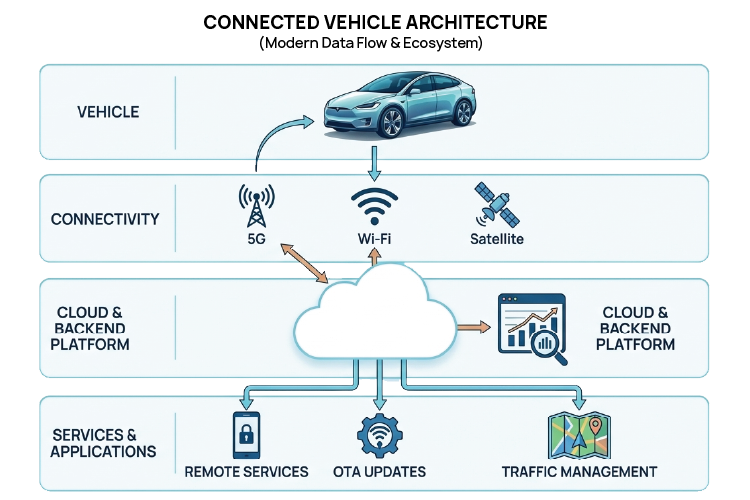
Connected vehicles rely on a powerful digital ecosystem that keeps them continuously linked to the cloud and the businesses that manage them. At the core, connected vehicle tech transmit and receive data through cellular networks using embedded telematics systems and secure application programming interfaces (APIs).
This connected architecture enables real-time communication, service delivery, vehicle health monitoring, and over-the-air (OTA) updates helping organizations improve efficiency, safety, and customer experiences at scale.
Cellular Connectivity
Cellular connectivity forms the backbone of connected vehicle solutions, enabling vehicles to communicate with cloud platforms and enterprise systems in real time. Technologies such as 4G/LTE, 5G, and IoT cellular networks allow vehicles to transmit critical operational data quickly and reliably. In regions where cellular coverage is limited, satellite connectivity ensures continuous communication. As 5G networks expand, connected vehicles will benefit from lower latency, faster data exchange, and improved support for advanced mobility services.
Embedded Telematics and In-Vehicle Intelligence
Embedded Telematics Control Units (TCUs) connect vehicles to external networks and digital ecosystems. Powered by eSIM technology, these systems capture and transmit real-time data such as GNSS location, vehicle health metrics, driver behavior, and video feeds. This constant flow of data enables organizations to monitor vehicle performance, detect issues early, and gain actionable insights. As a result, businesses can implement predictive maintenance, fleet analytics, and intelligent automation to improve operational efficiency.
Cloud Integration, APIs, and Real-Time Data Exchange
Cloud platforms and APIs form the intelligence layer of connected vehicle solutions by enabling secure data exchange between automakers, fleet operators, insurers, mobility providers, and third-party applications. This integration supports capabilities such as over-the-air (OTA) updates, remote vehicle control, predictive analytics, and personalized digital services. By enabling scalable data processing and real-time insights, cloud integration helps build a connected mobility ecosystem that enhances safety, efficiency, and user experience.
Key Use Cases of Connected Vehicle Tech Across Industries
Connected vehicle solutions are transforming the way organizations design, operate, and manage mobility ecosystems. How these technologies are applied depends on your role—whether you manufacture vehicles, build platforms, manage fleets, provide insurance, or run large-scale transportation programs.
Below are some of the most impactful ways connected vehicles are being used across industries.
OEMs and the Shift to Software-Defined Vehicles
For original equipment manufacturers (OEMs), connectivity is the foundation of software-defined vehicles (SDVs). By integrating telematics and cloud connectivity, OEMs can deliver over-the-air (OTA) updates for recalls, feature enhancements, and performance improvements.
Remote diagnostics enable faster issue detection and resolution, improving safety while reducing service costs. At the same time, real-time usage analytics provide valuable insights into how vehicles are actually used helping manufacturers make smarter design and product roadmap decisions.
Solutions Providers and Connected Platforms
For technology and mobility solution providers, connected vehicle solutions enable the creation of end-to-end digital platforms. By bringing together data from vehicles, drivers, and infrastructure, providers can deliver unified dashboards, predictive maintenance, usage-based billing, and advanced analytics.
These integrated platforms help differentiate offerings, accelerate the launch of new services, and deliver continuous value to fleets, logistics operators, and transportation providers.
Transportation and Logistics
Fleet operators and logistics teams rely on connected vehicle data to gain real-time visibility into deliveries, vehicle location, performance, fuel usage, and critical alerts.
This intelligence helps optimize routes, minimize idle time, prevent breakdowns, and keep vehicles on the road longer. Connectivity also extends to related assets such as smart trailers, allowing operators to monitor their condition and status alongside their vehicles.
Insurance and Risk Modeling
For insurers and risk management teams, connected vehicle solutions power usage-based insurance (UBI) and behavior-driven pricing models. Telematics data enables more accurate premium calculations based on real driving behavior.
It also provides objective incident records, helps detect fraud, and allows insurers to identify emerging risk patterns early—leading to fairer pricing and improved loss prevention.
Shared Mobility and Subscription Services
Mobility providers offering rental, subscription, or rideshare services use connected vehicle technology to streamline operations. Features such as real-time location tracking, geo-fencing, remote unlock, and automated maintenance alerts reduce manual processes and vehicle downtime.
Role-based access and remote commands make it easy to transition vehicles between drivers, improving turnaround times and operational efficiency.
Smart Cities and Intelligent Transportation
City planners and infrastructure teams use data from connected vehicles and roadway sensors to improve traffic flow and transportation planning. This real-time information helps optimize traffic signals, reduce congestion, and create more predictable travel times.
The same data supports better route planning, staffing, and staging—making urban transportation systems safer, smarter, and more efficient.
How ACL Digital Enables Connected Vehicle Technology?
Organizations developing modern mobility platforms need a technology partner capable of delivering end-to-end connected automotive solutions.
ACL Digital provides engineering expertise across the connected vehicle ecosystem, including:
- Telematics platform development
- Cloud-based fleet management systems
- IoT connectivity and protocol integration
- Automotive cybersecurity solutions
- Connected mobile and web applications
With deep expertise in IoT, cloud platforms, embedded systems, and automotive engineering, ACL Digital helps organizations accelerate the development of scalable and secure connected vehicle solutions.
Frequently Asked Questions
What is connected vehicle tech?
Connected vehicle tech enables vehicles to communicate with cloud platforms, infrastructure, and digital services to deliver features such as fleet monitoring, remote diagnostics, and predictive maintenance.
What technologies power connected vehicles?
Connected vehicles use telematics, cellular connectivity, IoT platforms, cloud computing, APIs, and data analytics.
What industries use connected vehicle tech?
Industries such as automotive manufacturing, logistics, insurance, mobility services, and smart cities use connected vehicle platforms.
Related Insights