



Tejashree G
February 9, 2026
5 Minutes read
5 Databricks Lakehouse Concepts That Will Change How You Think About Data
Introduction: Beyond the Data Swamp
In the world of data, organizations often face a familiar and frustrating set of challenges: performance bottlenecks as datasets grow to massive scales, the constant struggle to govern sensitive information, and the costly, ongoing effort of copying data between systems and partners. Without the right approach, these issues can quickly turn a promising data lake into a murky, unmanageable “data swamp.”
But what if a platform could offer a more intelligent way forward?
To truly leverage the power of the Data Lakehouse, we need to look beyond basic feature lists. Below, we uncover five powerful, and sometimes counterintuitive concepts within Databricks. These are not just incremental improvements; they represent a fundamental shift in how organizations process, govern, and share data.
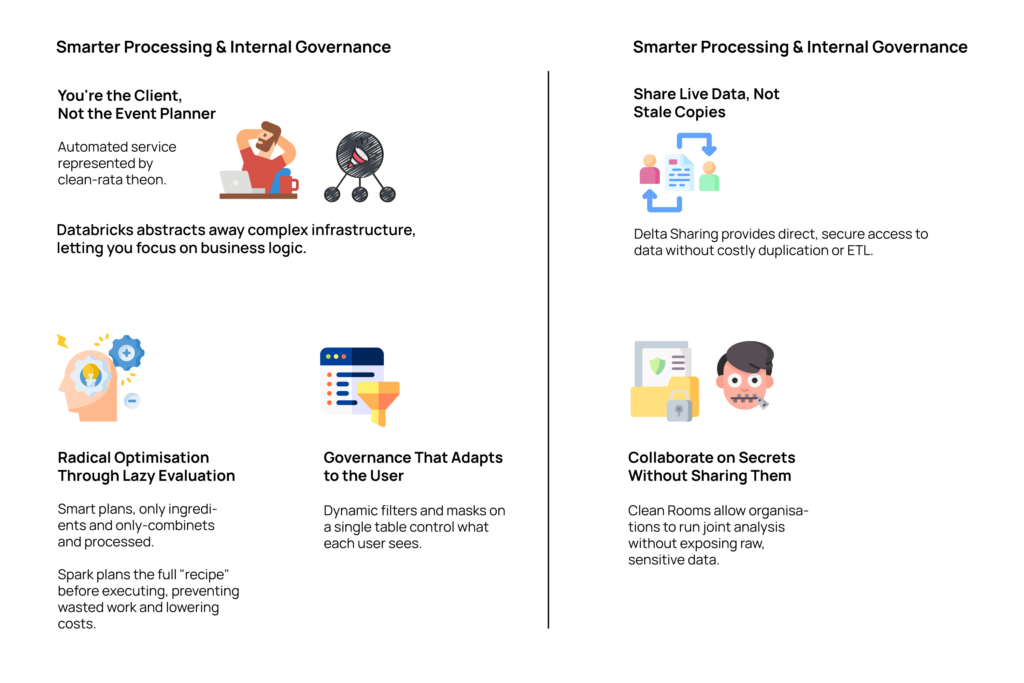
1. You're the Client, Not the Event Planner: Abstracting Away Complexity
Processing massive datasets on a single computer is impossible; it will inevitably run out of memory. The solution is distributed computing, where tasks are split across many machines. However, managing this type of “cluster” is notoriously complex.
Databricks addresses this challenge by adding layers of abstraction that allow teams to focus on data rather the infrastructure. The architecture is best understood through a wedding planning analogy:
- Distributed Computing (The Chefs):
Imagine preparing food for a large wedding. One chef is not enough. You need multiple chefs working in parallel. In data terms, this means splitting a workload across multiple computers, also known as worker nodes. - Apache Spark (The Caterer):
Managing each chef individually would be chaotic. Instead, you hire a caterer. You provide the recipe which here means the code, and the caterer coordinates the chefs and handles problems, such as chef becoming unavailable. Apache Spark plays the role by orchestrating distributed data processing and ensuring fault tolerance. - Databricks (The Event Planner):
Rather than hiring the caterer directly, you work with an event planner. The planner handles everything, from staffing to logistics. Databricks is a managed service. It provisions, configures, and operates Spark clusters so teams do not have to manage virtual machines, networking, and scaling.
This abstraction allows data teams to act as the client. They define the work, and the platform handles the operational complexity, allowing engineering resources for higher-impact business initiatives.
2. It Doesn't Run When You Think It Does: The Magic of Lazy Evaluation
Developers familiar with tools like Python’s pandas are used to “eager” execution: you write a line of code, and it runs immediately. Spark, the engine behind Databricks, operates on a different, more powerful principle known as lazy evaluation.
In Spark, operations are divided into two categories:
- Transformations:
Operations that define a new dataset such as filter or select. When called, Spark does not execute any code immediately. Instead, it simply builds a logical plan, essentially a “recipe” of steps. - Actions:
Operations that trigger computation such as show, count or write. An action tells Spark, “Okay, I have the full recipe. Time to cook.”
This distinction enables advanced query optimization. By waiting until an action is triggered, Spark can analyze the entire plan to combine steps and skip unnecessary work.
For example, if your code filters a billion-row table but the final action only displays five rows, Spark retrieves just enough data to satisfy the request. It does not process the entire dataset. This reduces compute costs, and significantly accelerate time to insight.
3. Governance That Adapts to the User: Dynamic Row Filters and Column Masks
Traditional data governance often relies on creating numerous static SQL views to control access. This approach increases maintenance effort and introduces unnecessary duplication.
Unity Catalog, the Databricks unified governance layer, replaces this model with dynamic, policy-based access controls applied directly to tables.
- Row Filters:
Consider a global sales table. A filter can ensure that a manager in the West region only sees rows where Region West. The filtering happens dynamically, and the user remains unaware of restricted data. - Column Masks:
At the same time, sensitive fields such as customer email addresses can be automatically masked. For users outside the marketing team, the column may appear as “REDACTED.”
This approach transforms governance into a built-in characteristic of the data itself. Teams manage a single table and a single set of policies, resulting in scalable, auditable, and maintainable security.
4. Share Live Data, Not Stale Copies: The Zero-ETL World of Delta Sharing
Traditional data sharing is slow and risky. It often involves complex ETL pipelines, file transfers and repeated loading into downstream systems. By the time partners access the data, it is already outdated.
Delta Sharing is an open protocol that eliminates this outdated process. It allows you to share live, real-time access to your data without ever moving or copying it.
This approach delivers two transformative benefits:
- Cross-Platform Sharing:
Recipients don’t need Databricks. They can use open-source connectors in Power BI, pandas, or Tableau to query the live data. - No Data Duplication:
Since everyone queries the single source of truth, there are no data silos and no expensive ETL jobs to maintain.
By adopting a “zero-ETL” approach, organizations can accelerate partner collaboration while reducing security risks associated with unmanaged data copies.
5. Collaborate on Secrets Without Sharing Them: The Power of Clean Rooms
While Delta Sharing enables live access to data, some use cases require collaborations on highly sensitive data such as patient records or fraud transaction logs, without actually revealing raw data.
Databricks Clean Rooms address this challenge.
A Clean Room is a secure, isolated environment where multiple parties can run computations on shared data without directly accessing each other’s underlying records. Organizations can bring their private datasets into the Clean Room to perform joint analysis—including AI and machine learning workloads.
For example, a retailer and a brand can jointly analyze the effectiveness of a campaign by joining their data, deriving insights on the results without ever exposing their customer lists to one another. This is a game-changer for industries where innovation requires collaboration, but privacy regulations are non-negotiable.
Conclusion: A New Relationship with Data
These five concepts—deep abstraction, lazy evaluation, dynamic governance, zero-ETL sharing, and privacy-safe clean rooms—demonstrate how the Databricks Lakehouse Platform redefines the data lifecycle.
It is a system designed to abstract away complexity, embed intelligent governance, and foster secure collaboration. As these powerful abstractions become the norm, we are left with an exciting question: What new innovations become possible when your data teams are finally freed from the constraints of infrastructure, maintenance, and data movement?
Why ACL Digital Is the Right Databricks Partner
While Databricks provides the technology foundation, realizing its full value requires the right strategy, architecture, and execution expertise. ACL Digital brings deep Lakehouse implementation experience to help organizations convert platform capabilities into tangible business outcomes.
From scalable architecture design and performance optimization to governance enablement and advanced analytics, the team ensures Databricks environments are efficient, secure, and future-ready. This approach reduces operational complexity, accelerates time-to-insight, and creates a strong foundation for data and AI initiatives.
By partnering with ACL Digital, organizations gain a trusted advisor focused on reducing operational complexity, accelerating time-to-insight, and building a future-ready data and AI ecosystem.
Related Insights


The Transpilation Deep Dive: PL/SQL to IRIS Native Python
Shubham Rathod

AI-Driven Pain Assessment: Leveraging Facial and Vocal Biomarkers to Transform Patient Care
Tharik Mohamed Alikul Jaman

On-Device AI & Edge Computing in Mobile Apps for the Healthcare Industry
Parthiban Mahendran