Home / Blogs / Edge AI for Real-Time Anomaly Detection in Industrial IoT
Deep Pandya
May 28, 2026
5 Minutes read
Edge AI for Real-Time Anomaly Detection in Industrial IoT
Industrial boiler systems have evolved from manual monitoring of multiple gauges and maintaining paper records to cloud-connected Industrial IoT (IIoT) dashboards. The next shift is towards adding intelligence within the controller itself, enabling real-time anomaly detection and alarm generation. This serves as a companion for on-field engineers and IIoT-connected dashboards.
The AI model processes data from multiple sensors (known as sensor fusion) in a time-series manner to identify anomalies and support preventive maintenance. It can also record device usage patterns to determine warranty eligibility.
The Core Challenges: Real-Time Anomaly Detection in Complex Systems
Developing a reliable real-time anomaly detection system requires addressing several challenges:
Understanding data characteristics for anomaly parameters and threshold criteria
Processor and memory selection for high-frequency data capture and processing
Sensor selection based on required data parameters and accuracy
Data cleanup, including noise removal and data conversion, such as analog-to-digital, and frequency-domain-to-time-domain, etc.
Selecting an edge inference engine with appropriate memory to process time-series models
Understanding environmental and deployment parameters
Designing a simulator platform to validate solution efficiency and prepare it ready for deployment
Traditional detection methods struggle with the unpredictable and non-linear behavior of multiple-sensor data. With AI models, these challenges can be effectively addressed through machine learning models orchestration.
Model Selection and Optimization Approach
The model selection was driven by the nature of the time-series sensor data and the requirement for real-time edge deployment. Since the data exhibits temporal dependencies and sequential patterns, recurrent neural network (RNN) architectures were evaluated. We evaluated Long Short-Term Memory (LSTM) and Gated Recurrent Unit (GRU) models after analyzing the data and its behaviour in the time domain.
The selection process involved analyzing different window sizes to capture daily operational cycles and reduce false positives. A time window was chosen to align with natural system patterns, prediction accuracy, and available NPU memory.
Edge AI Anomaly Detection Architecture
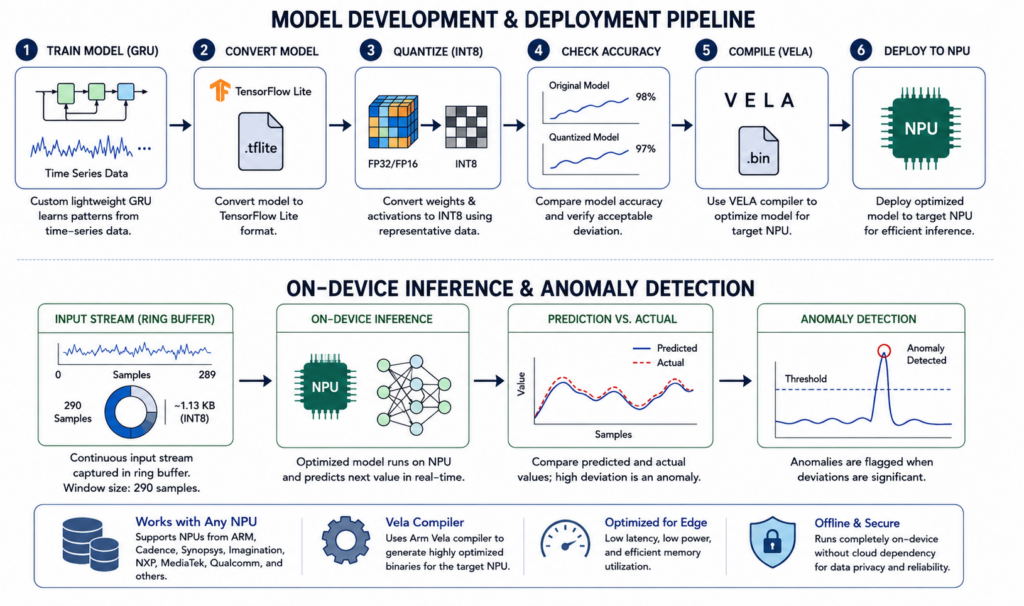
This diagram illustrates the complete workflow of the real-time anomaly detection system, from model training to deployment on the NPU, and how inference runs directly on the edge device.
Here, the model is used to predict sensor value and compare them with actual value. If the difference exceeds the threshold range for a specific duration, it is classified as an anomaly. The NPU helps generate accurate predictions, while the CPU determines whether an anomaly has occurred based on the configured threshold parameter and algorithm to avoid false-negative situations.
Supports device self-diagnosis and helps ensure that warranty criteria align with actual usage patterns.
Conclusion
This work demonstrates an effective Edge AI-based approach for real-time anomaly detection in Industrial IoT systems, enabling preventive maintenance directly at the source of data. By deploying a quantized GRU model on the edge device, the system achieves low-latency, offline inference with high reliability. This architecture reduces dependency on cloud connectivity while still leveraging the cloud for model refinement and updates, resulting in a scalable and robust solution for industrial deployments.
ACL Digital’s Path to Market Leadership: Building Intelligent Edge AI Ecosystems
ACL Digital differentiates itself by combining AI inference capabilities with edge hardware, enabling real-time intelligent processing without cloud dependency—a key advantage for industrial and enterprise applications. We develop proprietary model optimization tools and domain-specific AI solutions across manufacturing, healthcare, and infrastructure to create software-enabled revenue streams and customer differentiation beyond commodity hardware competition.
Through strategic partnerships with AI platforms and technology providers, ACL Digital continues to expand its ecosystem and deliver integrated Edge AI solutions that support scalable, secure, and intelligent connected systems.