


ACL Digital
June 30, 2026
5 Minutes read
Strong Authentication Beyond Browsers for the Future of Connected Devices
Our digital ecosystem expands far beyond traditional web applications like IoT, cloud platforms, and connected devices. One thing is clear that authentication is no longer just about logging into a browser. Today, enterprise is positioned not just as managing multiple employees it’s about securing an entire ecosystem of users, devices, APIs, and machines. At the same time, cyberattacks are becoming faster and more advanced as leveraging automated tools, credential theft, and sophisticated phishing to target any authentication layer left exposed. Today, there are over 21.9 billion active IoT devices connected worldwide. That creates a massive attack surface completely detached from traditional web browsers.
This transformation needs a new strategy which is popularly recognized as “strong authentication beyond the browser”, a security paradigm developed for distributed, always-connected environments.
The Growing Need to Move Beyond Traditional Authentication
Passwords are the go-to method for protecting digital accounts and systems.But due to the risk of cyber threats, passwords alone are no longer enough to keep organizations secure. It is the most common case where users use the same password for multiple applications and services as this password is more convenient to them. This would be more easy for attackers to use stolen credentials to gain access to other systems often if one account is compromised. Also, advanced cyberattack affects password authentication which is created carefully and this could be a significant security risk in today’s connected world.
Here are most common methods attackers use to compromise password-based security include:
- Phishing use to Trick users into revealing login credentials
- Brute force attacks use to Automated attempts to guess passwords
- Credential stuffing use for stolen credentials across multiple platforms
The security challenge changes completely within interconnected environments. Because devices, sensors, and applications now communicate without human intervention that makes traditional browser-based logins are rendered practically obsolete. Based on that, if organizations relying solely on passwords face increased risks, including:
- Unauthorized access and data breaches
- Financial and operational disruptions
- Regulatory and compliance challenges
- Erosion of customer trust and brand reputation
Key Components That Make Authentication “Strong”
As cybersecurity threats become more intense, organizations need to implement strong authentication to protect the systems they use because a single layer of security is not enough. Once stronger authentication frameworks are built. That will reduce the risk and overall security increase.
Use Multi-Factor Authentication (MFA)
Implementing Multi-Factor Authentication (MFA) is a straightforward and highly effective measure to enhance access security. Organizations majorly minimize the risk of unauthorized entry by demanding various methods of verification even in the case of passwords becoming exposed.
Encourage Strong Password Practices
Today, in the scenario where password methods are still widely used, weak or reused passwords created a major security gap. Organizations should enforce strong password policies and encourage the use of password managers to help users create and securely manage complex credentials.
Adopt Biometric Authentication
Adoption of Biometric methods such as fingerprint scans or facial recognition add an extra layer of security and also improve user convenience. As this method is unique to each individual, this would be much harder for attackers to replicate.
Monitor Authentication Activity
Regularly monitoring authentication logs can help organizations to identify suspicious login attempts and unusual behavior early. This will strengthen security and also be useful to provide insights into potential vulnerabilities and areas for improvement.
What are the Common Strong Authentication Methods Used Today
Recently organizations are adopting a variety of authentication methods based on their use cases and infrastructure.
Passwordless Authentication
Passwordless authentication has removed the need for traditional passwords and uses more secure methods like:
- FIDO2 and passkeys use cryptographic keys which are tied to devices
- Biometrics (fingerprint, face recognition) provide seamless access
Security and user experience can be improved with this approach which makes it ideal for industries like healthcare, retail, and manufacturing.
Hardware Security Keys
Devices like FIDO2 tokens provide:
- Tamper-resistant authentication
- Secure key storage
- High assurance for sensitive systems
These are widely used for privileged access and enterprise security.
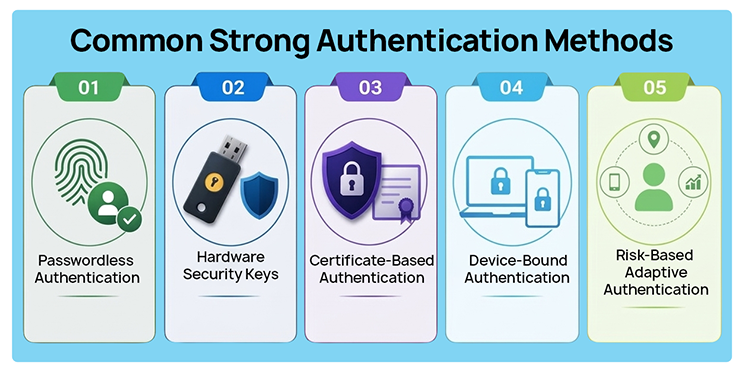
Certificate-Based Authentication (CBA)
Digital certificates verify identity without passwords.
- Ideal for machine-to-machine communication
- Common in IoT and enterprise systems
- Enables centralized identity management
Device-Bound Authentication
Authentication keys are stored securely within device hardware.
- Cannot be extracted or reused
- Ensures identity is tied to a specific device
- Critical for mobile and remote work environments
Risk-Based Adaptive Authentication
AI-driven systems evaluate risk in real time.
- Low-risk → seamless login
- High-risk → additional verification
This balances security with user convenience.
Compliance Requirements Driving Strong Authentication
Regulatory frameworks are increasingly mandating strong authentication to protect sensitive data.
NIST 800-63 Guidelines
NIST 800-63 Guidelines outline distinct Authenticator Assurance Levels based on risk. Level 2 establishes a baseline for secure access by requiring multi-factor authentication with cryptographic elements. Level 3 eliminates standard software vulnerabilities entirely by mandating physical, hardware-based authentication keys for high-risk environments.
PCI-DSS (Payment Security)
The PCI-DSS standard controls that secures cardholder data environments. It explicitly mandates multi-factor authentication (MFA) for all administrative access. Also prioritizing the transition to phishing-resistant authentication methods to neutralize modern credential interception tactics.
HIPAA (Healthcare Security)
HIPAA mandates secure access controls for protecting patient data, making strong authentication essential in connected healthcare systems. ACL Digital developed a cloud-based web and iOS application to monitor patient vitals through Connected Devices , where strong authentication helps secure patient data access and transmission while supporting HIPAA compliance.
Zero Trust Architecture
Modern security frameworks require:
- Continuous identity verification
- No implicit trust
- Strong authentication as a foundation
Today’s security frameworks are built on a rule which suggests never trust, always verify. Using strong authentication, modern architectures are forced to continuous identity verification and eliminate implicit trust while ensuring that no user or device is granted access without ongoing validation.
Benefits of Strong Authentication for Enterprises
- Eliminates Password Risks: Transitioning to strong authentication completely eradicates vulnerabilities that are attached with weak passwords, credential reuse, and database breaches.
- Reduces Phishing Attacks: Deploying cryptographic authentication also prevents credential interception, effectively neutralizing phishing and social engineering threats.
- Improves User Experience: Integrating passwordless and biometric logins removes authentication friction, reducing password resets and boosting workforce productivity.
- Enables Zero Trust Security: Adopting strong verification of identity establishes the fundamental baseline required to successfully execute a Zero Trust architecture.
- Simplifies Compliance: Standardizing strong authentication streamlines adherence to global data protection regulations and reduces organizational audit complexity.
What are the Challenges in Adopting Strong Authentication & How to Overcome Them
Despite its benefits, adoption comes with challenges.
Legacy System Compatibility
Older systems may not support modern authentication. For that solution could be:
- Use identity gateways
- Implement reverse proxies
- Plan gradual modernization
User Resistance
Users may hesitate to adopt new methods. For that solution could be:
- Provide training and demos
- Highlight ease of use (biometrics, passwordless)
- Run pilot programs
Device Limitations
Not all users have compatible devices. For that solution could be :
- Offer multiple authentication options
- Provide hardware security keys
- Define minimum device requirements
Budget Constraints
Implementation requires investment. For that solution could be:
- Start with high-risk systems
- Use phased deployment
- Leverage open standards like FIDO2
ACL Digital’s Approach to Strong Authentication
Authentication is not just about users logging into applications it is about securing every interaction across a connected ecosystem.
At ACL Digital, we help enterprises implement secure, scalable authentication frameworks as part of their digital transformation journey. Our expertise includes:
- IoT and connected device security
- Cloud and edge authentication
- Identity and access management integration
- Compliance-driven security frameworks
By combining chip-to-cloud engineering with advanced security models, we enable organizations to build trusted, resilient digital ecosystems.
FAQs
What is strong authentication in connected devices?
Strong authentication verifies both users and devices with the usage of multiple security layers such as biometrics, certificates, and device identity.
Why is browser-based authentication not enough for IoT?
Because IoT devices operate autonomously which require device-level authentication beyond user logins.
What is Zero Trust security?
Zero Trust is a security model in which every user and device must be continuously verified before access is granted.
How does authentication improve IoT security?
It ensures only trusted devices and users can access systems. This will reduce the risk of cyberattacks.
What industries need strong authentication the most?
The services like Healthcare, automotive, industrial IoT, and connected consumer devices require strong authentication due to sensitive data and critical operations.