



ACL Digital
January 9, 2026
5 Minutes read
Top 6 Enterprise Architecture Trends Shaping 2026 and Beyond
Enterprise architecture is no longer just about systems, applications, and process maps. By 2026, it becomes the foundation that determines how intelligence is designed, scaled, and governed across the enterprise.
Artificial intelligence is no longer an experimental layer sitting on the side. It is increasingly central to how organisations operate, make decisions, and deliver value.
As enterprises move from experimentation to execution, a clear set of enterprise architecture trends is emerging. These trends will determine which organisations turn AI into sustained advantage and which remain stuck in isolated pilots.
Leaders are already asking sharper questions. What will enterprise architecture look like in 2026? How should it support AI at scale? And what needs to change now to prepare for what’s coming next?
Trend 1: AI-First Enterprise Architecture Becomes the Default
AI adoption is no longer the problem. Scaling it is.
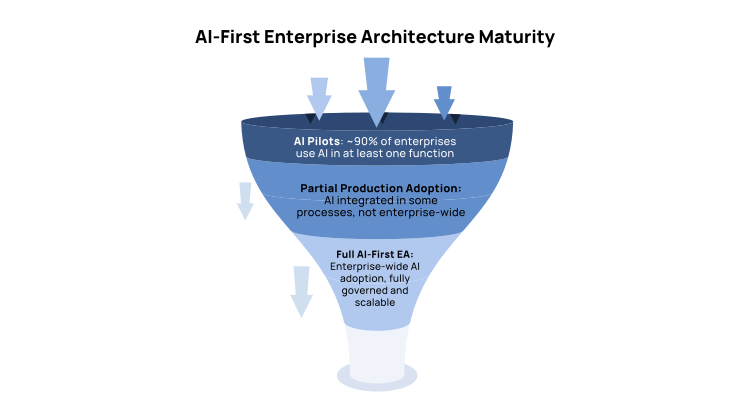
According to McKinsey’s State of AI report, nearly nine out of ten enterprises now use AI in at least one business function. Yet only a small fraction report sustained, enterprise-wide value from those investments.
Gartner’s research reinforces this. Organisations with higher AI maturity are more than twice as likely to keep AI systems running in production for three years or more, compared to low-maturity peers.
The difference isn’t better models or more experimentation.
It’s enterprise architecture strategy.
Strong governance, disciplined data foundations, and alignment with business priorities are what separate experimental AI from operational intelligence. Without that foundation, AI struggles to move beyond pilots.
By 2026, AI-first enterprise architecture becomes the dividing line. Either AI is designed into the core of the enterprise, or it remains fragmented, fragile, and difficult to scale.
Trend 2: Architecture Shifts from Process Automation to Intelligent Autonomy
Traditional enterprise architecture was designed for predictable systems. Automation followed rules. Workflows behaved the same way every time.
AI changes that assumption.
Intelligent systems learn, adapt, and make judgment calls. That requires a different architectural mindset. Instead of mapping static workflows, architects now design for decision ownership, accountability, and coordination.
The questions enterprises are grappling with are fundamentally different:
- Which decisions should machines make independently?
- Where must humans remain in the loop?
- How do intelligent systems coordinate actions across domains?
Despite widespread experimentation, only a small percentage of organisations have scaled autonomous or agent-driven AI beyond pilots, according to McKinsey.
The constraint isn’t model readiness.
It’s architectural readiness.
AI-first enterprise architecture starts with intent. It designs around decisions, not just workflows.

Trend 3: Agentic AI Forces New Governance and Control Models
Agentic AI is where enterprise architecture gets stress-tested.
These systems don’t just respond to prompts. They plan, act, and collaborate with other agents. That breaks many assumptions embedded in traditional enterprise architecture.
Gartner predicts that more than 40% of agentic AI projects could be abandoned by 2027 due to unclear ROI, high costs, or governance gaps.
At the same time, agentic capabilities are expected to be embedded across a significant portion of enterprise software in the coming years.
This contradiction is telling.
Agentic AI isn’t failing because it lacks potential.
It fails when autonomy is introduced without architectural control.
As autonomy increases, enterprise architects must define how agents are orchestrated, how actions are monitored and audited, and how decisions are explained and constrained by policy and business intent.
Control doesn’t disappear.
It moves higher up the architectural stack, into governance models designed for intelligent, autonomous behaviour.
Trend 4: Platform-Led, AI-Native Architectures Replace Application-Centric Design
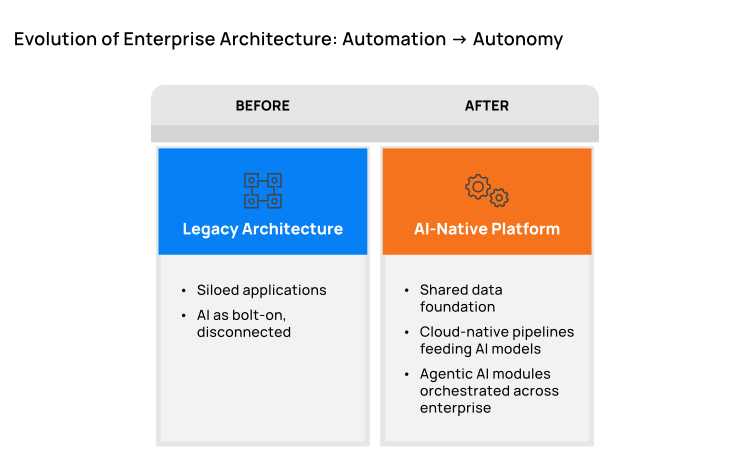
AI doesn’t respect organisational silos. It consumes data wherever it exists and acts wherever it’s allowed.
That’s why application-centric architecture is starting to break down.
In its place, platform-led architecture is taking shape. Shared data foundations. Cloud-native environments optimised for AI workloads. Real-time pipelines that continuously feed models and agents.
Market data reflects this shift. According to Business Research Insights, the global enterprise architecture market is projected to grow from under USD 1 billion to more than USD 3 billion over the next decade. AI-led transformation and AI-native platforms are major drivers of that growth.
This isn’t modernisation for its own sake.
It’s about building foundations that support intelligence at scale.
Enterprises that continue to treat AI as a bolt-on to legacy systems will find it harder to keep pace as intelligence becomes more embedded in day-to-day operations.
Trend 5: Governance, Security, and Trust Move to the Architectural Core
AI moves fast. Governance has to move with it.
As intelligent systems take on more responsibility, enterprise architecture becomes the first line of defence. Not by slowing innovation, but by designing trust into the system itself.
That means:
- Clear data lineage and access control
- Explainability by design, not as an afterthought
- Security models that assume autonomous behaviour
Gartner research on enterprise architecture trends consistently highlights data quality and security risks as top barriers to successful AI adoption, even among mature organisations.
Cloud security research highlights, how AI-driven workloads are increasing configuration complexity and attack surfaces faster than many enterprises can manage.
Governance, security, and trust can no longer be treated as add-ons. They must be embedded into enterprise architecture from the start.
Trend 6: Enterprise Architects Emerge as Strategic AI Advisors
One of the most important shifts is happening quietly.
Enterprise architects are moving closer to the business, not by choice, but by necessity. AI forces strategic conversations.
Gartner highlights a striking gap: while a majority of CEOs expect AI to drive significant growth, only a small fraction of CIOs shares that confidence.
Enterprise architecture sits at the centre of that gap.
Architects now translate business intent into system design. They help leadership understand what’s possible today, what requires foundational change, and where risk must be managed deliberately.
This shift elevates enterprise architecture from an enabling function to a strategic one.
What to Prioritise in 2026 and Beyond
The pattern is consistent. AI investment is accelerating. Expectations are rising. Architecture is the deciding factor.
Enterprises that lead in 2026 and beyond will:
- Design architecture around intelligent decision-making
- Treat agentic AI as a governance challenge, not just a capability
- Invest in AI-native platforms rather than incremental fixes
- Embed trust, security, and accountability into system design
- Empower enterprise architects as strategic partners
This is where ACL Digital’s approach fits naturally. The focus isn’t on chasing AI trends, but it’s on building architecture that can absorb intelligence, scale responsibly, and deliver outcomes that last.
Final Thought
Enterprise architecture isn’t becoming obsolete. It’s becoming indispensable.
The question ahead isn’t whether organisations will use AI. It’s whether their architecture was designed to support it.
Those who get this right won’t just adopt AI faster. They’ll operate differently. More intelligently. More confidently.
And that’s the real shift shaping enterprise architecture in the years ahead.
Ready to Turn Strategy into Architecture?
AI success in 2026 won’t come from pilots or isolated tools. It will come from enterprise architecture that’s designed to scale intelligence, manage risk, and deliver measurable outcomes.
At ACL Digital, we work with enterprises to assess AI readiness, modernise enterprise architecture, and design AI-first, platform-led systems that support real business priorities.
Talk to our enterprise architecture and AI experts to understand where your architecture stands today—and what needs to change to be ready for what’s next.
FAQs
- What are the top enterprise architecture trends shaping 2026 and beyond?
Key trends include AI-first architecture, intelligent autonomy, agentic AI governance, platform-led AI-native systems, embedded security, and strategic enterprise architects. - How do enterprises scale AI beyond pilots into enterprise-wide adoption?
By building strong enterprise architecture, aligning AI with business priorities, enforcing data governance, and adopting platform-led design. - How should organisations govern agentic AI systems in the enterprise?
Use architectural controls to orchestrate agents, enforce policy-based autonomy, monitor actions, and ensure explainability. - What role does enterprise architecture play in AI strategy?
EA translates business goals into AI-ready systems, embeds governance and security, and enables scalable AI adoption.
Research References
- McKinsey & Company – The State of AI (2024–2025)
https://www.mckinsey.com/capabilities/quantumblack/our-insights/the-state-of-ai - Gartner – AI Maturity and Enterprise Architecture Trends
https://www.gartner.com/en/newsroom
https://www.gartner.com/en/articles/2025-trends-for-enterprise-architecture - Reuters – Gartner Forecast on Agentic AI
https://www.reuters.com/business/over-40-agentic-ai-projects-will-be-scrapped-by-2027-gartner-says-2025-06-25/ - Business Research Insights – Enterprise Architecture Market Report
https://www.businessresearchinsights.com/market-reports/enterprise-architecture-market-117947 - TechRadar – AI and Cloud Security Risks
https://www.techradar.com/pro/security/new-research-reveals-ai-is-fueling-an-unprecedented-surge-in-cloud-security-risks - Gartner – Executive Expectations vs IT Readiness
https://www.gartner.com/en/articles/2025-trends-for-enterprise-architecture