
AI-driven Quality Assurance Engineering services for modern enterprises
Chip-to-Cloud Quality Assurance Engineering Services
In a digital landscape driven by speed and precision, intelligent engineering is the key to staying ahead. Modern ecosystems are growing in complexity; compatibility issues, hidden bugs, and deployment delays can quickly lead to reputational damage, revenue loss, and frustrated customers.
At ACL Digital, we address these challenges head-on. By combining our AI-Driven Quality Assurance Engineering Services with a comprehensive Chip-to-Cloud approach, we transform how enterprises validate solutions. We inject AI across the entire engineering lifecycle to help you launch products faster, optimize costs, and eliminate defects before they ever impact your end users. Accelerate your release velocity with ACL Digital Intelligent Quality Engineering is powered by our Test Automation Centre of Excellence, AI-skilled experts, and chip-to-cloud innovation for flawless delivery.
Enhanced
Software Reliability
Accelerated
Regulatory
Tailored
Next-Gen Quality Assurance Services for Modern Enterprise
AI-Powered QE
We understand that today’s digital products demand not only speed and scalability but also intelligent, self-evolving quality mechanisms. We offer a comprehensive suite of AI-driven QE services designed to address evolving testing challenges, including:
- AI-led Quality Engineering: Embed AI across the QE lifecycle to boost efficiency, accuracy, and intelligent decision-making, ensuring continuous quality improvement.
- QE for AI Systems: Ensure AI applications align with responsible AI principles—covering compliance, fairness, and explainability through rigorous, specialized testing strategies.

Quality Assurance Strategy
We offer a tailored quality assurance strategy designed to align with your business goals and product vision, ensuring efficiency and excellence.
- Quality Planning: Develop strategic, product-aligned quality plans, ensuring your project goals are achieved seamlessly.
- Risk Assessment: Identify potential risks early and implement mitigation strategies, to minimize disruptions and safeguard quality throughout the development lifecycle.
Test Automation
We deliver automated testing frameworks and CI/CD integration to streamline your testing, improving speed, reliability, and performance.
- Automated Testing Frameworks: Implement custom automation frameworks for seamless regression, functional, and performance testing, reducing manual effort.
- CI/CD Integration: Embed automated tests into CI/CD pipelines, accelerating release cycles while ensuring high-quality code delivery.
Performance Testing
We ensure your application performs flawlessly under varying conditions through comprehensive performance testing and reporting.
- Load and Stress Testing: Conduct load and stress tests to evaluate application performance under various conditions and user loads.
- Monitoring & Reporting: Use monitoring tools to track application performance and generate detailed reports for analysis.
User Acceptance Testing (UAT)
We facilitate UAT to ensure your product aligns with end-user needs, driving usability and satisfaction before deployment.
- UAT Planning and Execution: Manage UAT sessions with end-users to validate functionality, ensuring readiness for release.
- Feedback Integration: Collect and integrate user feedback to improve product features and meet user expectations.
Test Environment Management
We provide comprehensive test environment setup and data management to ensure reliable, accurate testing that mirrors production conditions.
- Environment Setup: Create precise test environments that replicate production systems, ensuring accurate testing.
- Data Management: Securely manage test data to simulate various testing scenarios, ensuring data integrity and safety.
Continuous Quality Improvement
We employ metrics and root cause analysis to continually improve product quality, preventing future defects and enhancing overall performance.
- Metrics and KPIs: Define and track key performance indicators (KPIs) to assess the effectiveness of quality initiatives.
- Root Cause Analysis: Conduct root cause analysis for defects and implement corrective actions to prevent recurrence.
Training & Best Practices
We offer tailored quality training programs, helping teams adopt best practices and foster a collaborative quality-driven culture.
- Quality Training Programs: Provide targeted training on testing methodologies and tools, empowering teams to improve testing processes.
- Knowledge Sharing: Encourage collaboration through workshops and seminars, fostering a shared understanding of quality standards.
End-to-End Testing Solutions
We provide comprehensive testing solutions, ensuring full coverage across all application layers and platforms for a seamless user experience.
- Comprehensive Test Coverage: Execute thorough testing across UI, API, and databases, ensuring full functionality.
- Cross-Platform Testing: Validate compatibility across devices and platforms, guaranteeing a consistent and smooth user experience.
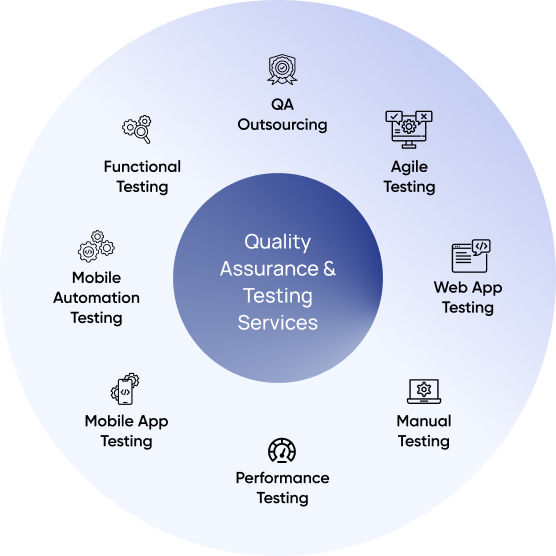
Comprehensive Quality Assurance and Testing Services
ToxiGen, RealToxicityPrompts for toxicity detection; BBQ for bias evaluation; SQuAD, Natural Questions, ARC, TruthfulQA, and HellaSwag for measuring factual accuracy, reasoning, and logical consistency. LLM-as-a-Judge methodology to evaluate chatbot responses for quality, coherence, and correctness.
NVIDIA NeMo Guardrails, Guardrails AI (guardrailsai.com), and LangKit (Lightricks) for enforcing responsible AI practices and building robust guardrails. RAGAS for evaluating Retrieval-Augmented Generation (RAG) applications.
IBM AI Fairness 360, Fairlearn (Microsoft) for bias and fairness checks. SHAP and LIME for Explainable AI (XAI) insights.
Jira, TFS, Redmine, Bugzilla, Mantis Bug Tracker, Test Link, Rational Software, and HP Quality Centre.
xUnit, Wire Shark, Fiddler, TCPDUMP, Postmark, Blazemeter, Burp Suite, Iometer, OWASP ZAP, and NMAP.
Selenium, Appium, Apache JMeter, Visual Studio, Robotium, Postman, Android UI Automator, QF-Test, TestComplete, Calabash Testing Tool, HP Loadrunner, Espresso, Cucumber, SoapUI, Cypress, Tricentis Tosca, Playwright, Karate.
Jmeter, NeoLoad, Loadrunner.
Our Tools and Technologies for Enhanced Product Quality and Reliability
Our Accelerators and Frameworks
We bring innovation to testing through proprietary frameworks and AI-powered accelerators that cut down manual effort, boost speed, and ensure intelligent coverage.
TestCraftAI
A GenAI-powered accelerator that intelligently auto-generates new functional test cases based on system usage and real user behavior.
API AutoPilot
A smart API testing tool powered by AI that discovers endpoints, auto-generates test cases, and ensures optimal coverage and performance.
DataXposure
Detects unencrypted sensitive data across files and databases using AI-driven pattern recognition for regulatory compliance and data protection.
SecureLine
Our proprietary DevSecOps framework integrates SAST, DAST, and continuous security scanning across applications, containers, hosts, and cloud environments.
STLC GenAI Tools
PlanWiseAI, UIAutopilot, and TestTrackAI are GenAI tools for STLC, automating crucial planning, UI, and efficient test tracking.
Vanilla Accelerator
A ready-to-use test automation accelerator for rapid web, mobile, and API test automation with pre-built utilities and multi-language support. It is CI/CD-ready.
Why Choose ACL Digital for Your QA Needs

Proven Expertise
500+ projects successfully completed, ensuring extensive experience
Skilled Talent
1000+ certified QA programmers for high-level skill and proficiency
Metrics-Driven Approach
Automation and metrics-driven testing for optimal results
Rapid Time-to-Market
Bug-free, agile software products with reduced testing time
Comprehensive QA
Specialized testing services for immersive digital experiences
Client Impact

Accelerate Display Device Testing with Automated Solutions
We implemented a comprehensive testing automation solution, VOLANIUM, to optimize testing cycles and ensure product quality for a US-based manufacturer.
The Challenges
- Over 4000 test cases on Android devicesfrom the sensors
- Inability to perform parallel testing across multiple devices
The Outcomes
- Achieved 85% test automation coverage, significantly boosting team productivityg.
- Reduced release testing time from 45 days to just 1.5 days.
- Ensured product quality and reliability through rigorous testing.

Complete Automotive Wheel Management System Testing with ACL Digital
We provided comprehensive testing services, including lab and field trials, to ensure the quality and performance of a complex wheel management system for a US-based technology company.
The Challenges
- Over 1500+ test cases required for comprehensive validation.
- Absence of a robust multi-stage testing approach.
- Lack of functional and non-functional testing coverage.
The Outcomes
- Achieved a high level of test effectiveness, ensuring product quality and reliability.
- Optimized testing efforts through efficient lab and field testing.
- Accelerated time-to-market with streamlined testing processes.
- Mitigated risks and ensured regulatory compliance through rigorous testing.

Robust Penetration Testing for Industrial IoT Gateways to Fortify Security
ACL Digital conducted comprehensive penetration testing to identify vulnerabilities, strengthen IoT gateway security, and ensure robust compliance for seamless industrial IoT operations.
The Challenges
- Identifying security vulnerabilities in IoT gateways
- Ensuring compliance with industry security standards
- Mitigating risks of unauthorized access and data breaches
The Outcomes
- Detected and resolved critical vulnerabilities in the IoT system
- Enhanced gateway security with improved threat resilience
- Achieved compliance with key industry standards
- Ensured secure industrial IoT operations at scale
What We Think






FAQs
AI-driven Quality Assurance (QA) Engineering strategically integrates Machine Learning, NLP, Computer Vision, and Generative AI across the software testing lifecycle to design, run, maintain, and analyze tests with minimal human friction. Unlike rigid conventional automation, it uses self-learning, adaptive models that automatically handle UI updates, auto-generate test data, and resolve maintenance bottlenecks like broken scripts.
ACL Digital delivers AI-driven Quality Assurance through two core pathways: AI-Led Quality Engineering, which embeds AI into traditional dev-test ecosystems to provide self-healing UI regression, synthetic data generation, and smart API testing via accelerators like API AutoPilot; and Quality Engineering for AI Systems, which delivers specialized risk governance and validation for LLMs, GenAI, and ML models—covering toxicity, bias/fairness (IBM AI Fairness 360), explainability (SHAP, LIME), and response evaluation (RAGAS, LLM-as-a-Judge).
Traditional test automation relies on hardcoded scripts bound to static object locators (like fixed XPaths or element IDs). When UI design layouts, CSS structures, or DOM properties update, traditional scripts break, leading to false negatives and high maintenance workloads.
AI automation employs adaptive locators, self-healing algorithms, and computer vision models. It recognizes UI components contextually much like a human tester and automatically updates object identifiers in real time when interface modifications occur. By integrating intelligent automation through ACL Digital’s Test Automation Centre of Excellence, organizations eliminate brittle script maintenance, minimize execution friction, and ensure continuous testing across complex multi-platform architectures.
AI replaces repetitive and routine execution tasks rather than human engineers. By handling time-consuming, mechanical testing, AI frees human QA professionals to focus on strategic, high-value activities like exploratory testing, complex business workflows, usability, and edge-case design. At ACL Digital, AI is leveraged to augment and elevate QA teams rather than replace them:
- Human-in-the-Loop Strategy: While AI handles continuous regression suites and automated test generation, human engineers maintain oversight on quality strategy, domain logic, and creative risk modeling.
- Specialized AI Evaluation: Augmented QA teams transition into higher-level engineering roles, utilizing frameworks to evaluate complex AI models, verify explainability and enforce governance.
Widely used commercial and open-source AI testing platforms include Mabl and Testim (for self-healing UI test automation), Applitools Eyes (for visual AI validation), testRigor (for generative plain-English test scripting), and DeepEval (for evaluating LLM responses, hallucinations, and prompt safety).
At ACL Digital, these core platforms are integrated into an enterprise-grade testing ecosystem paired with specialized toolkits, frameworks, and accelerators:
- Proprietary Automation Accelerators: Solutions like API AutoPilot enable AI-powered API discovery, self-generating integration test suites, and performance coverage optimization.
- Responsible AI & Evaluation Frameworks: Tools such as NVIDIA NeMo Guardrails, Guardrails AI, LangKit, and RAGAS enforce safety guardrails and evaluate Retrieval-Augmented Generation (RAG) pipelines.
- Bias Detection & Explainability Toolkits: IBM AI Fairness 360 and Microsoft Fairlearn conduct bias and fairness checks, while SHAP and LIME deliver Explainable AI (XAI) insights.
- Benchmarking Datasets & Methodologies: Application quality and LLM responses are benchmarked using datasets like ToxiGen, RealToxicityPrompts, BBQ, SQuAD, TruthfulQA, and HellaSwag, paired with LLM-as-a-Judge evaluation patterns.
Start by targeting a high-friction pain point within your current testing pipeline such as implementing self-healing test automation to fix fragile UI regression suites before scaling into generative test creation or specialized AI model red-teaming.
At ACL Digital, enterprise adoption is streamlined through a structured, high-impact transition model:
- Strategic Assessment & Roadmap: Conducting gap analyses across existing test assets to identify automation bottlenecks, high-maintenance UI suites, and integration friction points.
- Targeted AI Accelerators: Implementing solutions like API AutoPilot and self-healing UI frameworks to deliver immediate efficiency gains and drastically reduce script maintenance.
- Continuous Quality Scale: Expanding adoption from core regression suites into automated synthetic test data generation, predictive risk analytics, and comprehensive AI system evaluation.
Chip-to-Cloud Quality Engineering provides end-to-end validation across every layer of the technology stack ensuring seamless integration, secure data flow, and synchronized performance from low-level silicon microcode and embedded device firmware up to edge gateways and enterprise cloud applications. Through ACL Digital’s Chip-to-Cloud Engineering Expertise, organizations ensure full-stack reliability across complex ecosystems:
- Silicon & Embedded Systems: Hardware-software validation, low-level firmware testing, and zero-trust security checks for IoT solutions, automotive, medical, and semiconductor devices.
- Edge & Cloud Synchronization: Rigorous testing of network protocols, API integrations, microservices, and high-scale cloud platforms to guarantee low-latency telemetry transmission and complete end-to-end performance stability.