



Sushant Mane and Prafull Sonawane
December 1, 2025
5 Minutes read
The Architecture of Agentic RAG: Reasoning-Driven AI Systems Explained
Imagine asking an AI assistant a complex question and watching it not just retrieve information, but actively reason about where to look, what sources to trust, and how to synthesize insights from multiple documents—much like a skilled researcher would. This is the promise of Agentic RAG (Retrieval-Augmented Generation), a paradigm shift that transforms passive information retrieval into an intelligent, goal-driven process. While traditional RAG systems fetch and present relevant documents, Agentic RAG employs autonomous AI agents that can plan retrieval strategies, evaluate source quality, and iteratively refine searches.
To understand this transformation, let’s trace RAG’s evolution, explore its core architecture, and see how it solves real-world business challenges—from responding to complex RFPs in hours rather than days
Evolution (From Traditional to Agentic RAG)
The evolution of Retrieval-Augmented Generation (RAG) represents a fundamental shift in how AI systems access and utilize external knowledge to generate more accurate, contextually grounded responses. This progression from simple retrieval pipelines to sophisticated autonomous systems has transformed RAG from a basic technique into a cornerstone of modern AI applications.
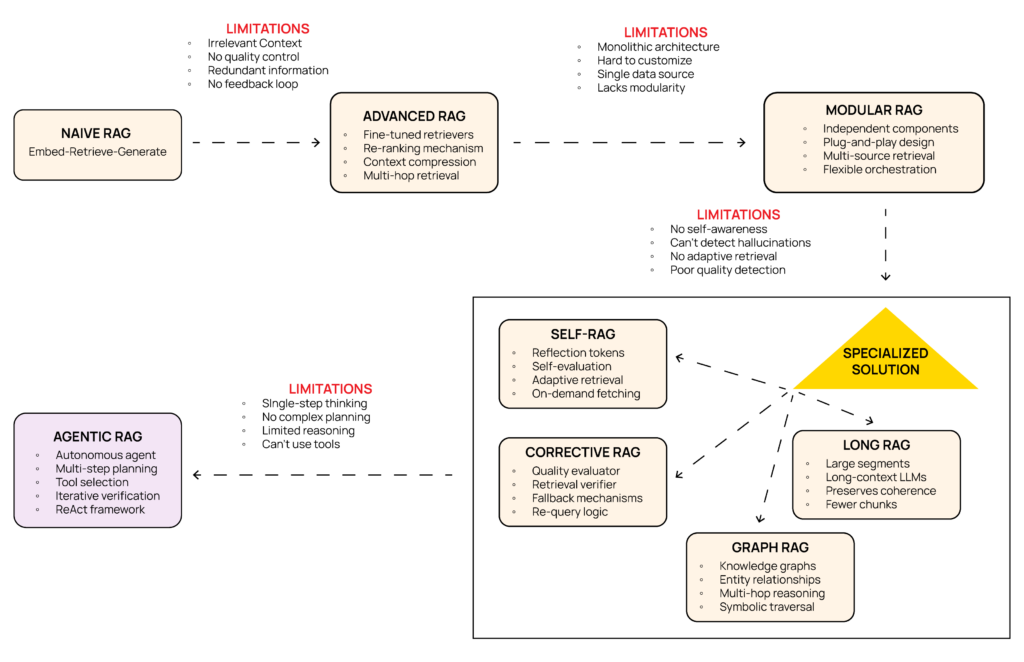
This architectural evolution enables sophisticated real-world applications. Let’s explore how these components work together before seeing them in action.
Core Architecture of Agentic RAG
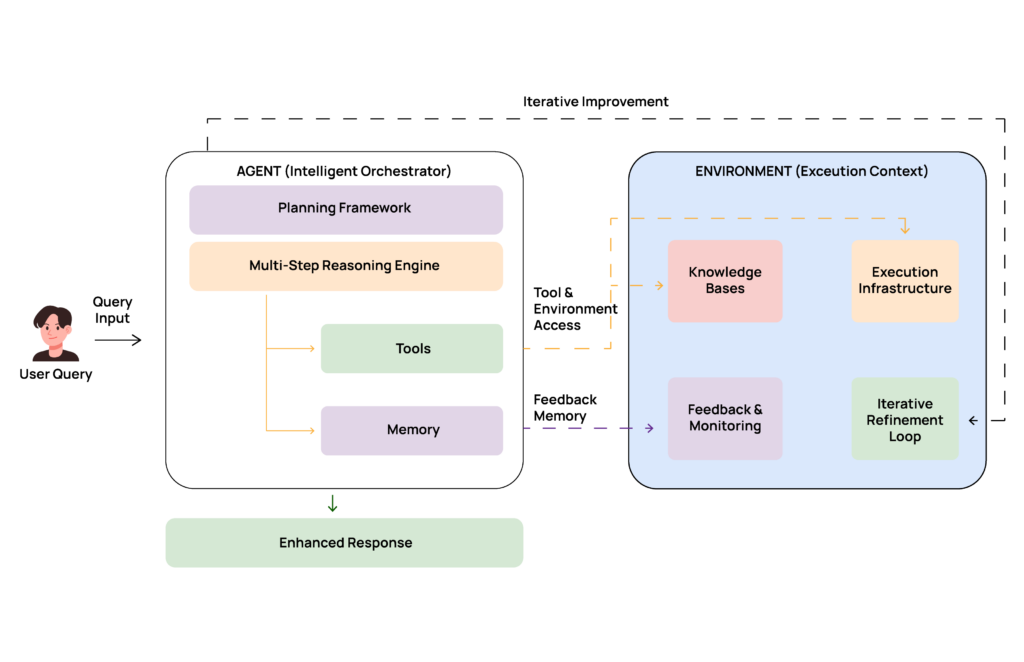
This architecture represents a sophisticated evolution in AI systems, moving beyond simple pipelines to intelligent, adaptive agents. Its modular design—agents, memory, tools, and environment—provides flexibility and extensibility. Planning frameworks like ReAct and LangGraph enable sophisticated reasoning, allowing these systems to handle complex queries through multi-step orchestration with human-like problem-solving capabilities.
This architecture comes to life in complex business scenarios. Consider one of the most challenging tasks in enterprise sales: responding to RFPs.
Use Case: Intelligent RFP (Request for Proposal) Response Generator with Agentic RAG
The Challenge
For IT services companies, responding to RFPs is exhausting. Teams spend 40-80 hours searching through hundreds of past proposals, technical documents, and case studies scattered across systems, manually piecing together content while coordinating between departments. This leads to missed deadlines, inconsistent quality, and burned-out teams. Traditional search tools find documents but can’t understand what the RFP requires or intelligently synthesize information from multiple sources.
The Agentic RAG Solution
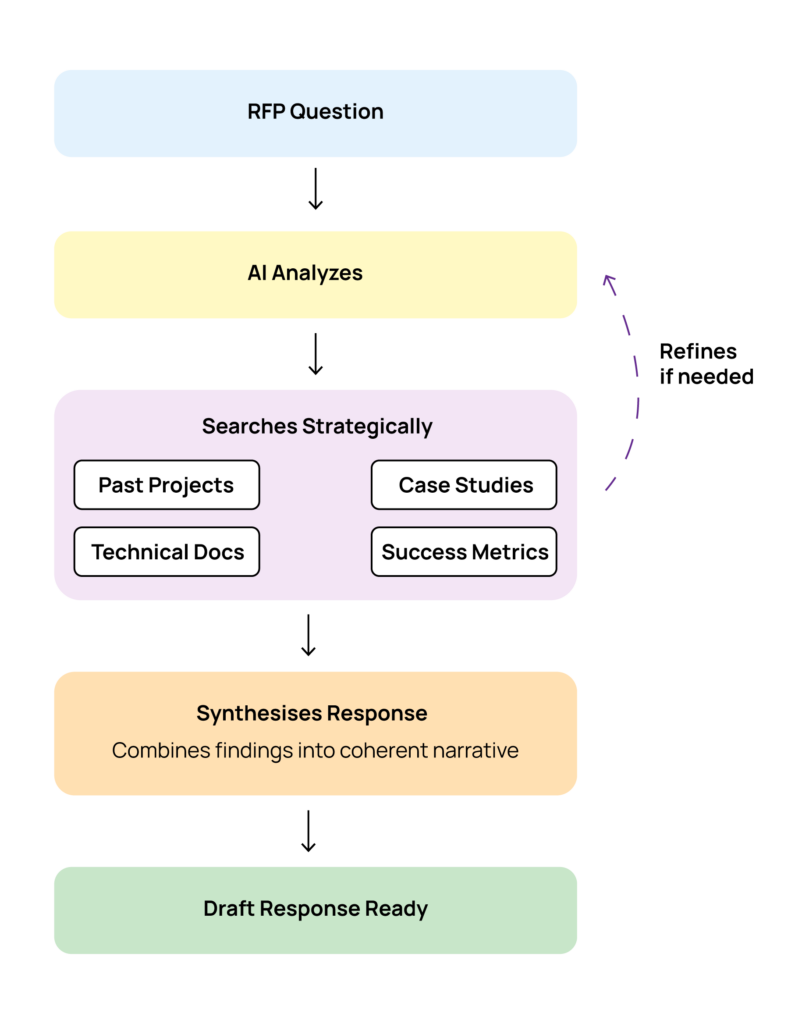
When an RFP asks, “Describe your experience implementing CRM systems for retail companies,” the Agentic RAG system analyzes the question. It identifies key elements: CRM implementation, retail industry, and experience. It strategically searches knowledge bases, discovers a case study about implementing Salesforce for a fashion retailer, and retrieves technical implementation guides. The system synthesizes a tailored response incorporating proven methodology, specific success metrics, and relevant outcomes, then performs quality checks.
Observation
Companies implementing Agentic RAG for RFP responses see dramatic improvements. Response time drops from 60 hours per RFP to 20, allowing teams to handle more opportunities without expanding headcount. Win rates improve by 15-25% because responses are more consistent and comprehensive. What makes this truly “agentic” is the multi-step reasoning—the AI thinks through what’s needed, searches strategically, evaluates findings, and decides whether to search deeper or synthesize results.
RFP (Request for Proposal) Response Generator
What Makes This "Agentic"?
The key difference is intelligent reasoning. Unlike traditional search that retrieves documents and stops, Agentic RAG actively thinks through what is needed, adjusts its search based on new findings, and creates customized responses—all automatically. This process makes RFP responses 3x faster while enhancing quality and consistency.
The RFP example demonstrates how Agentic RAG’s capabilities are transforming enterprise workflows and driving widespread adoption in AI solutions.
Market Outlook: A New Frontier in AI
The RAG market is projected to reach $74.5 billion by 2034, driven by enterprise needs for factual accuracy, unlocking unstructured data, and hyper-personalization. A major e-commerce company using Agentic RAG for customer service saw significantly reduced support escalations and improved satisfaction.
Implementation Considerations: From Theory to Practice
Building a robust Agentic RAG system involves a data pipeline (ingest, clean, vectorize data into searchable embeddings), retrieval & generation (retrieve relevant information and pass to LLMs for contextual answers), and an agentic layer where autonomous agents break down queries, search multiple sources, and refine results iteratively.
Track key metrics: Accuracy (factual correctness), Relevancy (query alignment), and Robustness (handling varied queries).
Challenges and Future Opportunities
Current challenges include data quality, system complexity, and bias management. Future advancements will bring multi-modal RAG (text, images, audio, video), self-improving systems that learn from feedback, and democratized access as tools become more accessible.
Conclusion: The Future is Autonomous
Agentic RAG represents a fundamental leap from retrieval to reasoning. As we saw with RFP generation—where response time dropped by 67% while quality improved—these systems don’t just find information; they think through problems, strategize their approach, and synthesize insights like expert researchers.
For organizations drowning in data but starving for insights, Agentic RAG isn’t just an incremental improvement—it’s a competitive necessity. From customer service to knowledge management, from proposal generation to research synthesis, businesses leveraging this technology unlock efficiency and innovation that passive search systems cannot match. The journey to building autonomous retrieval may be complex, but in a world where information advantage determines success, the rewards are worth every effort. The future of information retrieval is here, and it’s powered by agents that reason.
At ACL Digital, we’re pioneering the evolution from intelligent automation to autonomous intelligence through Agentic RAG. Our solutions go beyond retrieval – they reason, plan, and act with purpose to transform data into strategic advantage. By bringing together cutting-edge AI reasoning, robust engineering, and ethical AI frameworks, we help enterprises move from reactive decision-making to proactive insight generation. From knowledge synthesis to enterprise automation, our agentic systems enable organizations to think faster, innovate deeper, and operate smarter – securely, transparently, and at scale. The future of intelligent systems isn’t just responsive; it’s reasoning – and we’re building it today.
Resources
- Lewis, P., et al., “Retrieval-Augmented Generation for Knowledge-Intensive NLP Tasks,” EMNLP 2020, https://arxiv.org/abs/2005.11401
- Yao, S., et al., “Synergizing Reasoning and Acting in Language Models,” arXiv:2210.03629, https://arxiv.org/abs/2210.03629
- Qdrant, “Agentic RAG with LangGraph,”https://qdrant.tech/documentation/agentic-rag-langgraph/
- https://medium.com/@ai-futures/agentic-rag-the-next-evolution-in-ai-powered-information-retrieval-f1ae4e316c09
- Nvidia, “What Is Retrieval-Augmented Generation aka RAG,”https://blogs.nvidia.com/blog/what-is-retrieval-augmented-generation/
- Yang, Z., et al., “HotpotQA: A Dataset for Multi-hop Question Answering,” EMNLP 2018,https://arxiv.org/abs/1809.09600
- us, “Retrieval Augmented Generation Market Size Report,”https://market.us/report/retrieval-augmented-generation-market/