



Prashant Hegde
December 24, 2025
5 Minutes read
Unlocking Industry 5.0: Real-Time Monitoring Meets Edge Computing
Industrial systems are entering an era where insights must be generated and acted upon instantly. With 20–21 billion IoT devices expected by 2025 and nearly half of enterprise applications moving to the edge by 2027, a growing share of mission-critical data is now produced outside the cloud. Traditional cloud architectures cannot meet the sub-millisecond to millisecond timing required for vibration monitoring, closed-loop control, and safety-critical actuation. Latency, jitter, and bandwidth constraints make deterministic response impossible.
Edge computing eliminates these constraints by bringing compute, storage, and inference engines directly next to field devices, enabling faster, autonomous, and resilient operations. This edge intelligence bridges IoT devices and the cloud by delivering real-time processing, localized optimization, and autonomous machine interactions.
The Need for Deterministic, Real-Time Visibility in Modern Systems
Modern embedded and industrial systems must go beyond periodic sampling. They are expected to:
- Detects anomalies within milliseconds.
- Maintain clean and reliable sensor streams.
- Predict failures and adapt automatically.
- Operate reliably during network interruptions.
- Deliver contextual diagnostics and root-cause insights—not just alarms.
For example, a 7–12ms vibration spike can reveal early bearing damage. Missing this signal could escalate into catastrophic machine failure.
How Edge Computing Boosts Real-Time Monitoring
The edge layer forms a high-speed local control loop (Sensor → Edge → Actuator) that significantly outperforms traditional cloud-centric architectures.
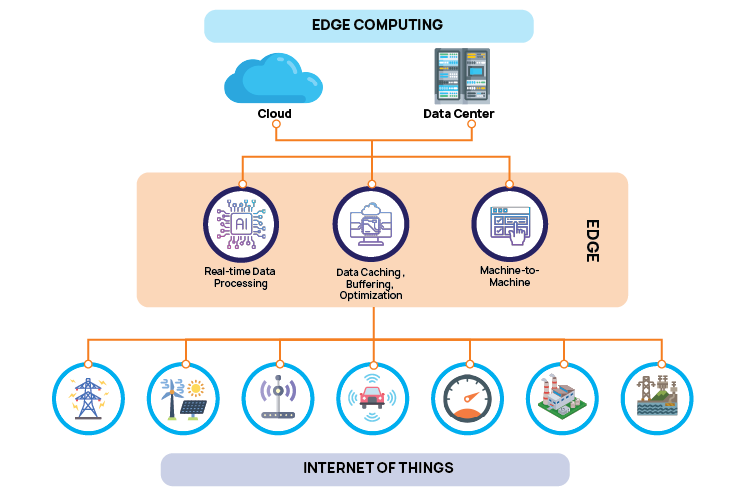
- Local Data Processing: Edge devices such as sensors, gateways, and controllers perform analytics at the source instead of sending raw data to the cloud.
- Reduced Latency: Eliminates round-trip delays and supports applications where milliseconds matter.
- Bandwidth Consumption Drop: Only filtered insights or alerts are sent upstream, lowering communication costs.
- Immediate Response: Autonomous decisions—like throttling motors or isolating faults—happen directly at the edge without cloud dependency.
What Happens When Real-Time Monitoring Meets Edge Computing
The convergence of real-time monitoring and edge computing delivers the following critical advantages:
- Ultra-Low Latency Decision Loops: RTOS-level signal capture combined with on-device inference enables corrective actions such as speed modulation, fault isolation, load balancing within <10ms.
- Predictive & Self-Healing Behaviour: Edge systems forecast failures, adjust operating parameters, and autonomously initiate safe modes, significantly reducing unplanned downtime.
- Operation without Cloud Dependency: Even during extended network outages, local logic maintains continuous monitoring and control.
- Lower Cloud Consumption: Only actionable insights are sent upstream, reducing cloud load and bandwidth consumption by 70–85%.
- Seamless OT–IT Integration: Protocols such as TSN, OPC-UA, and MQTT-SN enable interoperability between legacy industrial assets and modern edge systems.
- Contextual Insights for Operators: Operators receive prioritized, context-rich alerts enabling faster and more accurate decisions.
Applications That Benefit Most
The areas of applications where the solutions benefit a lot are as below.
- Industrial IoT: Real-time edge intelligence enables continuous machine health monitoring and live optimization of production lines, helping manufacturers prevent failures and improve operational efficiency.
- Smart Cities: Edge-based monitoring supports adaptive traffic management and efficient smart grid load balancing by processing data locally and responding instantly to changing urban conditions.
- Retail: Real-time inventory visibility and personalized in-store experiences are enabled through edge analytics that respond immediately to customer behavior and shelf-level data.
- Healthcare: Edge computing enables continuous patient monitoring with immediate alerts, ensuring timely clinical intervention while keeping sensitive data processed locally.
- Autonomous Vehicles: Millisecond-level edge processing supports sensor fusion and navigation decisions, ensuring safe and reliable operation in dynamic, real-world environments.
Key Statistical Benefits
The table below highlights practical use cases that quantify the impact of adapting edge computing with real-time monitoring, enabling intelligence directly at the device level.
| Benefit | Description | Use Case |
| Reduced Latency | 85–95% faster response vs cloud | A factory’s vibration-monitoring system detects imbalance and triggers motor slowdown within 5–10 ms instead of 80–120 ms, preventing rotor damage during high-speed operation. |
| Bandwidth Savings | 70–85% lower data transmission | An energy-monitoring gateway reduces cloud data transfer from 10 GB/day to under 2 GB/day by performing local FFTs and transmitting only anomaly summaries. |
| Enhanced Privacy | Local processing | A healthcare edge device processes ECG and vitals signals locally, ensuring zero raw patient data leaves the hospital floor, aligning with HIPAA-grade privacy requirements. |
| Improved Reliability | Works even during cloud outages | A remote mining conveyor system continues running safely during a 30-minute network blackout, using edge logic to maintain speed control and fault protection. |
| Scalability | Distributed processing | A smart-city lighting system scales to 50,000+ streetlights, each running local edge rules to avoid overwhelming cloud servers while coordinating grid-wide behavior. |
How Edge Computing Powers Real-Time Monitoring: The Core Technology Stack
Edge Computing brings compute, analytics, and control directly to the point of data generation. Instead of relying on centralized processing, the edge acts immediately enabling faster, safer, and more autonomous operations. As a result, the technology stack must be optimized across three critical layers: hardware, intelligence, and connectivity.
The Hardware Foundation (Sensing & Compute)
The physical layer requires hardware capable of capturing high-frequency data and processing it locally without the latency and bandwidth limitations of cloud transmission.
- High-Speed Sensors and DAQ: Vibration, thermal, and current sensors paired with high-frequency ADCs to capture raw signals at the source.
- Edge Hardware Accelerators: Specialized silicon including ARM, i.MX, Sitara, and NVIDIA Jetson to provide the necessary GPU, NPU, and DSP performance for heavy local inference.
The Intelligence Layer (Software & Logic)
This layer handles the “thinking” aspect—processing raw data into actionable insights within milliseconds.
- RTOS Platforms: Real-time operating systems such as FreeRTOS, QNX, and Zephyr ensure deterministic, millisecond-level task execution.
- On-device Signal Processing: Local Fast Fourier Transforms (FFTs), noise filtering, and pattern recognition enable immediate anomaly detection.
- Edge AI/ML Engines: Frameworks like TensorRT, TFLite Micro, and ONNX Runtime enable millisecond-class predictions on constrained devices.
- Local Control Logic: Embedded PLC logic and PID/MPC controllers that deliver immediate autonomous actions (actuation).
- Containerized Edge Apps: Docker, Podman, or K3s enable modular, resilient, and updatable edge deployments.
Connectivity & Trust (Network & Security)
Ensuring data moves reliably between the machine, the edge node, and the wider network without compromising safety.
- TSN (Time-Sensitive Networking): Sub-microsecond synchronization and scheduled traffic to ensure strictly deterministic data flow.
- Industrial Connectivity: Protocols such as OPC-UA, EtherCAT, Modbus, CAN-FD, and MQTT to unify communication between legacy assets and modern gateways.
- Edge Security Architecture: A “zero-trust” approach leveraging Secure Boot, TPM/TEE-based hardware roots of trust, and signed OTA updates to protect devices from physical and remote tampering.
Conclusion
Real-time monitoring combined with edge computing transforms industrial embedded systems into deterministic, intelligent, and autonomous platforms. By enabling decision-making at the point of data generation, this convergence delivers sub-millisecond response times for safety-critical applications, high operational reliability even during network or cloud disruptions, lower operational costs through reduced bandwidth and cloud dependency, enhanced security via localized processing and trusted device architectures, and scalable, distributed intelligence across large device fleets. Together, these capabilities form the foundation of Industry 5.0, where humans and machines collaborate through intelligent, responsive, and resilient systems designed for real-world industrial demands.
How ACL Digital Helps Accelerate This Journey
ACL Digital brings proven experience in engineering real-time, edge-enabled industrial systems by combining deep expertise in hardware design, embedded software, edge AI, industrial communication protocols, Time-Sensitive Networking (TSN), secure OTA frameworks, and cloud telemetry integration. Our experts work closely with OEMs, IEMs, system integrators, and software enterprises to modernize traditional hardware-centric products into software-defined, intelligent edge platforms. Through this engineering-led approach, ACL Digital enables deterministic performance, autonomous decision-making at the device level, stronger security and device trust, scalable device fleet management, and seamless integration with enterprise cloud environments. From chip to cloud, ACL Digital delivers end-to-end system engineering experience that supports the development of resilient, high-performance industrial intelligence.