



Devanshi Shah
February 13, 2026
5 Minutes read
Operational Excellence in Databricks Through Terraform Automation
In the era of data-first enterprises, the challenge is no longer just managing data volume—it’s managing the growing complexity of the platform itself. Without a disciplined strategy, Databricks environments can quickly become fragmented, difficult to govern, and costly to operate.
In practice, this often appears as inconsistent access controls, raising DBU costs, and fragile deployments that break during Dev-to-Prod promotion.
The solution lies in a rigorous Infrastructure as Code (IaC) approach. By treating the data platform as software, organizations can enforce security standards, streamline governance, and maintain tighter control over costs.
This guide outlines a proven automation strategy built on a dual-tool approach: Terraform for the foundation layer and Databricks Asset Bundles (DAB) for the application layer.
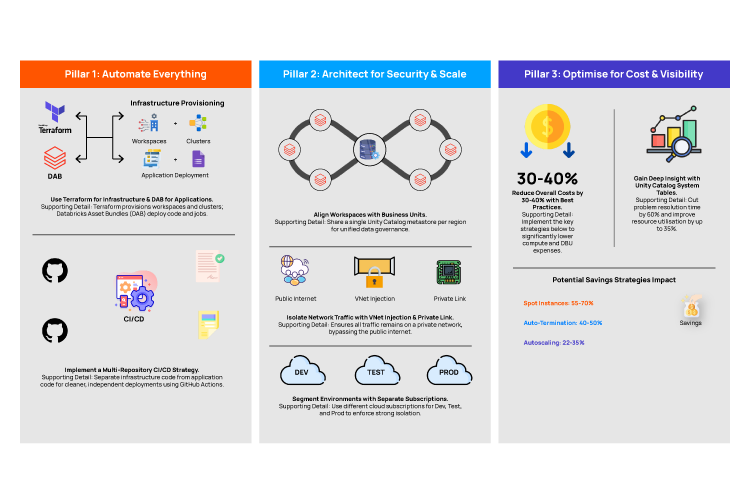
The Core Automation Strategy: The Right Tool for the Job
A common anti-pattern in platform engineering is using a single tool to manage the entire lifecycle. In practice, this often leads to brittle automation and poor separation of convers. To manage Databricks environments effectively at scale, a split-stack strategy is recommended.
- Terraform: The Foundation
Terraform acts as the primary provisioning tool and is responsible for managing the static components of the platform.- Scope: Cloud workspaces, Unity Catalog setup (metastores and credentials), network configurations, and security permissions.
- Role: Terraform builds the foundation and ensures security controls from day one.
- Databricks Asset Bundles (DAB): The Application Layer
Databricks Asset Bundles is the preferred tool for the dynamic layer of application deployment.- Scope: Modular, code-driven deployments of notebooks, workflows, and jobs.
- Role: DAB provides native support for environment-specific overrides, enabling seamless promotion of code across Dev, QA, and Production environments.
This dual-tool stack is best orchestrated via CI/CD integration such as GitHub Actions or Azure DevOps. A multi-repository strategy is recommended to separate foundational infrastructure from platform-level objects and application code.
Architecture and Security: Built for Isolation
A robust architecture is essential at enterprise Scale. Terraform configurations should consistently enforce three core security principles:
- Unified Governance: Implement a shared Unity Catalog metastore per region. This ensures that access control, auditing, and data lineage are consistent across all workspaces, regardless of environment.
- Network Isolation: The data platform should not be exposed to the open web. Deploy workspaces using VNet Injection and Private Link. Furthermore, enable Secure Cluster Connectivity (SCC) to ensure compute resources operate without public IP addresses.
- Environment Segmentation: Isolate Dev, Test, and Production environments by deploying them into separate cloud subscriptions or accounts. This creates a blast-radius boundary and reduces the risk of development-level issues from impacting production data.
The Financial Impact: Infrastructure as Code for Cost Optimization
Cost optimization is not just about finance; it is an engineering discipline.
Industry benchmarks and reports suggest that organizations can achieve up to a 42% reduction in Total Cost of Ownership (TCO) by managing the dual-cost model of cloud Infra and DBUs programmatically.
IaC is not just a deployment mechanism. It is also the primary enforcement layer for strategic resource management. Here is how Terraform policies can translate directly into measurable savings:
- Spot Instances (55–70% Savings)
Terraform can configure clusters to use preemptible or spot instances for suitable workloads. - Auto-Termination (40–50% Savings)
Enforcing auto-termination on interactive clusters prevents the “zombie cluster” problem, where resources run idle over the weekend. - Autoscaling (22–35% Savings)
Instead of fixed sizes, use IaC to set strict min/max worker limits, allowing the cluster to breathe based on actual demand. - Instance Pools
Pre-warming instances reduces cluster start times by up to 75%, saving 12–22% on overall costs by reducing idle wait times.
Governance & Observability
Beyond compute optimization, IaC ensures that every resource is deployed with mandatory tagging. This facilitates accurate cost attribution to specific business units, which has been shown to reduce unnecessary resource usage by 28%. Furthermore, leveraging the Unity Catalog system tables improves visibility into usage, permissions, and operational behavior. This level of observability can reduce issue investigation and resolution times by up to 60%.
The Implementation: A Multi-Repository Skeleton
To implement this strategy, we divide the Terraform code into two distinct logical layers: Cloud Infrastructure and Databricks Platform Objects.
Repository One: Workspace Setup (Cloud Infrastructure)
This repository uses cloud-native providers such as azurerm, to provision networking components and the Databricks workspace container.
The following Terraform configuration demonstrates how network isolation and Secure Cluster Connectivity are enforced during workspace creation.
main.tf Skeleton:
Terraform
# Provision the Virtual Network for VNet Injection
resource “azurerm_virtual_network” “databricks_vnet” {
name = “vnet-databricks-prod”
address_space = [“10.0.0.0/16”]
location = var.location
resource_group_name = azurerm_resource_group.this.name
}
# Subnets for host and container (Required for Secure Cluster Connectivity)
resource “azurerm_subnet” “public” {
name = “host-subnet”
virtual_network_name = azurerm_virtual_network.databricks_vnet.name
# … configuration for delegation to Microsoft.Databricks/workspaces
}
# The Databricks Workspace itself
resource “azurerm_databricks_workspace” “this” {
name = “dbx-workspace-prod”
resource_group_name = azurerm_resource_group.this.name
location = azurerm_resource_group.this.location
sku = “premium” # Required for Unity Catalog
custom_parameters {
no_public_ip = true # Secure Cluster Connectivity
virtual_network_id = azurerm_virtual_network.databricks_vnet.id
public_subnet_name = azurerm_subnet.public.name
private_subnet_name = azurerm_subnet.private.name
}
tags = {
Environment = “Production”
CostCenter = “Data-Engineering” # Tagging for cost attribution
}
}
Repository Two: Databricks Objects (Platform Level)
Once the workspace exists, the Databricks provider is used to manage platform-level resources. This allows for rapid iteration on governance and compute settings without risking the underlying network infrastructure.
providers.tf Skeleton:
Terraform
provider “databricks” {
host = var.databricks_host
# Authenticate via Service Principal (OAuth is best practice)
auth_type = “oauth-m2m”
}
unity_catalog.tf Skeleton:
Terraform
# Unified Governance via a Shared Metastore
resource “databricks_metastore” “this” {
name = “primary-metastore”
storage_root = “abfss://container@storageaccount.dfs.core.windows.net/”
region = “ukwest”
force_destroy = false
}
# Assign metastore to the workspace created in Repo 1
resource “databricks_metastore_assignment” “this” {
metastore_id = databricks_metastore.this.id
workspace_id = var.workspace_id
}
Cost-Optimized Compute Configuration
Cost controls are enforced through cluster policies and autoscaling defaults rather than manual configuration.
compute.tf (Cost-Optimised):
Terraform
# Enforce standards via Cluster Policies to prevent over-provisioning
resource “databricks_cluster_policy” “standard” {
name = “Standard Cost-Control Policy”
definition = jsonencode({
“autotermination_minutes”: { “type”: “fixed”, “value”: 20 }, # Auto-termination
“aws_attributes.availability”: { “type”: “fixed”, “value”: “SPOT_WITH_FALLBACK” } # Spot Instances
})
}
# Optimized Job Cluster
resource “databricks_cluster” “shared_autoscaling” {
cluster_name = “Production-ETL-Cluster”
spark_version = “13.3.x-scala2.12”
node_type_id = “Standard_DS3_v2”
autotermination_minutes = 20 # Savings of 40-50% on idle compute
autoscale {
min_workers = 2
max_workers = 10 # 22-35% reduction in costs via autoscaling
}
policy_id = databricks_cluster_policy.standard.id
}
Key Structural Considerations
When adopting this architecture, three principles must be maintained:
- Separation of Concerns
Secrets, credentials, and mount points should remain in Terraform. While DABs are excellent for jobs and workflows, they do not currently support managing these sensitive platform-level objects. - Strict Isolation
Use separate .tfvars files or backend configurations to deploy identical patterns across isolated subscriptions for Dev, Test, and Production. - Automated Triggers
This structure is designed for CI/CD. Infrastructure changes (Terraform) and application logic (DABs) should travel through distinct pipelines, ensuring that a change to a notebook never accidentally tears down a virtual network.
Conclusion
By automating the foundational layers of Databricks with Terraform and empowering developers with Databricks Asset Bundles, organizations can build platforms that are secure by design and cost-efficient by default. This approach allows teams to scale Databricks adoption with confidence while maintaining strong governance, isolation, and financial control from the start.