


Adhithya Neethiselvan
February 13, 2026
5 Minutes read
ETL Simplified: Storing and Transforming Data Fully Inside Databricks
Introduction: Building Faster, Trusted Data Pipelines
Organizations today are under pressure to deliver faster insights, reduce data platform costs, and maintain strong governance while supporting advanced analytics and AI initiatives. Traditional, fragmented data architectures struggle to meet these demands, often leading to higher operational overhead, slower decision-making, and increased risk.
Databricks addresses these challenges with a unified Lakehouse platform that brings data ingestion, transformation, analytics, and machine learning in a single, governed environment. This blog explains how Databricks enables an end-to-end ETL framework, the business values it delivers, and how it provides a scalable foundation for both current reporting needs and long-term digital transformation.
Why Simplify ETL Inside Databricks?
Traditional ETL pipelines rely on multiple tools for ingestion, storage, transformation, scheduling, and governance. While functional, this approach introduces significant complexity, increases maintenance effort, and raises operational cost.
By centralizing ETL within Databricks, organizations can reduce tool sprawl, apply consistent governance and security, accelerate development cycles, and seamlessly scale analytics and ML workloads. Teams spend less time managing integrations and more time delivering value from data.
Pain Points in AWS and the Business Case for Moving to Databricks
Fragmented AWS data services increase cost, slow troubleshooting, and delay time to insight, while Databricks simplifies operations with a unified, governed platform that accelerates analytics and business outcomes.
| Area | AWS (Traditional Approach) | AWS (Traditional Approach) |
| ETL Pipelines | Uses multiple services such as S3, Glue, EMR, Athena, and Redshift, each with separate configurations and logs, making troubleshooting complex and slow. | Unified platform for ingestion, ETL, and analytics with centralized monitoring and faster issue resolution. |
| Schema Changes | New columns often require crawler reruns, schema updates, and job fixes, often breaking pipelines. | Delta Lake supports built-in schema evolution, handling changes without impacting downstream jobs. |
| Governance | Permissions spread across IAM, Lake Formation, S3, and Redshift, making governance complex to manage. | Unity Catalog provides centralized access control, lineage, and auditing in one place. |
| Compute Cost | EMR and Glue jobs are often overrun, with duplicated compute across services. | Auto-scaling and auto-termination with clear cost visibility help reduce waste. |
| BI Performance and Data Duplication | Data is copied into Redshift for BI, increasing cost and latency. | Databricks SQL runs BI directly on Delta tables, eliminating duplication. |
| AI and Advanced Analytics | Data engineering, analytics, and ML are disconnected, slowing collaboration. | A single platform enables seamless collaboration across engineering, BI, and ML teams. |
How ETL Works in Databricks: The Medallion Architecture
Data Ingestion
Data is ingested using Auto Loader, REST APIs, JDBC connectors, or streaming tools like Kafka or Event Hubs. This flexibility allows organizations to support both batch and real-time data sources.
Bronze Layer — Raw Data Storage
The Bronze layer stores raw source data exactly as received, preserving the complete history and enabling full data replay when needed. By leveraging Delta Lake, it ensures ACID reliability, make data consistent, trustworthy, and recoverable.
Silver Layer — Clean and Refined data
The Silver layer focuses on cleaning and refining data through data cleansing, deduplication, schema standardization, and business enrichment. This layer prepares data for analytical consumption while maintaining data quality.
Gold Layer — Business-Ready Data
The Gold layer provides curated, business-ready datasets by curating information into domain models, KPIs, and aggregates, enabling BI dashboards, reporting, and operational analytics.
Data Consumption and Platform Services:
Gold data is consumed by
| 1.Databricks SQL 2.ML/AI pipelines 3.Business applications 4.Power BI / Tableau |
| Orchestration | Automate pipelines using Databricks Workflows |
| Governance | Use Unity Catalog for access control, lineage, and auditing |
Architectural Overview
The Databricks architecture described is the unified Lakehouse Platform utilizing the Medallion Architecture.
Databricks architecture is designed around the Lakehouse concept, which combines the scalability of data lakes with the reliability and performance of data warehouses. It is built to support data engineering, analytics, BI, and AI/ML on a single unified platform.
Please refer to the logical flow for more information.
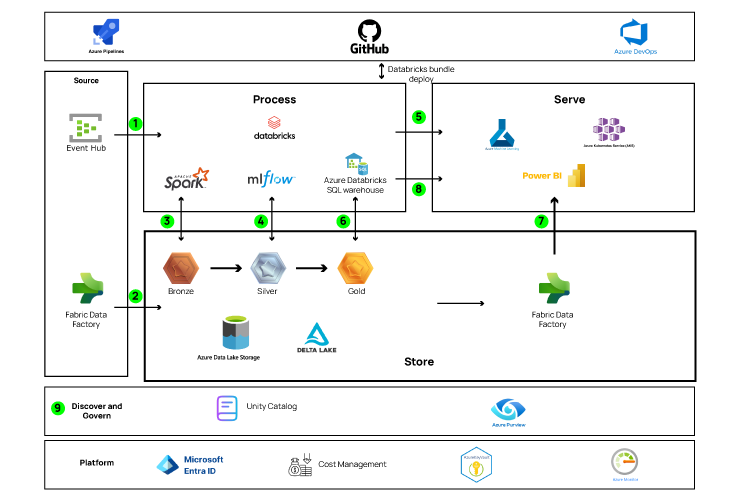
Deployment and CI/CD Workflow
- Develop Code in Dev Workspace
Build and test notebooks with development data. - Commit Code to Git
Use GitHub / Azure DevOps / GitLab for version control. - Define Deployment Config with Databricks Asset Bundles
Use yaml to define jobs, clusters, permissions. - Deploy to Dev Environment
Validate pipeline execution end-to-end. - Raise Pull Request for Promotion
Team reviews and approves changes. - Automated CI/CD Deployment
Pipelines deploy code to UAT and Production. - Schedule and Monitor in Production
Use Databricks Workflows with alerts and operational monitoring.
Business Benefits of Moving ETL to Databricks
Databricks enables faster insights, lower costs, stronger governance, and scalable analytics by unifying data, analytics, and AI on a single platform.
| Business Benefit | Description |
| Faster Insights | Unified data processing accelerates reporting and decision-making. |
| Lower Costs | Reduced data duplication and optimized compute lower total cloud spend. |
| Trusted Data | Built-in data quality checks and lineage improve confidence in analytics. |
| Simpler Governance | Centralized access control and auditing reduce compliance risk. |
| Scalable Analytics | Seamlessly scales from BI workloads to real-time and AI use cases. |
| Better Collaboration | A single platform for engineers, analysts, and data scientists speeds delivery. |
Suitable Use Cases for Databricks
Databricks is ideal for organizations that need a unified platform to modernize data lakes, enable real-time analytics, support BI, and scale advanced ML and GenAI workloads.
| Use Case | Description |
| Enterprise Data Lake Modernization | Modernizes legacy data lakes into a unified, governed Lakehouse for scalable analytics and storage. |
| Real-Time and Streaming Data Processing | Ingests and processes streaming data in near real time for operational insights and event-driven use cases. |
| BI, Reporting, and Self-Service Analytics | Enables fast, SQL-based analytics directly on Delta tables without data duplication. |
| Data Science, ML, and GenAI Workloads | Supports end-to-end ML and GenAI workflows, from data prep to model deployment, on one platform. |
| Complex Data Engineering and Large-Scale ETL | Handles large volumes of structured and semi-structured data with optimized, scalable ETL pipelines. |
Databricks Best Practices
To build scalable, secure, and well-governed data platforms in Databricks, teams should follow these best practices:
- Use Delta Lake as the default storage format for reliability and performance
- Follow the Unity Catalog hierarchy (Catalog → Schema → Table) for consistent governance.
- Manage all code in Git with PR-based workflows for traceability and quality
- Orchestrate pipelines using Databricks Workflows for automation and reliability
- Secure credentials with Databricks Secrets or Azure Key Vault.
- Maintain performance using OPTIMIZE and VACUUM operations
- Deploy environments using Asset Bundles with CI/CD pipelines
- Continuously monitor jobs, data quality, and pipeline health
Next Steps for Databricks Setup
To successfully onboard and operationalize Databricks, the following steps should be executed in sequence:
- Enable workspace access and define governance and user groups
- Register cloud storage and create required catalogs and schemas in Unity Catalog
- Establish Git-based development and code review standards
- Build initial ETL pipelines following the Medallion (Bronze–Silver–Gold) pattern
- Schedule Databricks Workflows and configure operational alerts
- Set up Asset Bundles and CI/CD for automated deployments
- Enable continuous monitoring, performance tuning, and cost optimization
Key Future Focus Areas
Below table highlights strategic capabilities that simplify data pipelines, accelerate development, and enable secure enterprise AI, adopted as data platforms scale and business demand for advanced analytics grows.
| Focus Area | Business Need | When to Adopt |
| Lakeflow | Reduces pipeline complexity, improves reliability, and lowers operational overhead by unifying ingestion, CDC, and orchestration | When managing multiple data sources, frequent schema changes, or complex ETL workflows |
| AI-Assisted Development | Reduces pipeline complexity, improves reliability, and lowers operational overhead by unifying ingestion, CDC, and orchestration | When teams are scaling, onboarding new engineers, or facing delivery bottlenecks |
| Enterprise GenAI & Vector Search | Enables secure, enterprise-grade GenAI use cases (search, recommendations, copilots) using internal data | When data foundations are stable and there is demand for advanced analytics or AI-driven business insights |
Conclusion
Centralizing ETL in Databricks creates a modern, scalable, and governed data foundation that enables faster and confident decision-making. The Lakehouse ETL framework unifies ingestion, transformation, analytics, and machine learning, reducing tool sprawl and complexity. This yields better data reliability, faster insights, and lower cost—critical for leaders.
From a leadership perspective, Databricks is a strategic enabler for growth, empowering teams to scale innovation, support AI initiatives, and respond quickly to meet business needs. Adopting the Lakehouse ETL approach is a forward-looking investment that strengthens governance, accelerates value delivery, and positions the enterprise for long-term success.
Related Insights