



Prashant Hegde
April 21, 2026
5 Minutes read
Industrial Connectivity Platforms: Enabling Multi-Protocol Interoperability for Smart Industrial Equipment
Industrial enterprises are at a decisive inflection point. Despite decades of automation, most systems still operate as disconnected islands. The imperative today is to transition toward integrated, intelligent, and interoperable industrial ecosystems.
From an Industrial Automation Engineering standpoint, the challenge has evolved beyond enabling connectivity. It now requires engineering interoperability at scale across diverse, multi-vendor, and legacy-intensive environments. This demands a structured, platform-led approach that abstracts complexity while enabling standardization and extensibility.
Industrial connectivity platforms are emerging as a strategic foundation in this transformation. They unify heterogeneous protocols, bridge legacy and modern systems, and enable seamless OT–IT convergence. More importantly, they are evolving into the control plane of digital industrial ecosystems—enabling data orchestration, embedded intelligence, and lifecycle governance across distributed assets.
Why Interoperability Remains a Challenge
Industrial communication architectures have evolved incrementally, resulting in a fragmented and layered ecosystem comprising:
- Legacy fieldbus systems (HART, Modbus, PROFIBUS)
- Industrial Ethernet networks (PROFINET, EtherNet/IP, EtherCAT)
- Deterministic Ethernet enhancements (TSN)
- Cloud and edge-based connectivity frameworks
While modern systems must operate across this entire spectrum, coexistence introduces significant complexity—particularly in enabling seamless, secure, and real-time data exchange across field, control, edge, and enterprise layers.
Key Challenges
- Protocol Fragmentation: Incompatible communication standards require protocol-specific handling, increasing engineering overhead.
- Data Inconsistency: Lack of standardization and semantic context limits the usability of machine data.
- Integration Complexity: Incremental integrations create tightly coupled and non-scalable architectures.
- Scalability Constraints: Point-to-point integrations fail at plant-wide and enterprise scale.
- Cybersecurity & Governance Risks: Expanded connectivity increases the attack surface and compliance complexity.
Without a structured, platform-driven approach, these challenges lead to escalating costs and limit the ability to leverage industrial data for advanced analytics and optimization.
Technology Landscape: Enabling Convergence
The industrial ecosystem is transitioning from protocol diversity toward unified, standards-based architectures.
- Legacy Protocols (HART, Modbus, PROFIBUS): Reliable and deterministic, but limited in scalability and interoperability.
- Industrial Ethernet (PROFINET, EtherNet/IP, EtherCAT): Enables high-speed communication and IT–OT convergence.
- Time-Sensitive Networking (TSN): Extends Ethernet with deterministic capabilities—bounded latency and synchronization.
- OPC UA (Semantic Interoperability Layer): Standardizes data models and enables contextual, cross-system data understanding.
This evolution reflects a convergence strategy—leveraging existing technologies while enabling future-ready, interoperable architectures.
Industrial Ethernet and Deterministic Networking
Industrial Ethernet has emerged as a key enabler in addressing performance, scalability, and integration challenges. Protocols such as PROFINET, EtherNet/IP, and EtherCAT have introduced:
- High-speed, low-latency communication
- Standardized and widely adopted networking infrastructure
- Improved convergence between IT and OT domains
The evolution of Ethernet with Time-Sensitive Networking (TSN) represents a significant advancement toward unified communication. TSN enables deterministic communication over standard Ethernet, allowing real-time control traffic and enterprise data flows to coexist on a single network.
Critically, TSN introduces:
- Time synchronization across distributed systems
- Bounded latency and guaranteed delivery
- Support for high-performance use cases such as closed-loop control, robotics coordination, and high-speed automation
This positions Ethernet as a converged backbone for next-generation industrial networks.
Semantic Interoperability through OPC UA
Achieving true interoperability requires more than connectivity – it demands a shared understanding of data across systems.
OPC UA addresses this by providing a robust, platform-independent framework that enables:
- Secure and standardized communication across devices and applications
- Rich, structured, and semantic data modeling
- Interoperable information models spanning multiple industrial domains
This shifts the paradigm from raw data exchange to contextual and actionable data intelligence. Furthermore, OPC UA Companion Specifications extend this capability by defining domain-specific information models. These specifications accelerate interoperability across industries such as automotive, energy, and process manufacturing, enabling faster integration and reduced engineering effort.
Industrial Connectivity Platform Architecture
A well-architected connectivity platform adopts a layered and decoupled approach, separating communication, data, and application concerns. From a technological perspective:
- Device Interface Layer: Provides multi-protocol connectivity and real-time data capture, enabling rapid onboarding of heterogeneous devices.
- Protocol Abstraction Layer: Normalizes protocols and eliminates vendor dependencies, enabling scalable and vendor-agnostic integration.
- Data Modelling Layer (OPC UA): Adds semantic context and standardized information models, enabling data interoperability and intelligence.
- Edge Processing Layer: Supports local analytics, filtering, and AI inference, enabling low-latency decision-making.
- Connectivity Layer (MQTT/REST): Facilitates secure, event-driven data transmission, enabling real-time data pipelines.
- Platform & Orchestration Layer: Leverages containerized, microservices-based deployment to enable scalability and lifecycle management.
- Security & Governance Layer (Cross-Cutting): Implements zero-trust architecture, IEC 62443 alignment to ensure secure and compliant operations.
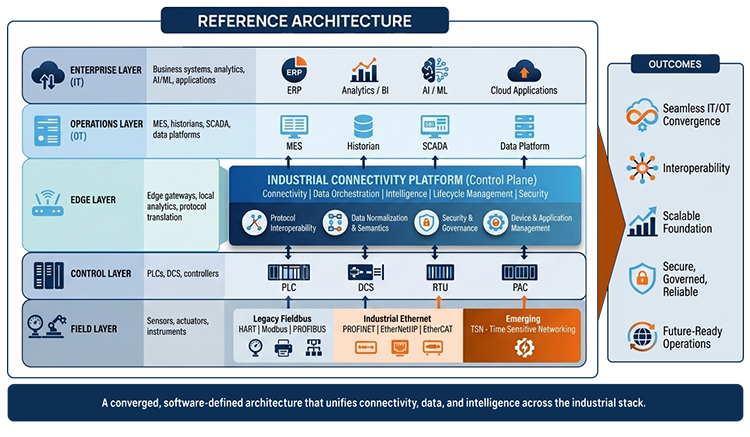
This layered architecture transforms rigid systems into modular, scalable, and future-ready platforms.
Key Technology Enablers for Industrial Connectivity Platforms
Industrial connectivity platforms are powered by complementary technologies that enable interoperability across the entire stack:
- OPC UA: Semantic data modelling and interoperability
- MQTT: Scalable, publish–subscribe communication
- Edge Computing: Distributed processing and low-latency response
- TSN: Deterministic networking for time-critical operations
- Secure OT–IT Frameworks: Governed and compliant integration
- Containerization & Microservices: Modular and scalable deployment
- Event Streaming Architectures: Real-time data pipelines
- Digital Twin Frameworks: Asset intelligence and simulation
Together, these technologies establish a unified, platform-centric architecture that enables intelligent industrial operations.
Real-World Industrial Use Cases
| Multi-Vendor Integration in Smart Manufacturing | Remote Monitoring and Service Enablement for Industrial Equipment |
Manufacturing environments consist of diverse OEM equipment operating across multiple protocols, limiting visibility and optimization. Connectivity platforms enable:
This enables closed-loop optimization, AI-driven insights, and improved asset utilization. | OEMs are transitioning toward service-driven business models requiring continuous monitoring and performance insights. Connectivity platforms enable:
This enables outcome-based services, uptime guarantees, and digital service ecosystems. |
Engineering Principles for Interoperability
Interoperability must be designed into the system—not added later. This requires adopting core engineering principles such as:
- Design protocol abstraction from the outset
- Standardize data models using OPC UA
- Ensure deterministic networking where required (TSN)
- Build scalable edge-to-cloud data pipelines
- Embed security by design
- Adopt event-driven, decoupled architectures
- Leverage microservices and containerization
- Integrate AI/ML and digital twins intelligently
Organizations adopting these principles significantly reduce integration complexity and accelerate digital transformation.
ACL Digital Engineering Capabilities
ACL Digital brings deep expertise in enabling industrial connectivity and interoperability at scale supporting OEMs and industrial enterprises in building future-ready, connected ecosystems.
Core capabilities include:
- Embedded systems and industrial protocol engineering
- Multi-protocol communication stack integration
- Industrial gateway and edge platform development
- Secure edge-to-cloud telemetry frameworks
- OPC UA information model integration
- TSN-enabled system design
- Edge AI/ML integration for industrial analytics
These capabilities enable OEMs to transform standalone machines into connected, intelligent, and interoperable assets, accelerating Industry 4.0 adoption.
Conclusion: Engineering the Future of Industrial Interoperability
Industrial connectivity platforms are no longer optional—they are a strategic imperative.
By converging legacy protocols, Industrial Ethernet, TSN, and OPC UA-based models, these platforms:
- Eliminate integration complexity
- Enable scalable, modular architectures
- Unlock data-driven operations
The leadership focus must now shift—from enabling connectivity to engineering interoperability as a core capability.
The next phase of industrial transformation will be defined by intelligent, autonomous, and self-optimizing systems, built on interoperable digital foundations. “The future of industrial systems will not be defined by individual technologies, but by how effectively systems integrate, communicate, and operate as cohesive ecosystems.” Connect with ACL Digital to accelerate your interoperability journey.