


ACL Digital
5 Minutes read
How AI Chips Are Transforming Modern Computing Beyond Traditional Processors
The semiconductor industry is in the middle of the most consequential architectural shift since the invention of the microprocessor. As generative AI, autonomous systems, and real-time inference become business-critical functions rather than experimental luxuries, the question is no longer whether to adopt AI-native hardware, but how quickly your organization can move. Understanding the fundamental difference between AI chips and traditional processors is now a strategic imperative for every decision-maker in technology, manufacturing, and enterprise software.
The Age of Purpose-Built Silicon
For four decades, the central processing unit ruled enterprise computing. Its design philosophy was universal: a small number of extraordinarily powerful cores, each capable of executing almost any instruction in near-perfect sequential order. This made CPUs indispensable for operating systems, transactional databases, and the general business logic that underpins modern software infrastructure.
The rise in AI workloads exposed a fundamental mismatch. Training a large language model or running real-time image recognition does not require a handful of brilliant cores solving problems one after another. It requires billions of simple multiply-and-add operations executed simultaneously across enormous matrices of numerical data. Traditional CPUs, no matter how fast their clock speeds, are architecturally unsuited for this kind of work. According to recent industry analysis, running a modern transformer-based inference workload on a high-end CPU alone can take 200 to 400 times longer than running the equivalent job on purpose-built AI silicon, a gap that translates directly into cost, latency, and competitive disadvantage.
This is the core insight behind the difference between AI chips and CPUs: it is not a matter of raw speed but of architectural intent. A CPU is a master generalist. An AI chip is an uncompromising specialist, designed from the transistor up for one category of computation.
Understanding the Architectural Divide
To appreciate how AI chips differ from regular processors, it helps to look at the three major compute categories that define the 2026 landscape: CPUs, GPUs, and dedicated AI accelerator chips, including neural processing units.
A CPU achieves its versatility through deep pipelines, large instruction caches, sophisticated branch predictors, and out-of-order execution engines. Each core is a feat of miniaturized engineering capable of handling complex conditional logic, memory hierarchies, and operating-system-level tasks. Modern server-class CPUs from Intel and Arm’s ecosystem partners carry anywhere from 16 to 128 cores, each operating at frequencies above 4 GHz. They remain irreplaceable for sequential, logic-heavy computation.
A GPU introduced parallelism on a scale. Originally designed to render thousands of pixels simultaneously, the GPU’s architecture, thousands of small shader cores operating in lock-step on the same instruction, turned out to be well-suited for the matrix multiplications at the heart of machine learning. NVIDIA’s H100 and H200 families, which dominated data center deployments through 2024 and 2025, offer over 16,000 CUDA cores paired with high-bandwidth memory delivering terabytes per second of memory throughput. GPUs remain the workhorse of model training, but their general-purpose parallel design still carries overhead that purpose-built AI silicon can eliminate.
AI accelerator chips and neural processing units represent the third and most differentiated category. Rather than adapting general architecture to AI tasks, these chips are designed around the specific mathematical operations that neural networks require: tensor multiplication, activation functions, attention computations, and weight-loading patterns. Chips from Google (the TPU v5 series), Cerebras, Groq, and semiconductor-embedded solutions from Qualcomm’s Hexagon NPU line have demonstrated that when you build silicon specifically for AI math, you can achieve inference throughputs that exceed GPU performance by factors of 10 to 50, while consuming a fraction of the power.
The architecture of AI processors centers on what engineers call a systolic array or tensor processing array, a grid of multiply-accumulate units wired together so that data flows through them in a wave pattern, eliminating the need to repeatedly fetch operands from memory. On-chip SRAM buffers sit close to the compute units, dramatically reducing latency. The memory wall, the performance bottleneck caused by waiting for data to travel between the processor and DRAM, is substantially mitigated through near-memory computation and carefully orchestrated data-flow pipelines.
The GPU vs CPU vs AI Chip Question for Enterprise Buyers
The GPU vs CPU vs AI chip comparison is not merely technical, but it has direct implications for infrastructure investment, operational expenditure, and time-to-value. In 2026, the three architectures coexist in most serious AI deployments, each playing a distinct role.
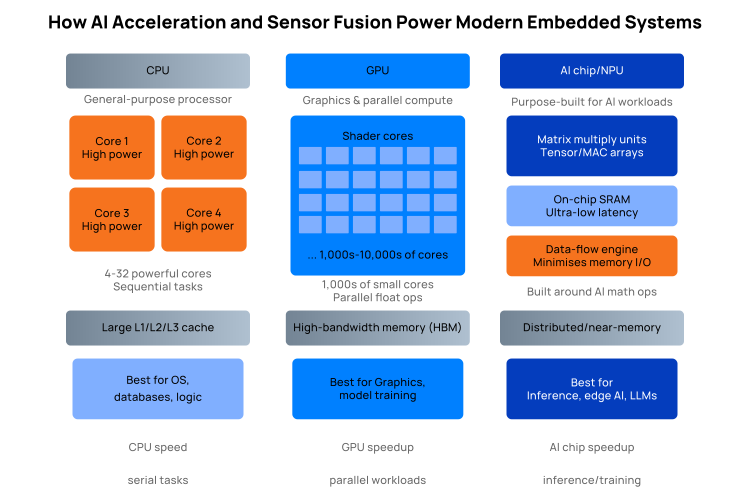
CPUs handle orchestration, preprocessing, and the business logic surrounding AI inference. GPUs remain dominant for training large foundation models, where flexibility and raw FLOPS count matter more than inference latency. Dedicated AI chips, including embedded NPUs within application processors and discrete accelerator cards in the data center, have become the preferred substrate for serving models in production, particularly in latency-sensitive applications like real-time fraud detection, natural-language customer interfaces, and on-device intelligence.
The emergence of choosing an embedded semiconductor solutions partner as a strategic decision reflects this convergence. Organizations are not simply buying chips; they are selecting an entire ecosystem: compilers, runtime software, memory controllers, thermal packaging, and the confidence that their chosen silicon will keep pace with model complexity over the next three to five years. The semiconductor partner you align with in 2026 will shape the economics of your AI infrastructure well into the 2030s.
The benefits of AI chips over traditional CPUs in production workloads are now well-documented. Power efficiency improvements of 5 to 15 times are common for identical inference tasks. Latency reductions from seconds to milliseconds unlock entirely new product experiences. And the total cost of ownership, factoring in rack space, cooling, and energy, often favors specialized AI silicon even when the chip’s unit cost is higher than that of a comparable server CPU.
Neural Processing Units: Intelligence at the Edge
One of the most consequential developments of the past two years has been the proliferation of neural processing units embedded directly into mobile and edge devices. Every flagship smartphone shipped in 2025 and 2026 contains an NPU delivering between 30 and 100 TOPS (tera-operations per second) enough to run multimodal AI assistants, real-time language translation, and computational photography pipelines without a network round trip.
The implications for enterprise architecture are significant. On-device inference eliminates the latency and bandwidth cost of sending sensitive data to a cloud endpoint. It enables AI-powered functionality in environments where connectivity is unreliable or prohibited, such as factory floors, medical devices, and remote infrastructure monitoring. And it substantially shifts the privacy calculus, since personal and proprietary data never leaves the device.
The design of NPUs embedded in system-on-chip solutions differs subtly from data-center AI accelerators. Power budgets are measured in milliwatts rather than hundreds of watts. Thermal constraints are severe. The software stack must support a wide variety of quantized model formats, such as INT4, INT8, and mixed-precision, to fit capable models within tight memory envelopes. Companies choosing an embedded semiconductor solutions partner for edge AI must evaluate not just benchmark performance but the maturity of the on-device compiler toolchain, support for model compression techniques, and the vendor’s commitment to over-the-air model update pipelines.
What This Means for the Semiconductor Partnership Landscape in 2026
The AI processors market has become significantly more fragmented since the near-monopoly conditions that prevailed in 2022 and 2023. NVIDIA retains dominant market share in data-center training, but inference is a far more competitive arena. Intel’s Gaudi line serves cost-sensitive enterprise workloads. Qualcomm, MediaTek, and Apple dominate the on-device NPU space. And a new generation of inference-specialized startups like Groq, Tenstorrent, d-Matrix, and others, is pursuing architectural bets that could reshape the market by 2027 or 2028.
For enterprise technology leaders, this diversity is both an opportunity and a challenge. The opportunity lies in matching the right silicon to each specific workload, rather than defaulting to a single vendor’s entire stack. The challenge lies in the complexity of integration: each chip family brings its own programming model, memory layout requirements, and performance characterization methodology. Without a clear semiconductor partner strategy, organizations risk fragmented toolchains, suboptimal performance, and unsustainable engineering overhead.
The most successful organizations in 2026 are approaching this not as a hardware procurement exercise but as a capability partnership. They are working closely with semiconductor solution providers who can advise on chip selection, system integration, software optimization, and roadmap alignment from early-stage proof of concept through to high-volume production deployment.
Where AI Chips are Going
The pace of innovation in AI accelerator chips shows no sign of decelerating. Several architectural trends are converging to redefine what is possible over the next three years. Chiplet-based designs, in which multiple specialized tiles are assembled into a single package using advanced packaging techniques such as TSMC’s CoWoS and Intel’s EMIB, allow vendors to combine best-in-class compute, memory, and I/O without being constrained by monolithic-die yields.
Photonic interconnects are entering early commercial deployment, promising bandwidth between compute tiles that dwarfs that of electrical connections while operating at lower power. Analog and in-memory computing approaches, long a research curiosity, are beginning to appear in specialized low-power inference chips where the energy cost of reading weights from SRAM is the dominant bottleneck. And the integration of transformer-native primitives, such as hardware-accelerated attention mechanisms, KV-cache management units, and sparse computation engines, into silicon is closing the gap between the mathematical structure of modern AI models and the physical substrate on which they run.
By late 2026 and into 2027, the most capable AI deployments will likely run across a heterogeneous fabric of CPUs, GPUs, AI accelerators, and edge NPUs, orchestrated by software layers that abstract the complexity of the underlying silicon. The organizations that invest now in understanding this architectural landscape, and in building relationships with the right embedded semiconductor solutions partners, will have a decisive advantage in deploying AI at the speed and scale that competitive markets will demand.
Conclusion
The difference between AI chips and regular processors is not incremental but categorical. Where CPUs optimize for sequential versatility and GPUs for general parallelism, AI chips and NPUs optimize for the specific mathematical operations that define modern intelligence workloads. The performance, power, and latency advantages are not marginal improvements; they are the differences between AI that is economically viable in production and AI that exists only in demonstrations.
As the semiconductor landscape continues its rapid evolution through 2026 and beyond, enterprises face a pivotal decision: invest in understanding the architecture of AI processors and in deliberately choosing embedded semiconductor solution partners, or inherit a fragmented, cost-inefficient infrastructure built on yesterday’s assumptions. The silicon beneath your AI strategy is not a commodity. It is, increasingly, the strategy itself.
Frequently Asked Questions
Q: What is the main difference between AI chips and traditional CPUs?
A: The core difference lies in architectural intent. A traditional CPU is built for versatility, using a small number of powerful cores to handle sequential, logic-intensive tasks such as operating systems and database workloads. An AI chip, by contrast, is purpose-built for the specific mathematical operations that neural networks require, such as matrix multiplications and tensor computations. This allows AI chips to process these workloads 100 to 1,000 times faster than a CPU, while consuming a fraction of the power.
Q: Do AI chips replace GPUs for machine learning workloads?
A: Not entirely. GPUs remain the dominant choice for training large AI models due to their flexibility and raw parallel compute power. However, dedicated AI accelerator chips and NPUs have become the preferred hardware for running AI models in production, particularly for real-time inference tasks where latency, power efficiency, and cost per query matter most. In 2026, most serious AI deployments used all three: CPUs for orchestration, GPUs for training, and AI chips for inference.
Q: What is a neural processing unit, and where is it used?
A: A neural processing unit, or NPU, is a specialized processor designed to accelerate AI inference tasks directly on a device, without needing to send data to the cloud. NPUs are embedded in smartphones, laptops, edge computing devices, and industrial hardware. They are optimized to run quantized AI models within tight power and memory budgets, enabling capabilities such as real-time language processing, on-device image recognition, and AI-assisted photography, all without a network connection.
Q: How do I choose the right AI chip or semiconductor partner for my business?
A: Choosing the right embedded semiconductor solutions partner goes beyond comparing benchmark numbers. Businesses should evaluate the maturity of the software toolchain and compiler ecosystem, support for the model formats and frameworks their teams already use, the vendor’s roadmap for future architectures, and their ability to provide integration support from proof of concept through to production deployment. The right partner will align their silicon roadmap with your AI workload requirements over a three- to five-year horizon, not just with today’s use case.