



Arun Kumar
March 30, 2026
5 Minutes read
Enterprise Agentic AI: From Chatbots to Autonomous AI Systems
Artificial intelligence has advanced significantly in recent years, evolving from rule-based automation toward sophisticated large language models capable of interpreting and generating natural language. However, traditional AI assistants remain largely reactive: they answer questions but do not take action.
The next evolution in AI systems is Agentic AI — systems capable of reasoning, planning, and executing tasks autonomously using external tools and enterprise systems.
Instead of responding to a single prompt, agentic systems can:
- Break complex problems into sub-tasks
- Call APIs and external services
- Retrieve and analyse enterprise data
- Execute multi-step workflows
This architectural shift enables organizations to move from AI assistants to AI operators that actively support business processes.
What Is Agentic AI?
Agentic AI describes intelligent systems capable of planning tasks, interacting with external tools, and executing multi-step workflows independently.
Unlike traditional LLM applications, agentic systems operate in a continuous loop:
- Understand the goal
- Plan the required steps
- Execute actions using tools
- Evaluate results
- Iterate until the task is completed
This loop enables AI agents to solve complex problems that require reasoning, tool use, and decision-making.
Example of an Agentic Workflow:
User request – “Generate a sales report for last quarter and email it to the leadership team.”
An agentic AI system may:
- Query the sales database
- Aggregate revenue data
- Generate a summary report
- Create visual charts
- Send the report via email
This demonstrates how agents can execute real business tasks instead of only answering questions.
Core Components of an Agentic AI Architecture
Enterprise agentic systems typically consist of several core components.
The Language Model (Reasoning Engine)
The LLM acts as the decision-making component of the agent.
Its responsible for:
- Interpreting instructions
- Generating reasoning steps
- Deciding which tools to use
The model acts as the decision engine of the system.
Examples:
- GPT models
- Claude
- Gemini
- Llama
Tool Layer
Agents require tools to interact with the external world.
Examples of tools include:
- Databases
- APIs
- Document retrieval systems
- Analytics platforms
- Workflow engines
Tools allow AI agents to perform real operational tasks beyond text generation.
Example tool call:
get_sales_data(region=”APAC”, quarter=”Q3″)
Memory Systems
Memory is essential for agents to operate effectively.
Three common memory types:
1. Short-Term Memory
Maintains context within a conversation or task.
Example:
Current user instructions
Intermediate reasoning steps
2. Long-Term Memory
Stores historical interactions and organizational knowledge.
Example:
Company/internal documents
Previous task results
3. Retrieval Memory
Uses vector databases to retrieve relevant knowledge dynamically.
Example technologies:
Pinecone
Redis
Weaviate
Planning and Orchestration
Many agentic systems include a planner module responsible for breaking large/complex goals into smaller executable tasks.
Example workflow:
Goal: Create sales report
- Step 1: Retrieve data
- Step 2: Clean and aggregate metrics
- Step 3: Generate summary
- Step 4: Produce visualization
- Step 5: Send email
Specialized agents may handle different steps.
Modern Agent Frameworks
Building agent systems from scratch is complex, so developers now use agent orchestration frameworks.
Popular frameworks include:
- LangGraph
- CrewAI
- Microsoft AutoGen
- OpenAI Agents SDK
- Semantic Kernel
These frameworks provide:
- Agent orchestration
- Memory management
- Tool integration
- Multi-agent collaboration
For example, LangGraph enables graph-based workflows where agents act as nodes and exchange information through shared state, enabling complex multi-step reasoning pipelines.
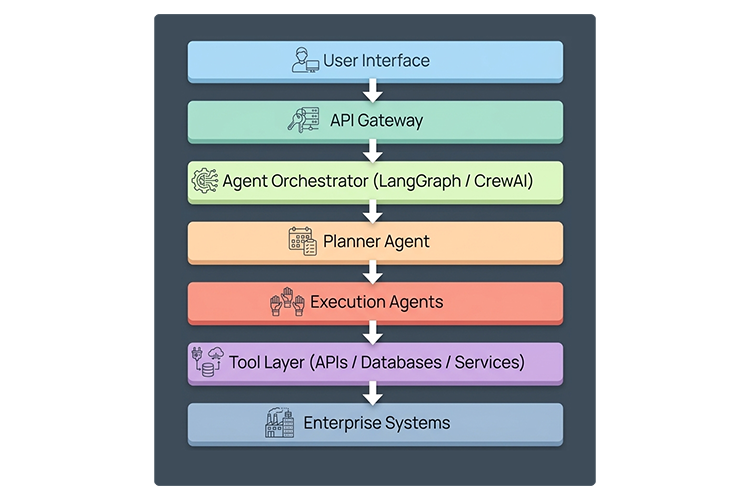
Example Enterprise Agentic AI Architecture
To understand how agentic systems operate in real enterprise environments, consider a typical enterprise architecture for an AI agent platform.
Single-Agent vs Multi-Agent Architectures
Agentic AI systems can be implemented using different architectural approaches.
Single-Agent Systems
One agent performs all reasoning and execution.
Advantages:
- Simpler architecture
- Easier debugging
Limitations:
- Limited scalability
- Difficult to manage complex workflows
Multi-Agent Systems
Multiple specialized agents collaborate to complete tasks.
Example architecture:

Each agent focuses on a specific responsibility.
Benefits:
- Improved modularity
- Better scalability
- Easier specialization
Modern AI systems increasingly adopt multi-agent collaboration models, where different agents coordinate tasks similarly to a human team.
Observability in Agentic AI
One of the biggest challenges in production agent systems is debugging and monitoring agent behaviour. Traditional monitoring tools are insufficient for AI systems.
This has led to the rise of LLM observability platforms, such as:
- Langfuse
- Arize Phoenix
- LangSmith
These tools help engineers track:
- Prompt usage
- Agent reasoning steps
- Tool calls
- Token usage
- Latency
Guardrails and Governance
Enterprise environments require strong governance mechanisms.
Common safeguards include:
- Permission controls
- Tool access restrictions
- Human-in-the-loop approvals
- Audit logs
These safeguards ensure agents operate within organizational policies and security boundaries.
Agent Protocols and Standards
The AI ecosystem is also developing standards for agent interoperability.
Examples include:
- Model Context Protocol (MCP)
- AGENTS.md
These protocols enable AI models to securely connect with tools, APIs, and external systems across different platforms, forming a shared ecosystem for agent development.
Example Enterprise Workflow
Consider an internal analytics assistant.
User query: “Why did revenue decline in Europe last month?”
Agent workflow:
- Query sales database
- Retrieve marketing campaign data
- Analyze trend changes
- Generate explanation
- Produce visualization
The agent acts as an analyst rather than a search engine.
Challenges in Building Agentic AI Systems
While agentic AI offers powerful capabilities, several challenges must be addressed.
Latency
Agent loops and tool calls can significantly increase response times.
Solutions:
- Semantic caching
- Prompt caching
- Tool result caching
Reliability
Agents may produce incorrect actions or hallucinated tool calls.
Mitigation strategies:
- Structured tool schemas
- Validation layers
- Agent evaluation pipelines
Evaluation
Evaluating AI agents is difficult because their behavior evolves over multiple steps.
Modern evaluation tools measure:
- Response correctness
- Reasoning quality
- Retrieval accuracy
The Future of Enterprise AI
Agentic AI represents a fundamental shift in how organizations interact with software systems.
Rather than manually navigating dashboards or executing workflows, users can delegate tasks to intelligent agents capable of reasoning, planning, and executing complex operations.
As these systems mature, enterprises will increasingly rely on AI agents as digital coworkers, capable of assisting analysts, engineers, and business leaders across daily operations.
The transition from chatbots to autonomous agents marks the beginning of a new generation of intelligent enterprise systems.