



ACL Digital
March 26, 2026
5 Minutes read
AI-Driven Test Automation Transforming Quality Engineering in 2026
In the current digital transformation era, integrating AI into quality engineering is no longer optional. It helps organizations transform large volumes of data into meaningful insights while automating tasks that previously required significant manual effort.
According to recent industry estimates, approximately 35–40% of companies’ IT budgets are expected to be allocated to AI-driven testing applications by 2026. As digital innovation continues to accelerate, quality engineering (QE) tools combined with artificial intelligence are improving process accuracy and setting new benchmarks for product and service excellence.
Studies also indicate that around 70–80% of software teams are expected to incorporate AI in some form by 2026. This shift highlights how AI is becoming an essential part of both professional and personal workflows. For QE leaders, adopting AI is increasingly critical to remain competitive and to integrate intelligent capabilities across the software development lifecycle (SDLC), business operations, and customer experience strategies. Before exploring the top tools, it’s important to understand what truly defines an AI-powered test automation platform and why it is becoming essential for modern software delivery.
Core Features to Look for in AI Testing Tools
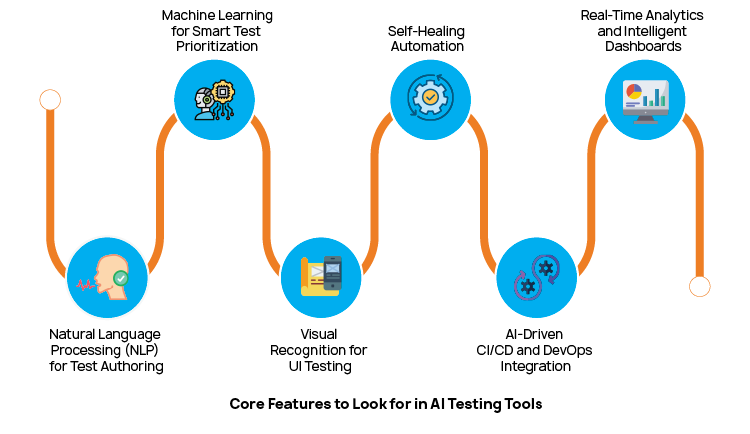
Natural Language Processing (NLP) for Test Authoring
The best AI tools allow teams to write test cases in plain English instead of complex scripts.
NLP-powered testing tools assist in generating test scenarios from natural language inputs with human validation and engineering configuration ensuring reliable executable tests. This makes testing more accessible and enables business analysts, product managers, and non-technical stakeholders to actively contribute to quality assurance. It matters for faster test creation and broader team collaboration.
Machine Learning for Smart Test Prioritization
AI-driven platforms analyze:
- Code changes
- Historical defect patterns
- Past execution results
- Risk areas in the application
Using this data, they intelligently decide which tests should run first. Instead of executing thousands of tests blindly, AI focuses on high-impact, high-risk areas — reducing testing time while maintaining strong coverage. It makes Faster releases without compromising quality.
Visual Recognition for UI Testing
Modern applications are dynamic, responsive, and visually complex. Traditional assertions often miss subtle UI issues. AI-powered computer vision can:
- Detect layout shifts
- Identify visual regressions
- Validate elements across browsers and devices
- Use perceptual comparison to detect UI changes
This ensures the user experience remains consistent and polished. It matters for better user experience and fewer production surprises.
Self-Healing Automation
One of the biggest challenges in traditional automation is maintenance. A simple UI change — like an updated element ID or DOM restructuring — can break dozens of test scripts. Self-healing AI automatically adapts to these changes by:
- Re-identifying modified elements
- Updating locators runtime without affecting existing execution with test failures relates to locator changes
- Reducing flaky tests
This significantly cuts maintenance efforts and keeps automation stable. It matters as it lowers maintenance costs and more reliable test suites.
AI-Driven CI/CD and DevOps Integration
AI testing tools must integrate seamlessly with modern DevOps workflows. Look for platforms that connect easily with. Look for platforms that connect easily with:
- Jenkins
- GitHub Actions
- GitLab CI
- Azure DevOps
- Other CI/CD pipelines
Modern AI-enabled testing platforms go beyond traditional CI/CD integration by using data-driven insights to optimize pipeline execution. They analyze code changes, historical defect patterns, and flaky test trends to automatically prioritize high-risk tests and focus on critical areas. The system should automatically trigger tests on code commits, pull requests, or deployments. This enables continuous testing, improves pipeline efficiency, and supports faster and more reliable release cycles.
Real-Time Analytics and Intelligent Dashboards
Raw test results aren’t enough. Teams need actionable insights. Advanced AI testing platforms provide:
- Root cause analysis for failures
- Test health and stability metrics
- Coverage gap identification
- Predictive quality indicators
Clear dashboards help stakeholders quickly understand quality trends and make informed release decisions. It matters for smarter decision-making and proactive quality management.
Top AI-Powered Test Automation Tools
BrowserStack
BrowserStack provides cloud-based testing infrastructure with AI-powered visual validation capabilities.
Key Features
- Real device and cross-browser testing
- AI-powered visual regression testing (Percy)
- Intelligent test distribution
Best For: Teams requiring extensive browser and device testing coverage
Katalon Studio
Katalon Studio is a comprehensive automation platform supporting multiple testing environments with AI-powered enhancements.
Key Features
- Web, mobile, API, and desktop testing
- Self-healing object locators
- AI-based visual testing
Best For: Teams needing an all-in-one testing platform
Applitools
Applitools specializes in AI-driven visual testing, ensuring applications deliver consistent UI experiences.
Key Features
- AI visual validation
- Responsive design testing
- Automated baseline management
Best For: Applications that require pixel-perfect UI validation
Mabl
Mabl is a low-code AI testing platform designed for modern Agile and DevOps teams.
Key Features
- Auto-healing test scripts
- Performance and visual testing
- Seamless CI/CD integration
Best For: Agile teams seeking fast automation
ACCELQ
ACCELQ is a codeless AI automation platform built for continuous testing in Agile environments.
Key Features
- Requirement-based test generation
- Unified API and UI testing
- Self-healing automation
Best For: Agile teams focusing on requirement-driven testing
Limitations and Challenges of AI in Quality Engineering
While AI is transforming quality engineering and test automation, organizations must also be aware of certain limitations and risks associated with AI-driven testing tools.
LLM Hallucinations
Large Language Models (LLMs) used in AI testing platforms may sometimes generate inaccurate or misleading outputs. This can lead to incorrect test cases or flawed analysis if human validation is not applied.
Security Risks and Code Access
AI testing tools often require access to source code, test repositories, or application data. Without proper access controls and security policies, this can create potential risks related to code exposure or unauthorized access.
Model Drift
Over time, AI models may become less effective if the underlying data or application behavior changes significantly. Continuous monitoring and retraining of models are necessary to maintain testing accuracy.
Data Privacy Concerns
AI-driven testing platforms may process sensitive user or application data. Organizations must ensure compliance with data protection regulations and implement secure data handling practices.
False Positives in Visual AI Testing
AI-based visual testing tools may sometimes flag UI changes as defects even when they are intentional design updates. Proper configuration and human oversight are required to reduce false positives.
Why Partner with ACL Digital for Quality Engineering Services?
At ACL Digital, we help organizations overcome these challenges with our comprehensive Quality Engineering and Assurance (QEA) services. Leveraging AI and machine learning, our approach integrates proven industry practices with strong domain expertise to deliver high-quality digital assurance solutions.
Our Test Automation Centre of Excellence builds tailored automation frameworks that enhance software performance testing and optimize QA processes across the full technology ecosystem from cloud platforms to embedded systems.
Connect with ACL Digital’s AI experts at business@acldigital.com to discuss AI-driven migration frameworks, readiness assessments, and modernization strategies designed to support your organization’s transformation goals.
Related Insights