



ACL Digital
March 13, 2026
5 Minutes read
How GCC-as-a-Service Models Are Accelerating AI-First Digital Product Engineering for Global Enterprises
Global Capability Centers (GCCs) are no longer back-office extensions quietly supporting global enterprises. They are emerging as AI-first innovation engines, leading digital product or AI-powered software engineering, platform and enterprise modernization, and enterprise transformation across industries. What began as cost arbitrage hubs has transformed into high-value digital ecosystems that drive product strategy, engineering excellence, and next-gen technology adoption.
India has established itself as the global center for GCC growth, supported by favorable policies, skilled talent, and robust infrastructure. The country is driving a new era in digital product engineering, redefining how multinational companies build, scale, and innovate.
Here, we discuss how GCCs and GCC-as-a-Service models drive digital product engineering across industries. It also highlights why India remains a strategic location for GCCs in 2026 and outlines the benefits enterprises gain by partnering with GCC-as-a-Service providers to accelerate transformation.
The Rise of GCC 3.0: From Cost Centers to AI-First Innovation Engines
The GCC journey has evolved dramatically over the past decade. Initially established for cost efficiency and operational support, GCCs are now central to enterprise innovation roadmaps. According to industry insights from NASSCOM and Deloitte, India is home to more than 1,600 GCCs, employing over 1.9 million professionals and contributing billions to the economy. But the real shift is qualitative, not just quantitative.
GCC 3.0 represents an AI-first operating model where centers are designed to drive product ownership, digital platforms, and intellectual property creation. Instead of executing predefined tasks, these centers are building core digital products, engineering SaaS platforms, developing AI solutions, and managing end-to-end product lifecycles.
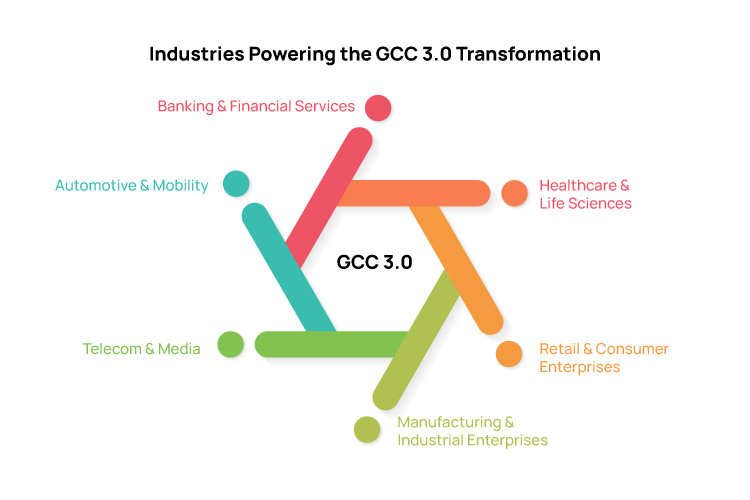
Enterprises in banking, healthcare, retail, manufacturing, communications, and automotive sectors are leveraging GCCs as strategic hubs for digital product engineering. These centers now lead initiatives in generative AI, cloud-native transformation, cybersecurity engineering, digital twins, and data-driven decision systems. In the present year, the narrative has clearly shifted, as GCCs are no longer support functions but digital product innovation powerhouses.
Why India Is the Global Hub for GCCs
India’s rise as the preferred destination for GCC solutions is not accidental. It is the result of a mature digital ecosystem supported by policy initiatives, robust infrastructure, and a skilled workforce.
Recent policy announcements, including forward-looking provisions in Budget 2026, reinforce India’s commitment to becoming the world’s innovation engine for GCCs. Strategic focus areas include AI research, semiconductor development, digital public infrastructure, and startup collaboration ecosystems. These initiatives strengthen India’s positioning as a long-term GCC destination rather than a short-term outsourcing alternative.
Moreover, cities such as Bengaluru, Hyderabad, Pune, Chennai, and the NCR have evolved into specialized GCC clusters. Events such as GCC Converge Hyderabad 2026 underscore India’s growing role in shaping global conversations on enterprise innovation.
India’s strengths extend beyond the availability of talent. The country offers a dynamic mix of digital engineering expertise, R&D capabilities, strong academic pipelines, and a thriving startup ecosystem. This convergence allows GCCs to co-innovate with emerging technology firms while delivering enterprise-grade digital product engineering solutions. In 2026, India is not just hosting GCCs; it is defining their global operating models.
Digital Product Engineering is the Core of Next-Gen GCCs
Digital product engineering has become the heartbeat of modern GCCs. Instead of building isolated applications, these centers are responsible for designing, developing, scaling, and maintaining global digital products used by millions of customers.
Product-centric GCCs now own full-stack engineering capabilities, including user experience design, platform architecture, DevSecOps, AI model integration, data engineering, and lifecycle management. They operate as independent innovation hubs aligned with global headquarters, yet empowered to make autonomous decisions.
Several transformative shifts define this evolution:
For example, GCCs are adopting cloud-native architectures to accelerate scalability and resilience. They are embedding artificial intelligence (AI) and machine learning directly into core product workflows. They are investing in cybersecurity frameworks to meet global compliance standards. They are leveraging advanced analytics to generate real-time insights for business leaders.
Furthermore, emerging technologies such as generative AI, blockchain, IoT, digital twins, quantum computing experimentation, and extended reality are now part of the GCC innovation stack. These capabilities are enabling enterprises to launch faster, iterate continuously, and deliver hyper-personalized digital experiences. As a result, digital product engineering within GCCs is no longer reactive. It is predictive, intelligent, and customer-centric.
The AI-First Operating Model: Reshaping GCC Strategy
The AI-first transformation is one of the most defining shifts in GCC evolution. Inspired by the AI-driven operating frameworks highlighted by industry bodies, modern GCCs are embedding artificial intelligence into every layer of enterprise operations.
In 2026, AI is not a pilot project within GCCs; it is foundational infrastructure. From automated code generation and intelligent testing to AI-powered customer insights and predictive maintenance systems, AI accelerates digital product engineering at scale.
Financial services GCCs are building AI-based fraud detection platforms and personalized banking engines. Healthcare GCCs are creating predictive diagnostics systems and digital health ecosystems. Retail GCCs are engineering recommendation engines and dynamic supply chain models. Manufacturing GCCs are deploying digital twin simulations and smart factory analytics.
This AI-first model increases agility, reduces time-to-market, and drives measurable business outcomes. It also redefines talent requirements, pushing GCCs to hire data scientists, AI engineers, cloud architects, and product strategists alongside traditional software developers.
Five Defining Shifts in India’s GCC Story
India’s GCC growth in 2025 and 2026 is shaped by five major shifts that are redefining enterprise strategy.
- First, GCCs are transitioning from scale-driven growth to value-driven innovation. Enterprises are prioritizing intellectual property creation and platform leadership over headcount expansion.
- Second, digital product ownership is increasingly centralized within GCCs. Instead of merely supporting global product teams, Indian GCCs now lead roadmap decisions and engineering direction.
- Third, there is a growing emphasis on Centers of Excellence (CoEs) within GCC ecosystems. These CoEs focus on AI, cybersecurity, cloud engineering, and emerging technologies, positioning India as a deep-tech powerhouse.
- Fourth, industry diversification is accelerating. While BFSI and technology sectors dominated early growth, healthcare, life sciences, automotive, and retail are rapidly expanding their GCC footprints.
- Fifth, sustainability and ESG integration are becoming strategic priorities. Modern GCCs incorporate green engineering practices and sustainable infrastructure into digital transformation programs.
These shifts collectively position India as the innovation backbone for global enterprises.
Choosing a GCC-as-a-Service or GCC Solutions Partner
As enterprises expand into India, choosing a GCC-as-a-service or GCC solutions partner becomes a critical strategic decision. Establishing a GCC independently requires deep regulatory knowledge, infrastructure readiness, talent acquisition strategies, and long-term operational governance frameworks.
A GCC-as-a-service model simplifies this journey. It enables organizations to set up and scale digital product engineering teams with reduced risk, faster timelines, and optimized costs. The right GCC solutions partner offers expertise in site selection, compliance management, talent hiring, technology infrastructure, cybersecurity protocols, and AI integration.
Beyond operational setup, an experienced partner helps design an AI-first digital product strategy aligned with enterprise goals. They ensure scalability, embed best practices in DevOps and agile product engineering, and seamlessly integrate emerging technologies. Enterprises are increasingly adopting hybrid models where strategic governance remains global while product engineering autonomy resides within Indian GCCs. Selecting the right partner determines how effectively this balance is achieved.
Industry-Wide Impact of GCC-Led Digital Engineering
The impact of GCC-powered digital product engineering spans multiple sectors.
- In banking and financial services, GCCs are engineering real-time payments infrastructure, digital lending platforms, and AI-driven compliance systems.
- In healthcare and life sciences, they are building telemedicine ecosystems, clinical data platforms, and predictive analytics engines for patient care optimization.
- In retail and e-commerce, GCCs develop omnichannel commerce platforms, intelligent inventory systems, and customer engagement analytics.
- In automotive and manufacturing, they lead software-defined vehicle platforms, IoT-based predictive maintenance solutions, and digital twin simulations for smart factories.
- In telecom and media, GCCs engineer 5G network digital transformation or optimization tools and immersive digital content platforms.
This cross-industry penetration reinforces the role of GCCs as digital product accelerators rather than support centers.
What’s Next for GCCs in the AI-Driven Enterprise Era

Looking ahead, GCC growth in India is expected to accelerate further. Industry projections suggest continued expansion in both number and capability sophistication. In the coming days, GCCs will evolve into integrated global innovation ecosystems.
Future-ready GCCs will prioritize advanced AI research, cybersecurity resilience, digital trust frameworks, platform engineering excellence, and sustainable infrastructure design. Collaboration between enterprises, academia, startups, and government bodies will intensify, creating a multi-layered innovation network. The convergence of policy support, AI-driven transformation, and digital product engineering maturity positions India as the world’s most strategic GCC destination.
Ending Notes
Global Capability Centers have evolved from supportive extensions into mission-critical engines of enterprise growth. By leading digital product engineering initiatives across industries, they accelerate innovation, enable AI-first transformation, and unlock scalable global expansion.
India’s ecosystem, strengthened by policy momentum, talent depth, and emerging technology leadership, has cemented its role as the global hub for next-generation GCCs. Enterprises that embrace this evolution and choose the right GCC-as-a-service or GCC solutions partner will unlock competitive advantages that extend far beyond cost optimization.
The future belongs to organizations that treat their GCCs not as offshore units, but as strategic innovation engines. As digital transformation accelerates, GCCs will continue to shape the next chapter of global enterprise technology, which is intelligent, agile, and deeply product-centric.
If your organization is exploring AI-driven digital product solutions or planning to establish a future-ready GCC in India, now is the moment to act. The GCC 3.0 revolution is already underway, and those who lead today will define the digital economy of tomorrow.
Frequently Asked Questions (FAQs)
- What is a Global Capability Center (GCC)?
A Global Capability Center is a strategic offshore or nearshore hub that drives core business functions such as digital product engineering, AI innovation, data analytics, cybersecurity, and platform modernization. Unlike traditional captive centers, modern GCCs operate with end-to-end product ownership, engineering autonomy, and direct alignment to global enterprise strategy. - Why is India considered the global hub for GCCs?
India has emerged as the preferred destination for GCC expansion due to its deep digital talent pool, mature technology ecosystem, policy support, and strong innovation infrastructure. With continued investments in AI, cloud computing, semiconductor research, and digital public infrastructure, India offers both scalability and advanced engineering capabilities that global enterprises require in the present year and beyond. - How are GCCs transforming digital product engineering?
GCCs are transforming digital product engineering by shifting from support roles to full lifecycle ownership. They design, develop, test, deploy, and continuously optimize global digital platforms. Many GCCs now lead AI integration, cloud-native architecture development, automation frameworks, and secure DevOps environments, making them central to enterprise-wide digital transformation. - What industries benefit most from GCC-led digital transformation?
While banking, financial services, and technology were early adopters, industries such as healthcare, retail, manufacturing, telecom, automotive, and life sciences are now heavily investing in GCC-driven digital product solutions. These centers power intelligent automation, predictive analytics, connected ecosystems, and scalable digital platforms across sectors. - What is a GCC-as-a-Service model?
GCC-as-a-Service is a structured approach that enables enterprises to establish and scale a Global Capability Center with the support of an experienced GCC solutions partner. This model reduces setup complexity, accelerates time-to-market, ensures regulatory compliance, and embeds AI-first digital product strategies from day one. - How do enterprises choose the right GCC solutions partner?
Choosing a GCC solutions partner requires evaluating their expertise in digital product engineering, AI-driven transformation, regulatory knowledge, infrastructure readiness, and long-term scalability frameworks. The right partner goes beyond operational setup and becomes a strategic advisor for innovation, technology modernization, and global capability building. - What role does AI play in next-generation GCCs?
AI is foundational in next-generation GCCs. From intelligent automation and predictive analytics to generative AI-based development and advanced data modeling, artificial intelligence enhances productivity, accelerates product development cycles, and improves decision-making across business units. - What does the future hold for GCCs beyond 2026?
Beyond 2026, GCCs are expected to evolve into global innovation ecosystems that combine AI research, product engineering excellence, sustainability initiatives, and cross-border collaboration. Enterprises that invest in future-ready GCC strategies today will be better positioned to lead in digital competitiveness and global market expansion.
Related Insights