



Om Bhavsar
April 13, 2026
5 Minutes read
Architecting a Multi-Agent System for Database Script / Procedure Migration
Many enterprises today still operate critical systems that were built years ago on large relational databases, a common challenge addressed through Enterprise Application Modernization and Legacy System Transformation initiatives. These systems often contain extensive business logic written directly inside the database using PL/SQL.
PL/SQL stands for Procedural Language / Structured Query Language, and it is Oracle’s extension of SQL that allows developers to write procedural programs inside the database. Through PL/SQL, developers can implement stored procedures, triggers, functions, and database packages that control how data is processed within large-scale Enterprise Data Platforms.
Over time, these scripts become large and complex. A single Oracle package can easily grow to several thousand lines of code and may include multiple procedures, nested loops, exception handling blocks, cursor-based queries, and dependencies on other database objects. When organizations decide to modernize their systems or migrate to new platforms as part of Database Migration Services and Cloud Transformation, these PL/SQL scripts become one of the biggest obstacles.
Recently, Large Language Models (LLMs) have been considered as a possible solution for automating database migration tasks, especially within Artificial Intelligence Services and Generative AI Solutions. The idea seems straightforward: provide the PL/SQL script to an AI model and ask it to convert the code into another language such as Python. However, this approach quickly encounters practical limitations. Large database scripts introduce challenges that simple AI prompts cannot reliably solve in real-world Digital Transformation Solutions.
To overcome these challenges, modern AI systems are increasingly adopting agentic architectures, where multiple specialized AI agents collaborate to complete different parts of a complex task, a key pattern in AI Engineering Services and Intelligent Automation. Instead of relying on a single model to understand and convert an entire database script, a multi-agent system divides the work across agents that focus on specific responsibilities.
The Migration Wall: Why Single LLMs Fail
When teams first experiment with AI-assisted database migration, they typically start with a simple prompt. A developer copies a large Oracle PL/SQL package and asks the model to convert it into Python or another database dialect. At first glance, the generated code may appear correct, but deeper inspection often reveals logical inconsistencies and missing dependencies, highlighting limitations in AI-driven Code Transformation.
These problems occur because database migration is not just a text transformation task. It requires understanding the structure of the database, the relationships between tables, and the procedural flow inside the script, which are core aspects of Data Engineering Services. When an LLM attempts to process a large script all at once, several technical limitations become visible.
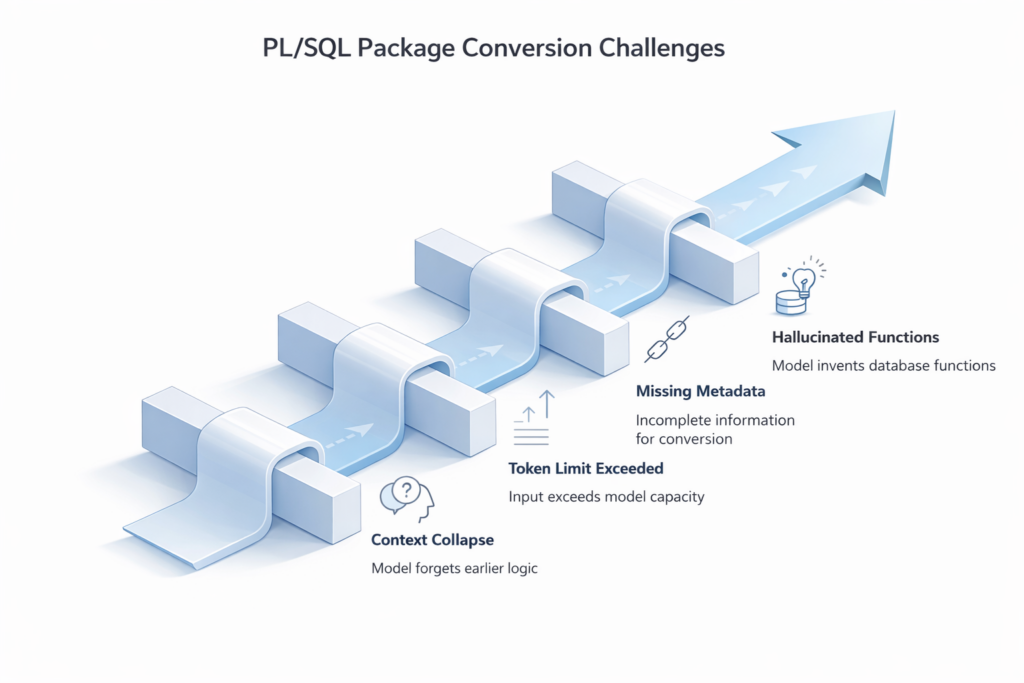
Context Collapse in Large Scripts
One of the most important concepts when working with LLMs is the context window. The context window refers to the amount of text that a model can process and remember while generating an output. When a script becomes very large, the model must maintain awareness of many different components simultaneously, including variables, procedure calls, table names, and conditional logic.
In large PL/SQL packages, the model may lose track of earlier parts of the script while generating later sections. This issue is often described as context collapse, which occurs when the model cannot maintain consistent understanding across long pieces of input text. As a result, the generated output may redefine variables incorrectly, forget earlier logic definitions, or produce inconsistent translations of the same construct.
Token Limitations
Another important concept in language models is the token. Tokens are the smaller pieces of text that models process internally. Words, punctuation marks, and parts of words are all converted into tokens before being analyzed by the model.
A large database script can consume thousands of tokens by itself. However, migration tasks usually require additional context such as table schemas, column definitions, and instructions for the target platform, which are critical in Data Management Solutions. When all this information is combined into a single prompt, the total token count may exceed the model’s capacity. In such cases, parts of the input are truncated or compressed, which can lead to missing information and incorrect code generation.
Hallucinated Database Functions
Another common issue during automated conversion is hallucination, which occurs when a model generates information that appears valid but does not actually exist. During SQL migration, this often happens when the model attempts to translate Oracle-specific constructs.
Oracle PL/SQL includes features such as:
- DECODE
- %ROWTYPE
- CURSOR
- BULK COLLECT
- FORALL
These constructs do not always have direct equivalents in Python or other systems. When the model cannot find an appropriate mapping, it may generate placeholder functions or fabricated constructs that look correct but are not supported in the target environment, creating risks in Automated Code Migration workflows.
This problem makes the generated code unreliable for production environments, especially when the migration involves critical business logic in industries like Banking , Healthcare, Telecom and Retail.
Lack of Database Awareness
Another limitation of simple prompt-based approaches is the lack of database metadata awareness. Metadata refers to structural information about the database, such as table definitions, column types, indexes, and constraints. Without this information, the model cannot accurately interpret how the script interacts with the underlying database, which is a key requirement in Database Consulting and Schema Intelligence.
For example, if a procedure updates a table column that has a specific constraint or index, the migration logic must account for those characteristics. When metadata is missing, the translation process becomes guesswork. This often results in incorrect data types, broken constraints, or inefficient query patterns.
The Agentic Design Pattern
To address these challenges, engineers are increasingly adopting the agentic design pattern. Agentic AI refers to systems where multiple autonomous or semi-autonomous agents collaborate to solve a complex problem, a growing trend in AI/ML Solutions and Digital Engineering. Each agent is responsible for a well-defined task and operates with a limited scope of responsibility.
This design allows the overall system to break a large problem into smaller components that can be solved independently. Instead of forcing one model to understand an entire migration process, the system distributes the workload across agents that specialize in metadata retrieval, logic translation, and platform optimization, aligning with modern Cloud-Native Development practices.
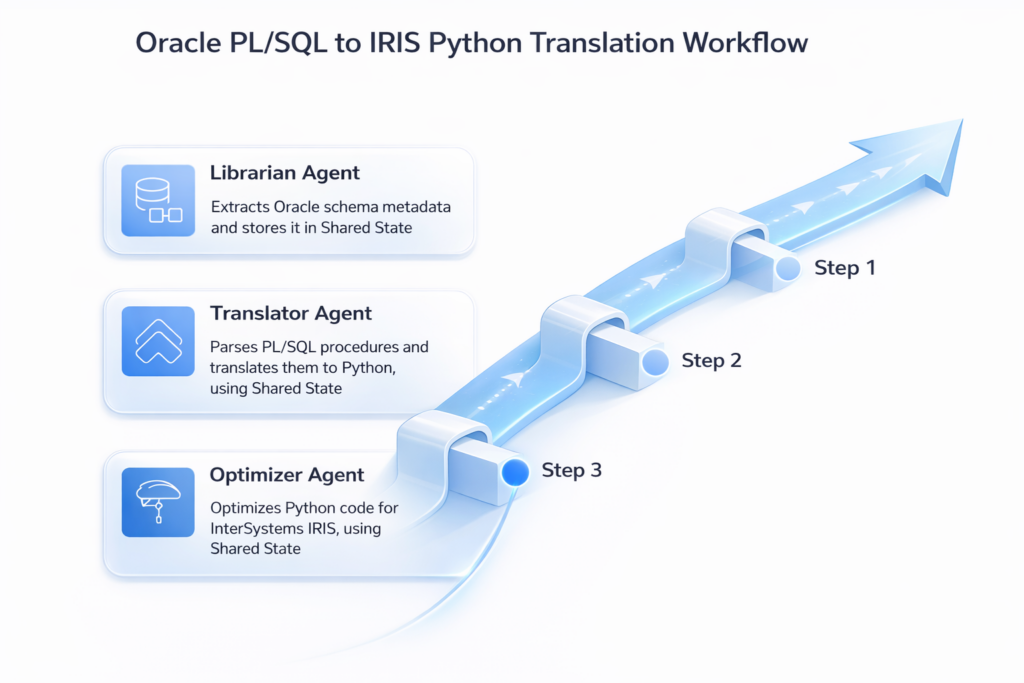
The Librarian Agent: Metadata Retrieval
The first agent in the system is the Librarian Agent, which focuses on collecting metadata from the Oracle database. Metadata simply means information that describes the structure of the data stored in the database.
The Librarian agent retrieves information such as table definitions, column data types, indexes, and primary and foreign key constraints, forming the foundation for Enterprise Data Management and Cloud Data Migration strategies.
The Translator Agent: Logic Conversion
Once the database structure is understood, the next step is to convert the procedural logic itself. This responsibility belongs to the Translator Agent, which focuses exclusively on translating Oracle PL/SQL logic into the target programming language.
Rather than processing an entire script in one step, the Translator agent operates on smaller logical components, improving accuracy in Application Modernization and Code Refactoring Services.
The Optimizer Agent: Platform-Specific Enhancements
After the logic has been translated, the resulting code often represents a generic implementation. However, the final application environment may offer platform-specific features that can significantly improve performance and maintainability.
The Optimizer Agent is responsible for adapting the translated code to take advantage of the capabilities of the target platform, which is essential for Platform Engineering Services, Performance Engineering, and Cloud Optimization.
Coordinating the Multi-Agent Workflow
The full migration workflow emerges when these agents operate in sequence, supported by orchestration frameworks that enable Workflow Automation, AI Orchestration, and DevOps Automation.
State Management and Handoffs
A common solution is to use a shared State Object that stores structured information accessible to all agents, ensuring consistency across Distributed Systems Engineering and Scalable AI Architectures.
Practical Considerations and Trade-offs
Automated migrations must include verification mechanisms such as testing, schema validation, and code reviews, which are critical components of Quality Engineering and Software Testing Services.
How ACL Is Adapting to This Trend
At ACL, the increasing complexity of enterprise software modernization has made AI-assisted engineering workflows a key area of exploration. This includes Digital Engineering, AI/ML Solutions, and Cloud Transformation initiatives across industries such as Banking, Healthcare, Telecom, and Retail.
Key Lesson Learned
One of the most important insights from building AI-assisted migration systems is that the goal should be to understand intent rather than simply convert syntax, a principle central to Cognitive AI Systems and Next-Gen Software Engineering.
Conclusion
Database migration is fundamentally a system-level challenge rather than a simple code translation task. Multi-agent architectures offer a practical solution by distributing the migration process across specialized agents, enabling scalable Enterprise Automation and AI-led Digital Transformation.
Related Insights



The Hidden Cost of Fragmented Data Architectures
Adhithya Neethiselvan

The Transpilation Deep Dive: PL/SQL to IRIS Native Python
Shubham Rathod
