



Srikanth Sharma
April 1, 2026
5 Minutes read
Mutual TLS (mTLS): Strengthening Authentication in Modern Distributed Systems
Modern digital platforms rely heavily on APIs, microservices, and connected devices. As organizations increasingly adopt distributed architectures and zero-trust security models, traditional authentication mechanisms such as API keys and tokens are proving insufficient for secure, high-trust machine-to-machine communication. Secure communication has always been a foundational requirement for distributed systems. Early internet security relied on Secure Sockets Layer (SSL), which later evolved into Transport Layer Security (TLS) to provide stronger encryption and data integrity during transmission. While TLS enables encrypted communication, it typically authenticates only the server, leaving a gap in verifying the identity of the client. Mutual TLS (mTLS) addresses this limitation by introducing bidirectional authentication, where both the client and the server verify each other’s identity using cryptographic certificates before any communication begins. As a result, mTLS has emerged as a critical security mechanism for modern platforms, particularly in API ecosystems, microservices architectures, and IoT environments. This blog explores the evolution from SSL to TLS to mTLS, the reasons behind the growing adoption of mTLS, the architectural patterns involved, the challenges in implementation, and how enterprises can leverage it to establish strong service identity and secure machine-to-machine communication.
Why Mutual TLS (mTLS)?
Mutual TLS provides stronger authentication by verifying both ends of a connection. It eliminates reliance on passwords or tokens and instead uses certificates issued by a trusted Certificate Authority (CA). This is especially useful for machine‑to‑machine communication such as microservices, APIs, and IoT devices.
TLS vs mTLS Comparison
| Feature | TLS | Mutual TLS (mTLS) | Security Impact | Typical Use Cases |
| Authentication Model | Server authenticated | Client and server authenticated | Higher trust with mutual verification | Service‑to‑service communication |
| Credential Type | Server certificate only | Certificates for both sides | Stronger cryptographic identity | Microservices, IoT |
| Client Identity | Verified at application layer | Verified during TLS handshake | Prevents unauthorized systems | B2B integrations |
| Security Level | Moderate | Very High | Protects against impersonation | Zero‑trust architectures |
| Operational Complexity | Low | Higher due to certificate lifecycle | Requires automation tools | Large distributed systems |
Market Insights of mTLS
The adoption of mTLS has increased significantly as organizations modernize their digital infrastructure. Several industry trends are driving this shift.
- Growth of API Ecosystems: Organizations expose internal capabilities through APIs for partners, mobile applications, and external services. As API traffic increases, secure authentication mechanisms become essential to prevent unauthorized access.
- Expansion of Microservices Architectures: Modern applications often consist of hundreds of loosely coupled microservices communicating over internal networks. Each service must verify the identity of the services it interacts with, making mTLS a natural solution.
- Rise of Zero-Trust Security Models: Traditional security models relied on network perimeters to protect internal systems. Today, security strategies focus on verifying every connection regardless of network location. mTLS enables strong identity verification in such environments.
- Growth of IoT Platforms: IoT ecosystems often include thousands or millions of connected devices sending telemetry data to cloud platforms. mTLS enables each device to be uniquely identified and securely authenticated.
Emerging Trends in Mutual TLS (mTLS)
- mTLS in Kubernetes and Service Mesh Architectures: In cloud-native environments, service mesh technologies automatically manage communication between microservices. These platforms often implement automatic mTLS encryption between services.
- API Gateway Security: Modern API gateways are increasingly incorporating mTLS as a built-in authentication mechanism. This allows organizations to securely expose APIs to trusted partners.
- Identity-Driven Security: Security is shifting from network-based trust to identity-based trust. Systems must prove their identity using cryptographic credentials such as certificates.
- IoT Device Authentication: IoT platforms rely heavily on certificate-based authentication to ensure that only authorized devices can connect to cloud services.
Key Trends in mTLS Implementation
While mTLS significantly strengthens security, implementing it at scale introduces several operational and technical challenges.
Certificate Lifecycle Management
Certificates must be generated, distributed, rotated, and revoked throughout their lifecycle. In large environments with thousands of services or devices, manual certificate management becomes impractical. Organizations often need automated certificate management solutions to handle this complexity.
Operational Complexity
Implementing mTLS requires changes to infrastructure, networking configurations, and service deployment pipelines. Development teams must ensure that certificates are securely stored and correctly configured across services.
Integration with Legacy Systems
Many legacy systems were not designed to support certificate-based authentication. Integrating mTLS with such systems may require architectural modifications or intermediary security layers such as API gateways.
Performance Considerations
TLS handshakes involve cryptographic operations that introduce computational overhead. Although modern hardware and optimized protocols reduce this impact, organizations must still consider performance implications when implementing mTLS at scale.
Architectural Overviews
TLS Handshake (Server Authentication Only)
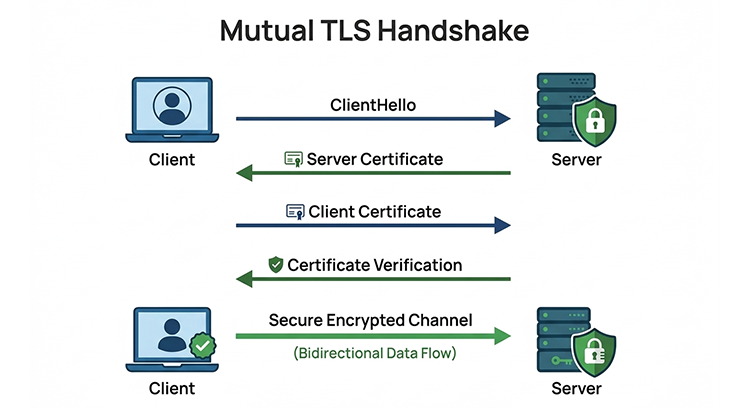
In this model, the server proves its identity, but the client is not cryptographically verified.
- Client-Hello Initiation: The client initiates the connection by sending a ClientHello message to the server. This message includes supported TLS versions, cipher suites, and a random value used later in key generation.
- Server Identity Verification: The server responds with its Server Certificate, which contains the server’s public key and is issued by a trusted Certificate Authority (CA). The client verifies this certificate to confirm the server’s identity.
- Session Key Exchange: After validating the certificate, the client generates a session key and securely shares the key material using the server’s public key. This process ensures that only the server can decrypt it.
- Secure Channel Establishment: Both the client and server derive the same symmetric session keys from the exchanged information. These keys are used for encrypting all further communication.
- Encrypted Communication Begins: Once the handshake completes, a secure encrypted connection is established, allowing data to be transmitted confidentially and with integrity.
- One-Way Authentication: In this model, only the server is authenticated. The client does not present a certificate, which is why this is commonly used for standard web browsing (HTTPS).
Mutual TLS Handshake
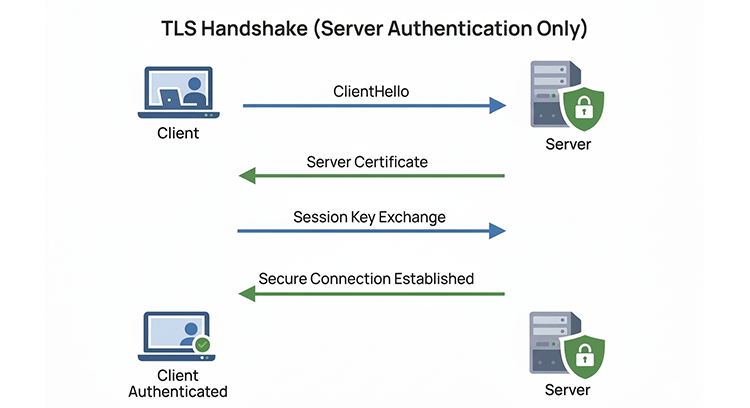
In this model, both the client and the server verify each other’s certificates before establishing the secure connection.
- Connection Initiation (ClientHello): The client starts the TLS handshake by sending a ClientHello message to the server, specifying supported TLS versions, encryption algorithms, and other security parameters.
- Server Authentication: The server responds with its Server Certificate, which the client validates using trusted Certificate Authorities (CAs) to confirm the server’s identity.
- Client Authentication: Unlike standard TLS, the client also sends its Client Certificate to the server. This allows the server to verify the identity of the client.
- Certificate Verification: The server validates the client’s certificate against its trusted CA store to ensure the client is authorized to connect.
- Mutual Trust Establishment: Since both sides verify each other’s certificates, both the client and server identities are authenticated, establishing strong trust between the two parties.
- Secure Encrypted Channel Established: Once verification is successful, the handshake completes and an encrypted communication channel is established using symmetric session keys.
- Common Use Cases: Mutual TLS is commonly used in API security, microservices communication, IoT device authentication, and zero-trust architectures, where machine-to-machine authentication is critical.
API Gateway + mTLS Architecture
In this architecture, the API Gateway serves as the primary security control point for the entire system. It acts as a gatekeeper that enforces strict identity verification before traffic can penetrate the internal network.
- Client to Gateway (mTLS): The client application must establish an mTLS connection with the API Gateway.
- Certificate Validation: The Gateway validates the client’s digital certificate to ensure the requester is authorized before allowing the request to proceed to any backend services.
- Internal Routing: Once the identity is verified, the Gateway routes the traffic to the Microservices Cluster, which typically consists of services like the Order Service, Payment Service, and Inventory Service.
- Service-to-Service Security: Within the cluster, mTLS or Service Identity may be used to continue ensuring secure communication between individual microservices.
Why use an API Gateway for mTLS?
- Centralized Security: It ensures that only cryptographically authorized systems can invoke your APIs.
- Simplified Management: It simplifies certificate management for backend services because the Gateway handles the initial heavy lifting of client verification.
- Zero-Trust Foundation: This setup supports a zero-trust model by verifying every connection at the edge of your service environment.
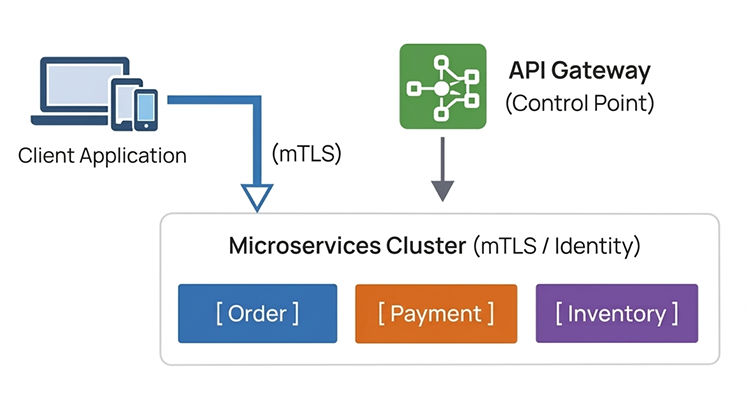
The API Gateway acts as the security control point, validating client certificates before requests reach backend services.
IoT Platform mTLS Architecture
In IoT environments, mTLS is the gold standard for securing massive fleets of devices. This architecture ensures that every piece of hardware is cryptographically unique and verified before it can transmit sensitive telemetry data.
- IoT Device (with Cert): Each device is provisioned with a unique X.509 digital certificate during the manufacturing or onboarding stage. This certificate acts as the device’s immutable identity.
- IoT Gateway / IoT Core: This component serves as the entry point. When a device attempts to connect, the Gateway performs a mutual TLS handshake, verifying the device’s certificate against a trusted Certificate Authority (CA).
- IoT Platform Services: Once the identity is verified, the data is securely routed to the platform’s backend services:
- Device Registry: Manages the lifecycle and metadata of all authorized devices.
- Data Processing: Ingests and transforms incoming telemetry.
- Analytics Platform: Derives insights and patterns from the processed data.
Key Benefits for IoT
- Uniqueness at Scale: Enables thousands or millions of devices to be uniquely identified without managing passwords for each one.
- Zero-Trust Connectivity: Verifies every device connection, ensuring only authorized hardware can interact with the cloud.
- Secure Provisioning: By issuing certificates during provisioning, organizations ensure that a device’s identity is baked in from day one.
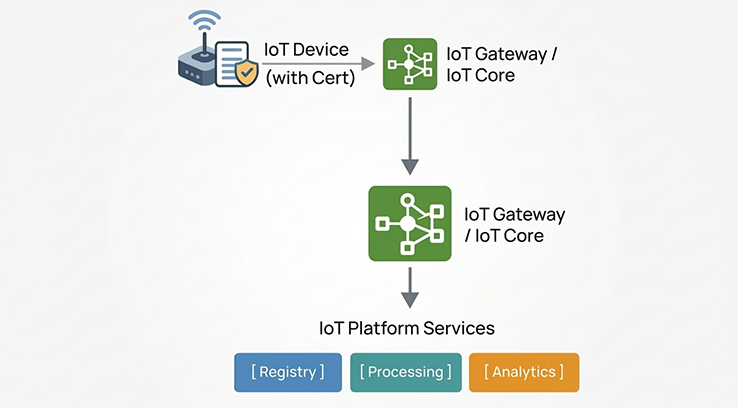
Each device is issued a unique certificate during provisioning to verify identity before data transmission.
Use Case: Securing Microservices Communication
Microservices architectures involve numerous services communicating frequently with each other through internal APIs. While these communications often occur within internal networks, relying solely on network isolation is no longer considered secure.
Without strong authentication mechanisms, malicious actors who gain access to the internal network may attempt to impersonate services or intercept sensitive data.
mTLS provides a robust solution by ensuring that every service must present a valid certificate before communication is allowed.
Challenges
- Service Identity Verification: In large microservices environments, identifying which service is making a request becomes difficult without strong identity mechanisms.
- Secret Management Complexity: Using API keys or shared tokens across many services increases the risk of credential leakage and complicates credential rotation.
- Unauthorized Service Communication: Without strict authentication controls, unauthorized services may attempt to interact with sensitive systems.
Solution
By implementing mTLS, organizations establish a certificate-based identity for each service.
A trusted Certificate Authority issues certificates to each service during deployment. When services communicate, both sides validate each other’s certificates before exchanging data. Only services with valid certificates are allowed to participate in communication.
This approach ensures that service interactions are authenticated, encrypted, and auditable.
Benefits
- Strong Service Identity: Each service has a unique certificate that cryptographically proves its identity.
- End-to-End Encryption: All communication between services is encrypted, protecting sensitive data in transit.
- Reduced Credential Exposure: Unlike API keys or tokens, certificates eliminate the need for shared secrets.
- Zero-Trust Security Enablement: Every communication request is verified, even inside internal networks.
As organizations continue to adopt cloud-native architectures, APIs, and connected device ecosystems, securing communication between systems becomes increasingly complex. Traditional authentication methods such as API keys and tokens are insufficient for establishing strong machine identities in highly distributed environments.
Mutual TLS provides a powerful solution by combining encryption with bidirectional authentication, ensuring that both communicating entities are trusted before data exchange occurs.
By implementing mTLS and automating certificate lifecycle management, organizations can significantly enhance the security of their APIs, microservices, and IoT platforms while supporting modern zero-trust security architectures.