



Kashyapi Mistry
April 2, 2026
5 Minutes read
Prompt vs Semantic Caching: How Modern AI Systems Avoid Recomputing Everything
As large language models move from experimentation into production systems, the cost of repeatedly processing the same context or answering similar queries becomes significant. In enterprise AI applications such as support assistants, document analysis systems, and AI copilots, repeated inference can dramatically increase latency and API costs.
Caching strategies are therefore becoming a core architectural component in modern AI systems.
Prompt Caching avoids repeated processing of identical context structures, whereas Semantic Caching avoids repeated reasoning for similar user intent.
While both approaches aim to improve speed and cost efficiency, they address fundamentally different challenges within the system architecture. The following sections provide a detailed comparison of prompt caching and semantic caching across their definitions, matching logic, use cases, performance impact, and operational complexity.
Core Definition: What is being stored?
The most fundamental difference lies in what the system actually stores for reuse.
Prompt Caching
This method stores the processed tokens or the prompt prefix itself. It allows the model to reuse the work it already performed to interpret a specific block of text at the beginning of a request.
Semantic Caching
Instead of storing tokens, this method caches the meaning of queries and their corresponding responses using vector embeddings. It stores past query–response pairs so they can be reused when a new question has the same underlying intent.
Matching Mechanism: How is a "hit" identified?
The logic used to detect a cache hit is significantly different in both approaches.
Prompt Caching
It relies on exact or prefix matching. If the first 5,000 tokens of a prompt are identical to a previous request, the system identifies the match and retrieves the processed state from the cache.
Semantic Caching
This approach uses embedding-based similarity search. Since it evaluates meaning rather than exact wording, it can detect matches even when phrasing differs. For example, it can recognize that “How do I reset my password?” and “I forgot my login, what should I do?” represent the same intent. Advanced systems may also use a QuerySignature, which decomposes a query into structured components such as category, metrics, and filters to improve matching precision.
Ideal Use Cases: When should you use which?
The choice depends on the structure of your AI workflow.
Prompt Caching
Best suited for long-context scenarios where a large and relatively fixed block of information is reused repeatedly. Examples include summarizing a lengthy document across multiple interactions or maintaining multi-turn conversations with stable system instructions.
Semantic Caching
More suitable for high-volume environments where users ask similar questions in different ways. It works well for customer support chatbots, knowledge base systems, and RAG pipelines where query phrasing varies but intent remains consistent.
Performance and Cost Impact
Both strategies deliver measurable efficiency gains, but they optimize different layers of computation.
Prompt Caching
- Latency: Reduces the cost of reprocessing long contexts, leading to faster time-to-first-token.
- Cost: Allows heavy context computation to be performed once and reused, reducing repeated inference overhead.
Semantic Caching
- Latency: In certain workloads, semantic caching can significantly reduce response latency because the system may bypass the LLM entirely and return a stored response.
- Cost: Can reduce API and LLM usage costs by eliminating redundant model calls, in some cases by as much as 90 percent.
Technical Complexity and Maintenance
The engineering effort required for each approach differs considerably.
Prompt Caching
Generally simpler to implement. Many major AI providers such as Anthropic and OpenAI provide built-in or prefix-based mechanisms to enable it. Cache invalidation typically occurs automatically when context changes or when a short time-to-live expires.
Semantic Caching
More complex to design and maintain. It requires a vector database such as Redis to store embeddings and perform similarity search. It also demands monitoring for embedding drift or model upgrades that may affect similarity accuracy. Additionally, teams must define appropriate similarity thresholds to determine when a cached response is sufficiently close to return.
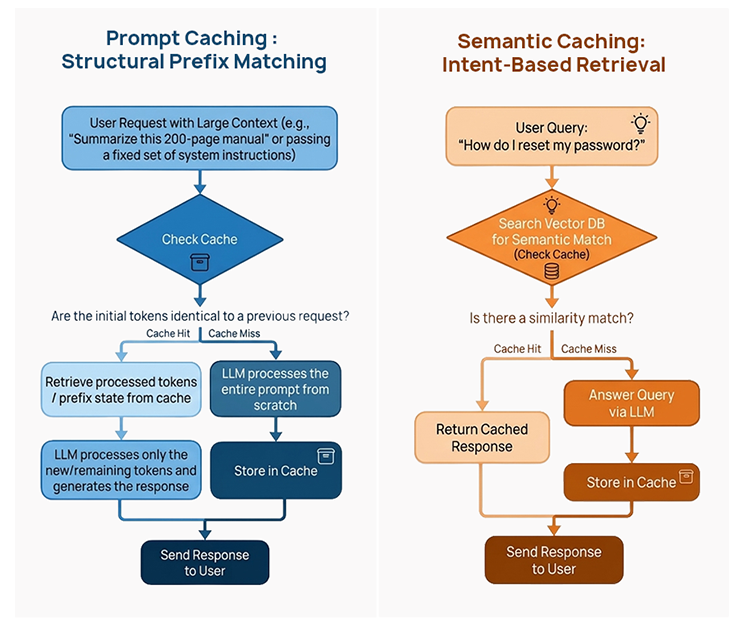
Visualizing the Workflows
Before comparing these approaches side-by-side, it is helpful to see exactly how a user request flows through each system. As shown below, the routing logic fundamentally changes depending on whether the system is checking for exact structural context or evaluating semantic meaning.
Comparison Summary Table
| Feature | Prompt / Context Caching | Semantic Caching |
| What is cached | The actual prompt prefix/processed tokens | The meaning of queries/responses via embeddings |
| Matching Logic | Exact/prefix matching | Similarity search or “QuerySignature” decomposition |
| Best For | Large, fixed contexts (e.g., a 200-page manual) | Repetitive queries with different phrasing |
| Primary Benefit | Faster processing of long instructions | Bypassing the LLM entirely for known answers |
| Complexity | Low; often managed by the model provider | High; requires vector search and similarity tuning |
| Latency Gap | Reduces time-to-first-token | Can be 2.5x to 15x faster than a fresh call |
The "Double Caching" Strategy
For enterprise-grade systems, the most effective solution is often a hybrid approach. Prompt caching can handle large, static background context such as internal knowledge bases, while semantic caching manages the different ways users ask about that information. Together, they optimize both structural redundancy and semantic variation.
Conclusion
Prompt caching and semantic caching address different layers of inefficiency in modern AI systems. While prompt caching optimizes repeated processing of large, stable contexts, semantic caching reduces redundant reasoning by reusing responses for similar user intent.
As AI applications scale in production, combining these approaches becomes increasingly important. A hybrid strategy enables systems to optimize both context reuse and intent reuse, resulting in lower latency, reduced costs, and improved overall performance.
In this evolving landscape, caching is no longer just an optimization technique—it is a foundational design principle for building efficient, scalable, and intelligent AI systems.