



ACL Digital
January 16, 2026
5 Minutes read
Future-Ready Enterprises: How Salesforce Implementation Services Enable Scalable CRM System
In the past decade, Salesforce has grown from a simple CRM tool into a platform that touches nearly every part of a modern business. Whether it’s sales forecasting, customer engagement, marketing journeys, service operations, or partner management, Salesforce now sits at the center of many digital strategies.
But buying Salesforce licenses is the easy part. Making the platform actually work for your teams, your data, and your business goals—that’s where many organizations struggle. This is why Salesforce implementation services exist. They help companies turn the platform into a system that is usable, reliable, and aligned with the way the business truly operates.
If you are exploring Salesforce for the first time, or planning to rebuild an existing setup, this guide will walk you through what implementation services include, how the planning phase influences success, and what a complete implementation journey looks like. It also explains the collaboration between consultants and technical teams, the challenges most companies face, and the qualities you should look for in an implementation partner.
What Salesforce Implementation Services Really Include
Salesforce implementation is often misunderstood as “setting up the CRM.” In reality, it’s a much broader, more strategic process. It starts long before someone clicks a button inside Salesforce and continues long after the system goes live.
At the heart of every implementation is a deep look at how the business runs today. Teams map out every step—how leads are generated, how service queries move across departments, how approvals work, which tools feed customer information, and where the current gaps are. This assessment becomes the foundation for the entire implementation.
Once this understanding is clear, the actual system work begins. Salesforce is configured to match the organization’s structure, roles, and workflows. Sometimes it requires simple adjustments like custom fields or automated reminders; other times, it involves complex logic, custom apps, or industry-specific workflows.
Then comes data—possibly the most sensitive and time-consuming part. Data from older CRMs, ERPs, spreadsheets, email systems, or homegrown tools must be cleaned, validated, and migrated. One wrong step and your reports, dashboards, and automation rules can all fall apart.
Integrations follow. Salesforce rarely stands alone. It needs to exchange information with marketing platforms, finance systems, collaboration tools, or internal databases. Implementation teams build these integrations so that information flows smoothly throughout the business.
Of course, none of this matters unless people use the system. That’s why training and change management are essential elements of implementation services. Whether it’s a sales rep logging activities or a support manager checking weekly reports, every user needs to feel confident navigating the system.
And even after everything is launched, support continues—tweaks, enhancements, and improvements become part of the journey as teams adopt new habits and new business needs emerge.
In short, implementation services are about far more than technology. They shape the way your teams work every day.
Why Thoughtful Planning Matters So Much
If there’s one thing that determines how successful a Salesforce project will be, it’s the quality of planning done upfront. Many organizations rush into configuration, assuming they’ll figure things out along the way. But this usually leads to rework, confusion, and costs that spiral beyond expectations.
Planning gives you clarity. It helps answer foundational questions:
- What do different teams want from Salesforce?
- What pain points must the new system eliminate?
- Which business outcomes matter most over the next 12 to 24 months?
- What should be built now, and what should wait?
A good plan prevents over-customization and keeps the project rooted in actual priorities instead of wish-lists. It also ensures your data model and integrations are designed with the future in mind, not just the immediate rollout.
Planning also impacts how people adopt the system. When users understand the purpose of each feature and see that the system reflects their daily routines, they are far more likely to embrace it. Without planning, Salesforce can quickly become an overwhelming collection of screens and buttons.
The planning phase might look like a few workshops or interviews, but it’s actually the moment where the overall direction of the project gets locked in. A clear plan saves time, reduces cost, and avoids frustration later.
The Stages of a Successful Salesforce Implementation
Although every company has different needs, most Salesforce implementations follow a similar journey. The steps below give a realistic picture—not a textbook version—of how the process usually unfolds.
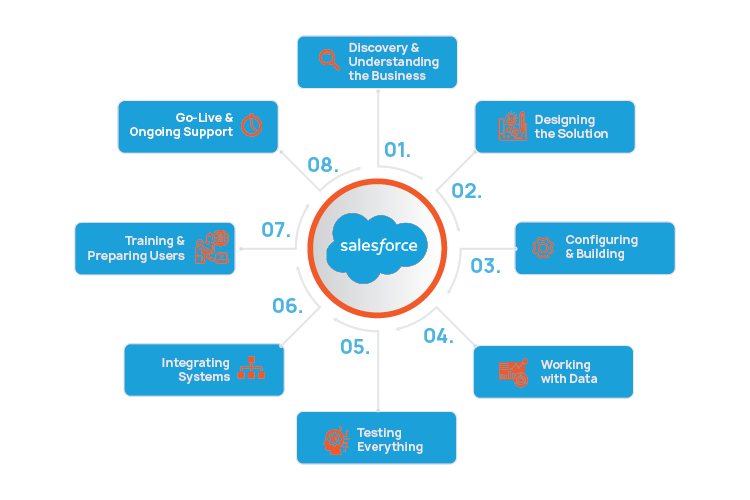
1. Discovery and Understanding the Business
This stage is where project teams sit with stakeholders to understand their current operations. It’s informal but thorough. People talk honestly about what slows them down, what information they lack, which reports they trust, and what they wish existed in their daily workflow.
By the end of discovery, both the company and the implementation team have a shared view of what Salesforce must deliver.
2. Designing the Solution
Here, architects take everything gathered during discovery and translate it into a system blueprint. They decide what goes into standard Salesforce features, what needs customization, how objects relate to each other, and what the long-term structure should look like.
A well-designed solution prevents future complications as the business evolves.
3. Configuring and Building
This is the hands-on engineering phase. Fields, objects, automations, email templates, approval flows, dashboards—everything is built to mirror the real business workflows. If needed, developers create custom components or integrations.
The focus here is practicality, not complexity. A clean, simple setup always performs better than an unnecessarily customized one.
4. Working with Data
Data migration can make or break the entire project. During this stage, teams identify which data is useful, which is outdated, and which must be cleaned. They map fields, remove duplicates, fix inconsistencies, and run test migrations to make sure nothing breaks downstream.
Clean data leads to better reporting and stronger adoption.
5. Integrating Systems
Salesforce becomes the hub for customer activity only when it is connected to the rest of the business. Integration ensures information flows automatically, so teams don’t waste time switching between systems.
6. Testing Everything
Before going live, users get to test the system in a controlled environment. They verify whether workflows make sense, automation triggers correctly, and integrations behave as expected. Testing reduces surprises during launch.
7. Training and Preparing Users
Training is much more than showing people where buttons are. It’s about helping them understand how Salesforce fits into their role. If teams feel comfortable, adoption becomes natural.
8. Go-Live and Ongoing Support
Once everything is stable, the system goes live. The first few weeks are the “adaptation period,” where questions arise and minor adjustments are made. Over time, teams discover new improvements, and the system continues to evolve.
Why Businesses Benefit from Professional Implementation
Many companies start their Salesforce journey with enthusiasm but underestimate the level of detail required to set it up correctly. Professional implementation changes this experience entirely.
For one, expert teams know which features work well for different industries. They’ve seen similar challenges across other organizations, which means they can guide you away from pitfalls early. They also help create efficient workflows—simple processes that reduce manual work and increase productivity.
Another significant advantage is the accuracy of reporting. With a proper data model and clean migration, leaders gain trustworthy dashboards that support better decisions. Instead of guessing, teams can see exactly where deals get stuck, where service requests pile up, or which marketing channels drive the best leads.
A professional implementation also sets up Salesforce to scale. As the business grows, adds new services, or expands to new regions, the system can adapt without major disruption. Companies avoid the heavy cost of re-engineering later.
And perhaps the most underrated benefit is stability. When Salesforce is configured properly, employees don’t face broken automation, confusing layouts, or inconsistent data. The system becomes reliable and predictable—something that people actually enjoy using.
How Consulting and Implementation Work Together
Many organizations assume that Salesforce consulting and Salesforce implementation are separate categories of work. But in practice, they are two parts of a single, continuous process.
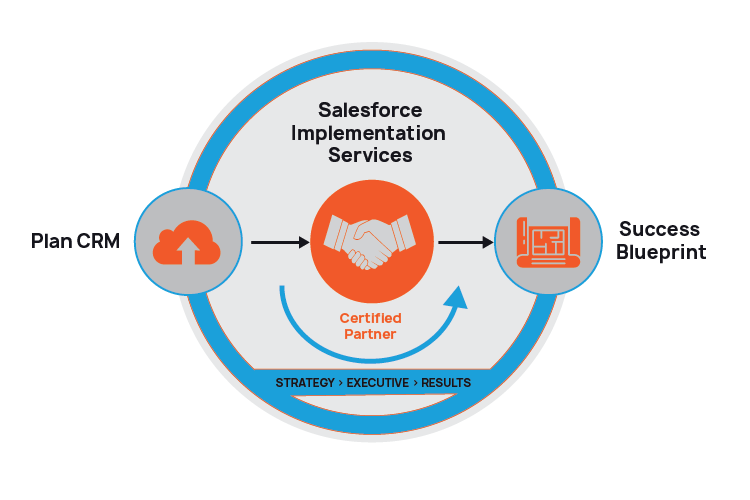
Consulting focuses on interpretation—understanding the business and translating those needs into a plan. Consultants help shape the roadmap, define priorities, evaluate risks, and outline the structure of the solution. Implementation is the execution stage—building what was envisioned during consulting. It involves configuring features, writing code, setting up integrations, migrating data, and preparing users. When these two groups collaborate closely, the project stays aligned with business goals. When they don’t, implementations often drift into unnecessary complexity or misaligned features.
Good partners blend consulting and implementation naturally, ensuring the final system feels purposeful rather than pieced together.
Typical Challenges and How to Steer Clear of Them
No Salesforce implementation is completely free of challenges. The key is not to avoid them but to manage them early.
- One common problem is incomplete requirements. When teams are unsure about what they want, the system ends up with gaps or mismatches. Spending quality time in discovery solves this.
- Data issues are another major challenge. Bad data follows you into Salesforce unless it’s cleaned. Taking the time to prepare data before migration saves countless hours later.
- Over-customization is also risky. Businesses sometimes build too many special workflows that only a few people understand. When the team changes, the system becomes difficult to maintain. Choosing simplicity over complexity ensures long-term stability.
- User adoption can also drop if the system feels unintuitive. Including users in testing and giving them practical training significantly improves engagement.
- Integration challenges arise when companies underestimate how interconnected their systems are. A clear integration plan early in the project prevents delays.
By recognizing these issues upfront, companies can run smoother implementations and avoid setbacks.
How to Choose the Right Salesforce Implementation Partner
Picking the right partner is one of the most important decisions in the entire journey. A strong implementation partner brings structure, clarity, and long-term support.
Look for a team that listens more than they pitch. Salesforce Partners who ask detailed questions about your workflows, challenges, and priorities tend to build better systems.
Experience also matters—not just general Salesforce experience, but experience in your industry. A partner who understands your domain can guide you more effectively.
Transparency is equally important. You want a partner who provides realistic timelines, explains trade-offs, and communicates openly throughout the project.
Finally, look for a team that stays with you beyond go-live. Salesforce evolves quickly, and your system must evolve with it. A long-term partner ensures your implementation keeps improving over time.
Conclusion
Implementing Salesforce is not a plug-and-play activity. It’s a transformation that touches processes, people, and data across the organization. With the right planning, a structured approach, and a capable implementation partner, Salesforce becomes a powerful engine for growth and customer engagement.
A thoughtful implementation gives teams a unified view of customers, smoother workflows, and the confidence to make decisions based on real insights. And as the business evolves, Salesforce continues to evolve with it.
If you’re preparing to adopt Salesforce or re-build your existing setup, approaching the implementation with clarity and expert guidance will ensure you unlock the full value of the platform—both now and in the years ahead. For more information, get in touch with our salesforce experts at business@acldigital.com
Related Insights