



Aditi Himpalnerkar
April 9, 2026
5 Minutes read
The Schema Bridge: Automating Context Discovery
The Blind Spot in AI Code Generation
In the current hype surrounding Large Language Models (LLMs), there is a persistent misconception: that an AI can simply “read” a snippet of legacy code and output a perfect modernization. While this may work for generic algorithms, it fails spectacularly when applied to mission-critical database logic in the Information Technology and Enterprise Software industry.
Why? Because database code is fundamentally anchored in its environment. A PL/SQL procedure is not a standalone island; it is the tip of an iceberg resting on a massive, invisible foundation of metadata. If an AI does not understand the constraints, indexes, primary keys,
and sequences that the code interacts with, the resulting migration may be syntactically
correct but operationally broken, highlighting a major gap in
AI-driven Database Migration and Legacy Modernization services.
This article explores the Schema Bridge, a critical infrastructure component in Generative AI and Intelligent Automation solutions, designed to provide AI with a “god’s-eye view” of the database environment through automated context discovery.
1. The Metadata Gap: The Difference Between Code and Context
Standard AI, no matter how advanced, suffers from a critical “Metadata Gap.” It can interpret the text of a procedure, but it cannot inherently understand the schema—posing challenges for Data Engineering and Enterprise AI Solutions across industries like Banking, Financial Services, and Healthcare Technology.
Consider a simple INSERT statement for an employee table:
INSERT INTO employees (name, dept) VALUES (p_name, p_dept);
An AI without context assumes this is a straightforward string insertion. However, in an actual Oracle database, the EMP_ID column is a Primary Key governed by a specific sequence (EMP_SEQ.NEXTVAL), and the dept field may have a Foreign Key constraint tied to a department table.
If the migrated Python script does not account for sequence logic in the target environment, or attempts to insert values that violate constraints, the migration fails at the very first execution. The “Metadata Gap” turns a simple migration into a debugging nightmare—one of the most common pitfalls in AI-powered Data Migration and Automation services.
2. Implementation: The Introspection Engine
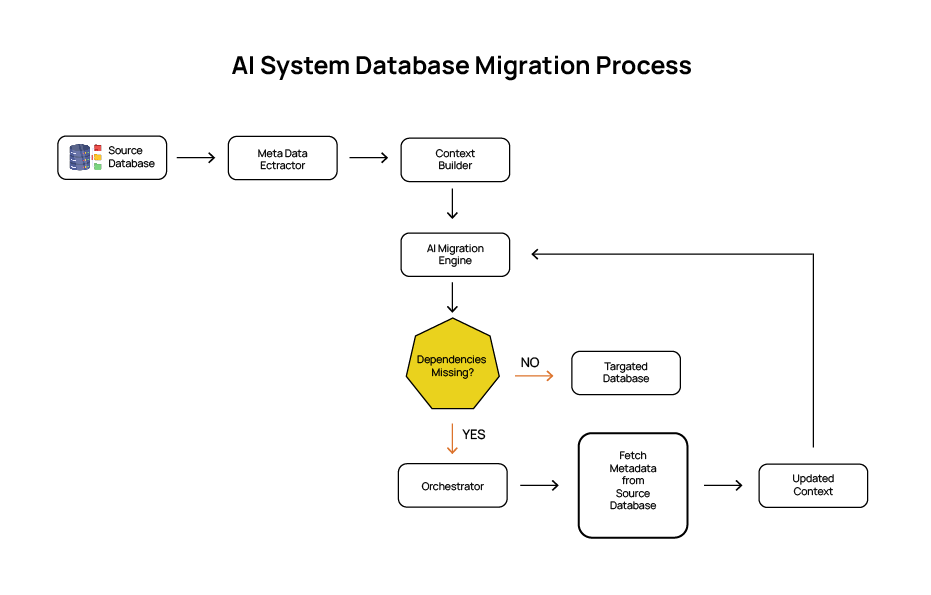
To bridge this gap, a dedicated Introspection Engine is introduced. Rather than acting as a simple parser, this component functions as a dynamic bridge between source and target database environments—forming the backbone of Generative AI-based Database Modernization solutions.
The Oracle Side: Deep Extraction
On the Oracle side, the engine queries system tables such as USER_TAB_COLUMNS, USER_CONSTRAINTS, and USER_DEPENDENCIES. It doesn’t just look at column names; it extracts the “hidden” logic. —identifying sequences, dependencies, and triggers that may silently influence data. This deep extraction is crucial in Data Analytics and Enterprise Software environments.
The IRIS Side: Structural Mapping
The engine maps these findings to InterSystems IRIS equivalents. It identifies IRIS class structures and table mappings to ensure that generated Python code aligns with native naming conventions and storage schemas—enhancing accuracy in AI-led Data Engineering workflows.
Dynamic Prompting: The Live Conversation
One of the most powerful features is Dynamic Prompting, a key capability in Generative AI services. During the migration phase, if the AI agent encounters an ambiguous column in the PL/SQL, perhaps a variable named v_status whose type isn’t defined in the script, it doesn’t guess. The agent queries the Introspection Engine in real-time.
Example Interaction:
- AI Agent: “I’m migrating a procedure referencing SALARY_TABLE.COMM_PCT. I need the exact precision and nullable status.I need precision and nullability.”
- Introspection Engine: “Checking Oracle metadata… SALARY_TABLE.COMM_PCT is NUMBER(5,2), non-nullable, default 0.00.”
- AI Agent: “Understood. Adjusting Python logic to use decimal.Decimal with two-point precision.”
3. Handling Data Type Friction: Mapping the Mismatches
Another key benefit of the Schema Bridge is enabling deterministic data type mapping, which is essential for AI-driven Data Transformation and Migration services in industries like BFSI and Healthcare Technology.
| Oracle Type | Python / IRIS Mapping | The Migration Challenge |
| NUMBER(10,2) | decimal.Decimal | Precision: Standard floating-point numbers in Python can introduce binary rounding errors (e.g., 0.1 + 0.2 != 0.3). We map to Decimal to ensure financial accuracy. |
| RAW(16) | bytes or uuid | Format: Ensuring the hex-string compatibility between Oracle’s byte storage and Python’s UUID management without corrupting the data during the transfer. |
| CLOB | iris.sql.exec / Stream | Memory: Large text blocks cannot be handled as simple strings. We utilize IRIS internal streams to manage memory efficiently when processing multi-megabyte text fields. |
4. Key Lesson Learned: Prune the Context
When designing systems like the Schema Bridge, an easy mistake is assuming that providing the AI with as much context as possible will improve accuracy. One common approach is to send the entire database schema to the model, under the assumption that more information leads to better reasoning.
Providing an entire database schema creates a “needle in a haystack” problem. The model must sift through irrelevant metadata, increasing token usage and reducing precision—impacting efficiency in Intelligent Automation solutions.
A better approach is implementing a Dependency Crawler, a key component in AI-powered Data Engineering services, which intelligently narrows context:
Process:
- Analyze the PL/SQL script to identify referenced tables
- Detect directly used database objects
- Recursively discover dependencies (views, sequences, constraints)
- Provide only relevant metadata to the AI agent
- This focused approach improves both efficiency and accuracy, critical for Database Modernization in Enterprise Software environments.
Result:
Empirical evaluation shows a 35% improvement in successful migration execution rates, along with reduced token consumption, demonstrating the effectiveness of Generative AI-driven optimization strategies.
In AI systems, “perfect context” is far more powerful than “infinite context.”
Conclusion
Automating legacy database modernization requires more than code translation; it requires contextual intelligence powered by AI, Generative AI, and Intelligent Automation services.
By combining an Introspection Engine for metadata discovery with a Dependency Crawler for context optimization, the Schema Bridge enables AI systems to generate environment-aware, production-ready code, making it highly relevant across Information Technology, BFSI, Healthcare Technology, and Enterprise Software industries.
At ACL Digital, this approach ensures that database migration is not just syntactically correct, but architecturally reliable from day one, positioning it as a leader in AI-driven Digital Transformation services.