



ACL Digital
February 10, 2026
5 Minutes read
AIOps: Redefining Modern IT Operations with Predictive Intelligence
For years, IT operations teams have worked in a familiar loop. Something breaks. Alerts start firing. Teams scramble to identify the issue, fix it, and move on—hoping the same problem doesn’t return. That approach worked when systems were simpler. It no longer does.
Today’s IT environments are spread across cloud platforms, applications, microservices, networks, and third-party tools. A single business service might depend on hundreds of components running in parallel. In this reality, reacting after a failure is expensive, slow, and risky. This is where AIOps is quietly changing how IT operations function.
What AIOps Really Means (Without the Hype)
AIOps stands for Artificial Intelligence for IT Operations. At its core, it’s about using machine learning and analytics to make sense of massive volumes of operational data.

Instead of teams manually watching dashboards or chasing alerts, AIOps platforms continuously:
- Collect data from systems, applications, and infrastructure
- Identify patterns that humans usually miss
- Detect anomalies early
- Predict issues before they impact users
- Trigger corrective actions where possible
In simple terms, AIOps helps IT teams move from reacting to problems to preventing them.
Think of it as an always-on assistant that watches your environment, learns how it behaves, and flags what truly matters—without getting tired or overwhelmed.
Why Traditional IT Operations Are Struggling
Modern IT environments are not just larger. They’re more fragmented. Most organizations today deal with:
- Hundreds of cloud services
- Hybrid and multi-cloud setups
- Continuous deployments
- Always-on digital customer experiences
Manual monitoring simply doesn’t scale in this scenario. Teams are flooded with alerts, many of which are symptoms rather than root causes. This leads to alert fatigue, slower response times, and missed early warning signs.
The business impact is real. Unplanned outages affect revenue, customer trust, and brand reputation. Over time, IT teams end up spending more effort on firefighting than on improving systems.
The Role of Observability in AIOps
AIOps does not work in isolation. It depends heavily on observability. Observability is about understanding what’s happening inside a system by analyzing logs, metrics, traces, and events together. While monitoring tells you something is wrong, observability helps you understand why.
When observability data feeds into AIOps platforms, IT teams gain a clear, continuous understanding of their environment. They can see how systems behave under normal operating conditions, understand how changes in code, infrastructure, or traffic affect performance, and quickly identify where issues originate when something goes wrong—without relying on guesswork or manual correlation. This combination allows teams to shift from guesswork to insight-driven decisions.
The Observability Lifecycle in Action
Modern IT operations don’t move in straight lines. Systems are built, tested, deployed, run, and improved continuously—often all at the same time. Observability brings visibility across this entire lifecycle, helping teams understand what’s happening as changes are introduced and workloads evolve.
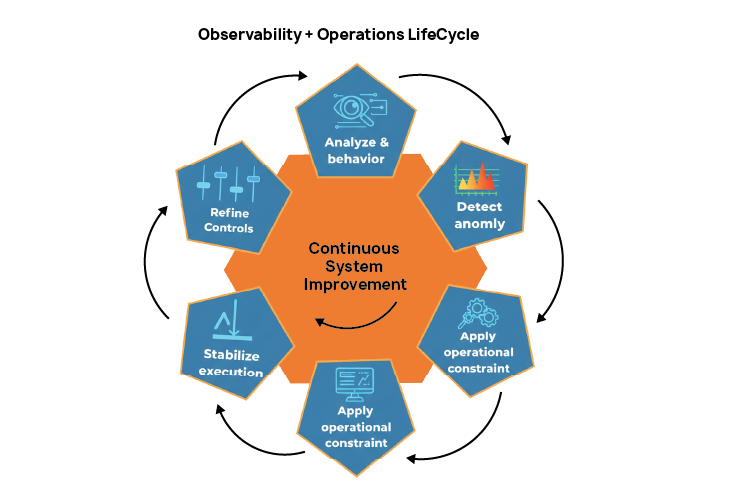
When AIOps sits on top of this visibility, the focus shifts from simply noticing issues to anticipating them. Abnormal behavior can be spotted during deployment or early runtime, long before it turns into a customer-facing problem. The result is faster detection, smaller impact zones, and far fewer surprises in production.
How AIOps Works in Real Environments
In practice, AIOps platforms focus on a few critical capabilities.
First is anomaly detection. The system learns what “normal” looks like and flags deviations automatically.
Next comes root cause analysis. Rather than presenting dozens of alerts, AIOps correlates signals to highlight the most likely source of the problem.
Predictive insights follow. Over time, the system identifies trends that indicate future risk—such as capacity constraints or recurring performance degradation.
Finally, automation closes the loop. In mature setups, predefined actions can be triggered automatically to resolve known issues, reducing manual intervention.
Moving from Observability to Automation
Visibility alone is not enough. The real value of AIOps appears when insights turn into action. This is where automation plays a key role. Repetitive tasks like restarting services, scaling resources, or routing alerts can be handled automatically. This reduces mean time to detect and resolve issues while freeing IT teams to focus on higher-value work. Over time, operations become more stable, predictable, and efficient.
Business Impact beyond IT
AIOps is not just an IT improvement initiative. Its impact reaches the business.
Organizations adopting AIOps often see:
- Improved system reliability
- Faster incident resolution
- Lower operational costs
- Better use of engineering talent
Most importantly, customer experience improves. Issues are addressed before users notice them. Digital services remain consistent, even during peak usage or rapid change.
Customer Experience: Reactive vs Predictive IT
In traditional setups, customers are often the first to report issues. Long resolution times then follow.
With AIOps-driven operations, potential issues are detected early. Teams act before customers are affected. The result is fewer disruptions and smoother digital journeys.
This shift from reactive to predictive operations directly supports business growth in digital-first environments.
AIOps Trends Shaping the Next Few Years
Industry adoption of AIOps continues to accelerate. Analyst reports suggest that AI-driven observability will become standard practice across enterprises in the coming years.
Key trends include:
- Deeper integration between observability and automation
- Increased focus on business impact metrics
- More autonomous operational workflows
As systems grow more complex, manual approaches will continue to fall behind.
How ACL Digital Helps Organizations Modernize IT Operations
ACL Digital supports enterprises in building AI-driven, resilient IT operations by combining deep engineering expertise with practical AIOps and observability practices.
ACL Digital brings decades of experience across digital and systems engineering, helping organizations move from fragmented monitoring to predictive, insight-led operations.
By aligning observability, automation, and AI, ACL Digital enables IT teams to reduce operational noise, improve system reliability, and support business-critical digital experiences.
Final Thoughts
IT operations are no longer just about keeping systems running. They play a direct role in customer satisfaction, revenue protection, and business agility. AIOps provides a clear path forward—one where issues are anticipated rather than reacted to, and where IT teams spend less time firefighting and more time improving systems.
For organizations navigating growing complexity, the shift to AIOps is not just an upgrade. It’s a necessary evolution.