



ACL Digital
February 11, 2026
5 Minutes read
India’s GCC Talent Evolution Defining the Global Workforce Advantage in 2026
India’s Global Capability Centers (GCCs) have reached a pivotal moment. Formerly offshore execution units, they now drive enterprise innovation, digital intelligence, and product ownership. By 2026, GCCs in India will be evaluated not only on scale and efficiency, but also on their ability to deliver measurable business outcomes, accelerate AI-driven digital transformation, and strengthen global organizations against volatility.
This evolution hinges on talent. Enterprises expanding or scaling GCCs in India must reconsider their approaches to sourcing, developing, and managing talent, focusing on acquiring advanced skills, nurturing leadership, and building flexible teams to align with new business priorities. As global workforce dynamics shift, India continues to play a key role in driving this change.
Global and Indian Talent Challenges Redefining GCC Strategy
Global enterprises now face unprecedented workforce pressures from relentless AI disruption, rapidly shortening skill life cycles, escalating geopolitical uncertainty, and urgent demands for speed and innovation. In India, GCCs must immediately confront fierce competition for specialized digital talent, surging attrition in critical roles, and a growing, critical leadership-readiness gap.
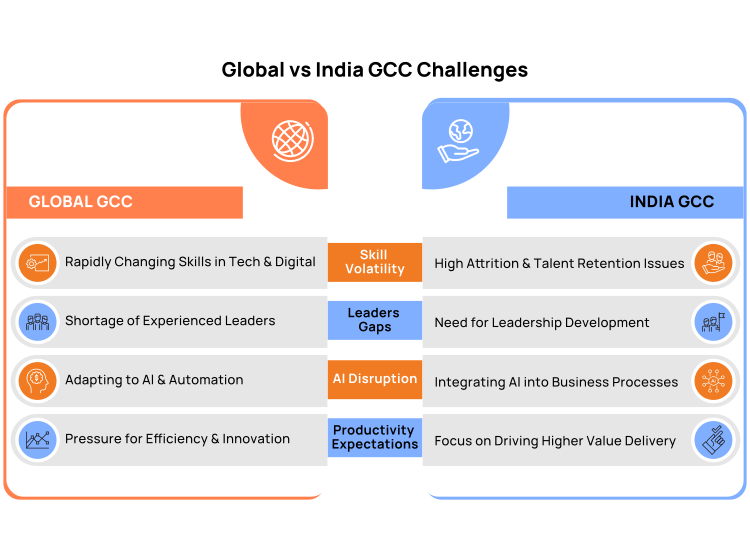
By 2026, more than three-fourths of GCCs in India are expected to manage mission-critical functions in AI platforms, digital products, cybersecurity, and enterprise data. However, many still rely on legacy talent models focused on transactional delivery. To safeguard long-term success, GCCs must urgently transform their talent strategies to build future-ready capabilities and bridge the gap between strategy and workforce.
Key GCC Talent Trends Shaping India and Global Enterprises in 2026
AI, Data, and Automation Talent Driving Enterprise Value
AI, data, and automation are now core GCC capabilities, not specialized functions. As enterprises infuse intelligence into every business layer, demand for AI-literate professionals has surged across engineering, operations, finance, customer experience, and risk management.This year, most GCC roles will require at least a working understanding of AI-driven workflows. Organizations that fail to build AI-ready talent pipelines risk falling behind competitors who can innovate faster and operate smarter. AI-enabled teams help drive continuous learning, boost productivity, and enable organizations to rapidly adapt to new challenges by applying intelligence at scale. Start investing now in upskilling your teams to ensure your organization stays ahead.
AI and ML as the Core Technical Edge Across GCCs
Machine learning has become the technical backbone of modern GCCs. India-based units and teams are ever more accountable for developing, deploying, and governing AI models that power global products and platforms. This requires not only technical depth but also strong AI governance, ethical oversight, and cross-functional collaboration. The most successful GCCs will treat AI and ML not as tools, but as enterprise capabilities deeply embedded into decision-making, product design, and customer engagement.
Hybrid and Distributed Workforce Models Redefining Talent Access
The conventional GCC campus model is giving way to hybrid and distributed workforce strategies. Businesses are getting bigger talent access beyond metropolitan hubs, tapping into emerging tech ecosystems across Tier-2 and Tier-3 cities.
The shift is not simply about flexibility. It reflects a broader move toward outcome-driven work cultures where productivity, collaboration, and innovation matter more than physical presence. In the current year, hybrid workforce models will be essential for scaling specialized skills while maintaining cost efficiency and workforce resilience.
Product-Aligned Talent Structures Accelerating Innovation
Legacy function-based structures are increasingly misaligned with the speed of digital business. Modern and advanced Global Capability Centers (GCCs) are reorganizing talent around products, platforms, and customer journeys. These product-aligned teams operate with end-to-end ownership, driving faster decision-making and tighter alignment with global business objectives. In India, this shift has empowered GCCs to move closer to the core of enterprise value creation, transforming them into true co-innovation partners rather than downstream execution arms.
Internal Talent Marketplaces and Continuous Upskilling
As skill requirements evolve rapidly, GCCs can no longer rely solely on external hiring. Internal talent marketplaces are emerging as powerful mechanisms to redeploy skills, increase workforce agility, and improve retention.
Continuous Upskilling as a Core Workforce Strategy
The current year will see skill obsolescence accelerate further, with many technical skills becoming outdated within two years. Leading GCCs are responding by embedding continuous learning into daily workflows, supported by AI-driven learning platforms that personalize development pathways. Upskilling has become a strategic investment that directly drives productivity, innovation velocity, and employee engagement, rather than remaining a cost center.
Outcome-Based Talent Metrics Replacing Traditional KPIs
The way GCCs measure talent success is changing. Utilization rates and headcount metrics are being replaced by outcome-based indicators such as business impact, time-to-market, and value delivered.
By aligning talent metrics with enterprise outcomes, GCCs strengthen accountability while demonstrating their strategic relevance to global leadership.
Leadership and Governance Talent as a Strategic Priority
While India offers a deep pool of technical expertise, leadership and governance capability remain a critical gap. As GCCs take on broader ownership of enterprise systems and AI-driven decision-making, the need for leaders who can navigate complexity, manage global stakeholders, and govern responsibly has intensified.
High-performing GCCs are investing in structured leadership development, global rotations, and AI governance frameworks. By building leadership capability alongside technical excellence, they ensure long-term scalability and trust across global enterprises.
Rethinking GCC Talent Strategy for the Future
To remain competitive, enterprises must redesign GCC talent strategies around intelligence, adaptability, and outcomes. This requires integrating AI into workforce planning, adopting product-centric operating models, and partnering with organizations that bring deep GCC and digital transformation expertise.
Enterprises that approach GCCs as strategic growth engines rather than cost-efficient delivery centers will unlock sustained value in a rapidly evolving global economy.
Enabling Faster and More Flexible GCC Scale-Up
As enterprises seek speed and flexibility in building Global Capability Centers, GCC-as-a-Service is gaining traction as a modern operating model. It allows organizations to access ready-to-scale talent, technology, and governance frameworks without long setup cycles. GCC-as-a-Service will help enterprises reduce risk, accelerate time-to-value, and focus on outcomes such as innovation and productivity, while maintaining strategic control over their GCC operations.
Conclusion
India’s GCC talent evolution is transforming the global workforce. As AI, data, and automation shift enterprise priorities, organizations that attract, develop, and manage future-ready talent will lead the market. To build a high-impact GCC, organizations need more than large-scale hiring. Success requires a partner with expertise in global business, advanced digital capabilities, and transformation management. ACL Digital offers GCC strategy, AI-driven talent solutions, and product-aligned operating models to help enterprises establish resilient, innovation-focused GCCs in India. Partner with ACL Digital to make talent your strongest competitive advantage.
Frequently Asked Questions
What makes India the preferred GCC destination in 2026?
India combines digital talent scale, AI expertise, mature GCC ecosystems, and cost efficiency, making it central to global workforce strategies.
Which GCC skills will see the highest demand?
AI, ML, data engineering, automation, cloud platforms, cybersecurity, and product leadership skills will dominate demand.
How are GCC talent models evolving?
They are shifting toward hybrid work, continuous upskilling, internal mobility, and outcome-based performance frameworks.
How do GCCs contribute to enterprise innovation beyond cost efficiency?
Global Capability Centers drive enterprise innovation by owning digital platforms, AI models, product engineering, and advanced analytics. Beyond cost savings, GCCs accelerate time-to-market, enable scalable experimentation, and support continuous innovation across global business functions.
What role does AI play in GCC talent acquisition and workforce planning?
AI improves GCC talent acquisition and workforce planning by forecasting skill demand, matching internal talent to projects, personalizing learning paths, and optimizing hiring decisions. By 2026, AI-led workforce planning will be essential for aligning talent strategy with business outcomes.
How can enterprises reduce attrition in high-demand GCC roles?
Enterprises reduce GCC attrition by offering continuous upskilling, clear career pathways, internal mobility, and meaningful product ownership. Competitive compensation alone is insufficient; employees stay longer when they see long-term growth, learning opportunities, and business impact.
What governance models are best suited for next-generation GCCs?
Next-generation GCCs require governance models that balance autonomy and accountability. Effective models include outcome-based performance metrics, strong AI and data governance, clear decision rights, and alignment with global enterprise leadership.
How long does it take to build a high-impact GCC in India?
Building a high-impact GCC in India typically takes 18 to 36 months. While basic operations can start quickly, long-term success depends on talent strategy, leadership capability, operating model design, and alignment with enterprise goals.
Why should enterprises partner with a GCC transformation specialist?
Enterprises partner with GCC transformation specialists to accelerate value creation, reduce risk, and build future-ready talent models. Specialized partners bring proven frameworks, market expertise, and execution capability essential for scaling AI-driven and product-led GCCs.
References
- https://www.mckinsey.com/capabilities/mckinsey-digital/our-insights/the-future-of-work-after-covid-19
- https://www.gartner.com/en/human-resources/topics/future-of-work
- https://www.weforum.org/reports/the-future-of-jobs-report-2023
- https://www.ey.com/en_in/services/consulting/global-capability-centers
Related Insights