


Ameya Bhawsar
5 Minutes read
Agent Lightning: The Absolute Trainer for AI Agents
In the rapidly evolving landscape of artificial intelligence, we have moved past the era of “static” bots. Today, we live in the age of AI Agents, autonomous entities that don’t just chat but also use tools, browse the web, and execute multi-step workflows.
However, even the most advanced agents built on frameworks like LangChain or AutoGen hit a ceiling. They often struggle with complex reasoning, fail at long-horizon tasks, or require manual “prompt hacking” to improve. Agent Lightning is a framework developed by Microsoft Research to enable continuous optimization of AI agents through structured feedback mechanisms.
What is Agent Lightning
Agent Lightning provides infrastructure that separates agent execution from optimization, allowing developers to iteratively improve agent performance using structured training signals.
You can think of it as a “general-purpose instructor” for AI. Whether your agent is a basic SQL query generator or a sophisticated multi-agent framework, Agent Lightning enables you to enhance its capabilities over time using advanced methods such as Reinforcement Learning (RL), Automatic Prompt Optimization (APO), and Supervised Fine-Tuning (SFT).
To better understand how these components interact, let’s examine the overall system architecture.
Why Was It Developed
Before Agent Lightning, the “Agent-RL gap” was a major hurdle:
- Complexity: Standard RL algorithms are designed for single-turn LLM calls, but agents are multi-step, multi-turn, and often involve multiple tools or agents.
- Code Coupling: Integrating RL typically forces developers to rewrite their agent workflows within specialized RL frameworks, losing modularity and flexibility.
- Data Scarcity: It was difficult to collect high-quality, structured execution traces from agents to use as training data.
Agent Lightning was developed to standardize agent training, making it as easy to “fine-tune” an agent’s behavior as it is to fine-tune a base model.
Understanding the Flow of Agent Lightning
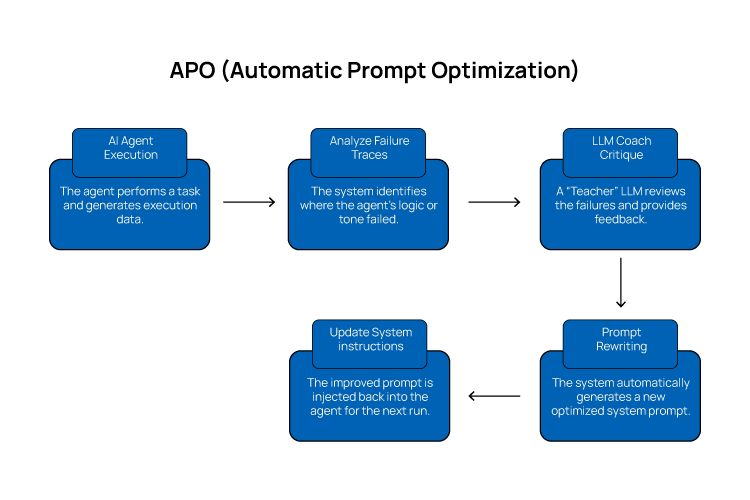
1. APO (Automatic Prompt Optimization): The Instruction Layer
The APO Loop focuses on “Natural Language Gradient Descent.” It doesn’t touch the model’s neural weights; instead, it iteratively refines the system prompt to eliminate logical or tonal errors.
- AI Agent Execution: The process begins when the agent performs a task, generating a detailed trace of its execution data.
- Analyze Failure Traces: The system automatically scans these traces to pinpoint exactly where the agent’s logic deviated or where the tone became inappropriate.
- LLM Coach Critique: A high-level “Teacher” LLM acts as an auditor, reviewing the failures and providing constructive feedback on why the mistake occurred.
- Prompt Rewriting: Using this feedback, the system automatically rewrites and optimizes the system prompt to prevent similar errors in the future.
- Update System Instructions: The refined prompt is injected back into the agent, enabling a smarter, more resilient performance in the very next run.
2. VERL (Model Optimization): The Reasoning Layer
When simple prompt changes aren’t enough for complex reasoning, the VERL Loop takes over. This is a deep Reinforcement Learning (RL) path that tunes the underlying model parameters using frameworks like PPO or GRPO.
- AI Agent Execution: The agent logs its full interaction history, including tool calls and internal chain-of-thought steps.
- Analyze Reasoning Steps: The framework evaluates the logical path the agent took, determining if the “thought process” was efficient and accurate.
- Calculate Reward Signal: Success is rewarded, and failure is penalized, converting performance into a mathematical signal used for training.
- GPU Fine-Tuning: The model enters a high-performance training phase, where GPU clusters update the neural weights to reinforce better reasoning patterns.
Update Model Parameters: The newly optimized model “weights” are loaded back into the agent, fundamentally upgrading its cognitive capabilities.

Differentiator: APO vs. VERL
While Agent Lightning supports both, they provide different solutions. This table breaks down their ideal use cases:
| Feature | Automatic Prompt Optimization (APO) | VERL (LLM RL Framework) |
| Primary Level | Prompt Layer: Optimizes the “instructions” given to the model. | Model Layer: Optimizes the “weights” and internal logic of the model. |
| Mechanism | Uses an LLM to “critique” and rewrite system prompts based on errors. | Uses Reinforcement Learning (like PPO) to fine-tune the model parameters. |
| Cost | Lower: Only costs the tokens required to refine the text prompt. | Higher: Requires significant GPU compute for backpropagation and training. |
| Speed of Change | Instant: Updates are immediate once the new prompt is saved. | Slow: Requires a training run and a new model checkpoint deployment. |
| Flexibility | Works with Closed Models (GPT-4, Claude) via API. | Primarily for Open Weights Models (Llama 3, Mistral), where you have full control. |
| Best For | Refining tone, adding “guardrails,” and fixing logic errors in complex workflows. | Improving core reasoning capabilities and “long-thought” processes (Deep RL). |
| Skill Transfer | Specific to the task defined in the prompt. | Generalizes better across similar types of reasoning tasks. |
Which One Should You Use
- Choose APO: When your goal is to regenerate or refine the prompt if the base prompt fails to produce the correct response for a given query. It is particularly useful when working with high-end API models like GPT-4o, where improving instruction-following through better prompts is more efficient than retraining the model.
- Choose VERL: If you want the agent to learn and improve its reasoning behavior through reinforcement learning, especially when using open-source models. This approach is useful for training agents to handle complex tasks such as coding, mathematical reasoning, or multi-step logic that cannot be reliably solved solely through prompt adjustments.
Agent Lightning is unique because it lets you toggle between them or use them together within the same training pipeline.
Where Can It Be Integrated or Used
Agent Lightning is designed to integrate seamlessly across the modern AI and agent development ecosystem. One of its core strengths is its high compatibility with existing agent architectures, allowing developers to adopt it without restructuring their entire system.
- Microsoft Ecosystem: Agent Lightning can integrate with Microsoft’s agent development frameworks such as AutoGen, Microsoft Agent Framework (MAF), and Semantic Kernel.
- Third-Party Frameworks: It also works smoothly with popular open-source frameworks like LangChain, CrewAI, and the OpenAI Agent SDK. These frameworks are commonly used to build RAG systems, multi-agent workflows, and tool-using agents.
- Pure Python Implementations: Even agents built without a formal framework can benefit from Agent Lightning. Developers who create agents directly using Python with raw OpenAI API calls, vLLM, or other LLM inference engines can still integrate Lightning.
Benefits of Agent Lightning
- Automated Continuous Improvement: It eliminates the grueling, manual process of “prompt hacking” by developers. The system creates a self-sustaining loop in which the agent automatically learns from its own successes and failures.
- Ultimate Flexibility (Hybrid Optimization): Unlike other tools that force you into a single paradigm, Agent Lightning supports both API-based closed models (via APO) and locally hosted open-weight models (via VERL) within the exact same infrastructure.
- Zero Performance Bottlenecks: Because of its “disaggregated” architecture, the heavy lifting of training happens on a separate server. The end-user experiences zero lag while interacting with the agent, even while massive optimization computations happen in the background.
- Higher Reliability in Production: By relying on structured feedback signals and rigorous trace logging, agents become highly specialized and less prone to hallucinations or reasoning breakdowns in complex enterprise workflows.
Use Case: Improving an SQL Agent with Agent Lightning
To demonstrate the practical value of Agent Lightning, we built a small Cricket Analytics system using a SQLite database (cricket.db). The database contains a table called top_batsmen with columns such as player_name, country_name, odi_runs, t20_runs, test_runs, and odi_debut_year.On top of this database, we created a SQL Agent that allows users to ask questions in natural language, such as “ List all batsmen from India”. The agent converts the question into an SQL query and executes it on the database.
For many simple queries, the agent’s base prompt works well and generates the correct SQL. However, when the user asks more complex questions, such as aggregations or multi-step reasoning queries, the base prompt may fail to generate the correct SQL query. In such cases, Agent Lightning’s APO (Automatic Prompt Optimization) mechanism is triggered.

For standard requests like “List all batsmen from India,” the Base Prompt successfully identifies the correct schema and generates a functional SQL query. The system returns a direct list of players, and the dashboard indicates a “Success” status with a positive reward.

When logic becomes more complex, such as finding which country has the most debutants after 2012, the system automatically triggers APO. The framework recognizes that the initial instructions were insufficient for aggregation and self-corrects on the fly to produce the accurate result seen here.
Observation
Agent Lightning represents a shift in mindset. We are no longer just “building” agents; we are “raising” them. By providing a standardized, scalable infrastructure for agent optimization, Microsoft has paved the way for AI that learns from its mistakes and adapts to users’ specific needs.
At ACL Digital, we leverage Agent Lightning to bridge the gap between rapid AI innovation and enterprise-grade stability. By leveraging its advanced capabilities, our engineers establish controlled environments in which agents undergo rigorous adversarial testing before deployment. This integration of responsible AI principles ensures the delivery of secure, compliant, and high-performance solutions for confident innovation.
References
- Agent Lightning – https://www.microsoft.com/en-us/research/project/agent-lightning/
- Agent Lightning GitHub Repository – https://github.com/microsoft/agent-lightning