


Ashutosh Deshmukh
5 Minutes read
How Generative AI is Transforming Project Risk Management
I am subscribed to newsletters from a few project management organizations such as PMI and Scrum.org. I’ve noticed a recent and significant trend in their communications.
In the past, these newsletters focused mostly on traditional methodologies or agile principles and mindset. But now, it is almost impossible to read their newsletter without a mention of AI or Gen-AI and how it can be applied in project scenarios.
Maybe this is a hint to all of us, the project managers and agile practitioners, that this whole AI or Gen-AI wave isn’t just about a new tool.

It’s about the evolution of our roles as project professionals.
In these newsletters, we’re seeing articles and case studies on how generative AI can be used to draft project charters, refine user stories, and automate the creation of risk registers. It is a clear signal that most of the organizations recognize AI as not just a technology to watch, but as a capability to put into practice and use it as a reliable tool.
This shift in focus highlights a critical need for project practitioners to adapt.
This article will delve into practical ways project professionals can leverage AI and generative AI to proactively and in a modern way, do the project risk management.
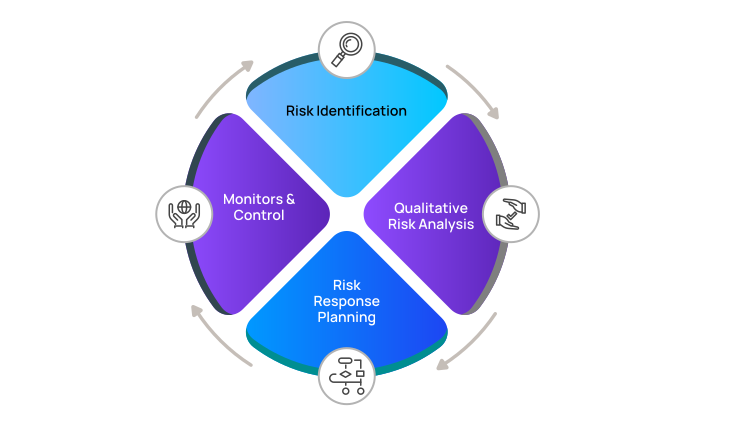
Quick recap of project risk management as per the PMI’s guidelines
- Risk identification: A cornerstone of effective risk management involves identifying project risks. While various methods exist, traditional project management emphasizes involving the entire project team in this identification exercise. It is not solely the project manager’s responsibility. Engaging the full team not only uncovers a more diverse range of risks and encourages team members to view the project from varied perspectives, such as legal and procurement, in addition to the usual development focus.
- Qualitative risk analysis: It is common for a project team to identify hundreds of risks during this phase, making it unfeasible to address every single one. Some risks will inevitably have a very low probability of occurring, and focusing on them would waste time and resources. Therefore, the logical next step is risk prioritization, often referred to as qualitative risk assessment within the project management institute’s lexicon.
- Developing the risk response: Once risks are prioritized and the team understands which are most significant in terms of probability and impact, risk owners are assigned and corresponding risk responses are documented. The nature of the risk dictates the response – some risks can be mitigated, others transferred, and positive opportunities can be explored and exploited. This step is critical to ensure that all significant risks, whether they pose a positive or negative impact on the project, have a clearly defined owner and a well-articulated response. It’s also highly advisable to develop these risk responses collaboratively with other team members, rather than the project manager shouldering the entire burden alone.
- Monitoring and controlling the project risks: With risk responses in place, it becomes the collective responsibility of the entire project team to continuously monitor project risks. Projects are inherently dynamic, and consequently, project risks are also dynamic. Risks that were high at the project’s outset might diminish as more details emerge, while new risks can also surface.
This reinforces the importance of the entire project team consistently tracking the status of risks, monitoring them diligently, and adhering to the risk response strategies developed earlier to safeguard project objectives from negative impacts.
Applying generative AI in risk management: Practical use cases
- Using Gen AI in risk identification – Generative AI can significantly enhance risk identification steps in projects by quickly analyzing vast amounts of project documentation, historical data, and stakeholder inputs to surface potential risks.
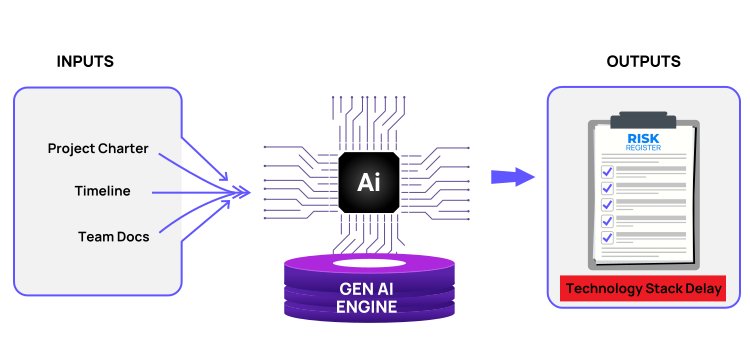
During the planning phase of the project, key project artefacts such as the stakeholder register and high-level project plan contain valuable information about the team roles, responsibilities, timelines, and objectives. By feeding these artefacts into a generative AI tool, the project team can automate the risk extraction.
The Gen AI tool can analyze the details such as critical milestones, resource allocations, and stakeholder interests to identify areas where conflicts, delays, or gaps might occur.
For example: Suppose the web development project planning document mentions aggressive timelines and use of a new framework. If this information is fed to AI, it may recognize from pattern analysis that similar projects previously experienced “framework learning curve delays.”
Aggressive timelines in past cases led to “reduced code quality” and “higher post-release defects.”
The AI would then auto-populate the project risk register with entries such as: “Risk of delayed delivery due to unfamiliar technology stack.”
Using Gen AI to de-risk the compliance challenges
Let’s say a company is developing a mobile app and cloud platform that stores and analyzes patient’s health data such as lab results, prescriptions, and treatment history. In this environment, the organization must comply with regulations like:
- HIPAA – Health Insurance Portability and Accountability Act
- GDPR (EU) – Data protection rules
- NABH / NDHM (India) – Healthcare data-sharing frameworks
The real challenge is that these regulations keep changing frequently with new data privacy clauses, updates from the Ministry of Health etc. Typically, each update comes in long, technical legal documents that are hard for software developers or architects to interpret.
The team must check whether existing code, architecture, and policies already meet the new requirements or if changes are needed. This is an often manual, time-consuming, error-prone process.
If the team uses the Gen AI system, it can read new healthcare regulations (for example, “Revised HIPAA Security Rule 2025”). These are usually PDF or Word documents full of legal terms and Gen AI can extract key compliance elements.
A generative AI model fine-tuned for healthcare regulations can automatically identify key compliance elements such as obligations, control statements, and risk statements from complex legal documents.
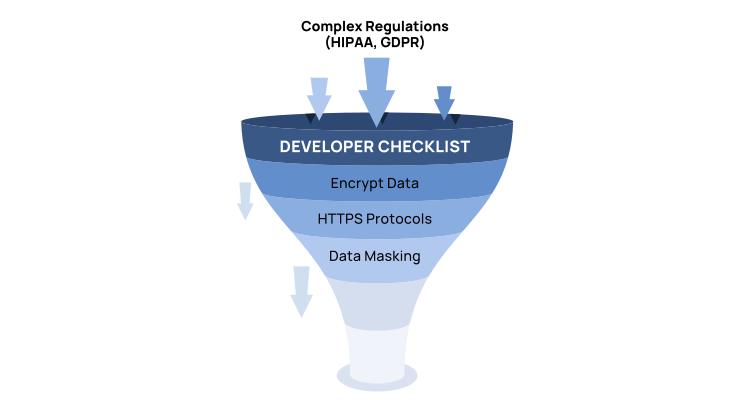
For instance, it can detect requirements like encrypting patient data or maintaining detailed access logs to prevent unauthorized disclosures. The AI then simplifies this regulatory language into clear, actionable summaries that developers can easily understand, such as ensuring all patient-related API calls use secure HTTPS protocols.
It also cross-references these extracted insights with existing architecture diagrams, policy documents, or code repositories in tools like Confluence or GitHub to check whether the necessary controls already exist or need to be updated.
Based on this analysis, the system generates a prioritized list of tasks for the project manager or compliance officer to act upon. These tasks may include reviewing API gateway settings, adding access logging components, or updating data retention policies.
This end-to-end automation helps bridge the gap between regulatory language and technical implementation, ensuring continuous compliance within healthcare software projects.
How as a PM will you measure/quantify the outcomes after applying the AI to risk management?
So far, we have discussed about how generative AI can be used in project risk management. Now, we need to look at how to measure and quantify the actual results of using AI in this field. But why is this important?
Well, that is because the organizational leadership aren’t just interested in new tools and shiny tools or new buzzwords in the industry – they want to see the business benefits and tangible advantages that generative AI can offer. The necessity of focusing on tangible benefits stems from the fact that senior leadership is constantly bombarded with new technologies claiming to be the next big disruption. For them, Generative AI is just another line item on a potential capital expenditure report until its value is unequivocally proven in dollars, time, and mitigated risk.
Hence, it is imperative that as a project manager or person in a similar position to serve as the crucial translator, converting the technical capabilities of a Gen AI into tangible business benefits of using it across the organization in a wide scale.
There can be many ways to measure the benefits of using generative AI in risk management. We will focus on 3 main categories of benefits and suggest a few metrics to objectively measure them.
- Efficiency – In traditional risk management, the Risk Identification phase is often the most time-consuming upfront effort and this process usually relies heavily on manual, time-intensive methods. Some of the most commonly used or applied methods for risk identification includes brainstorming sessions, Delphi techniques, stakeholder interviews, document reviews, and reviewing historical project data. But using any of these methods is usually a manual process and takes up significant portions of the time.
As a project team, we can use Risk Identification & Analysis Efficiency metrics.
This metric quantifies the reduction in the time and effort required to complete the initial risk identification and analysis processes.
In a software project, before GenAI, a Project Manager (PM) or Business Analyst might spend days manually reading project documentation, scope changes, and technical specifications to identify potential risks like ambiguous requirements or technical debt.
After implementing GenAI, the AI tool can ingest all these documents, automatically highlight potential risk areas (like unclear user stories or complex integration points), and draft an initial risk register with a suggested impact level. You would then compare the total hours spent by the human team on this task before versus after to calculate the time saved.
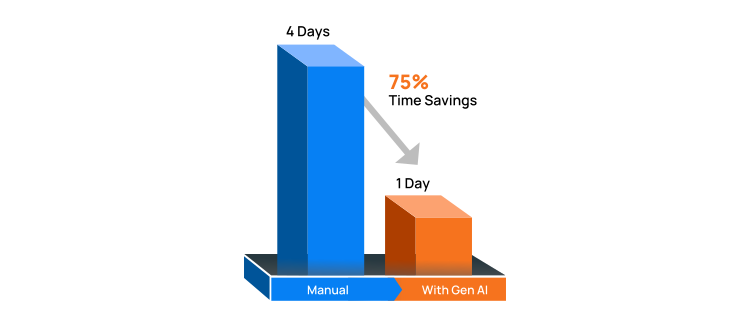
For example, reducing the time from 4-days to 1-day for the initial risk assessment means the team is 75% more efficient, allowing the project to proceed to coding much faster with a robust risk plan.
- Effectiveness: Risk management is a complex area, and even experienced project teams might not be able to identify and foresee every possible project risk. Human analysts tend to focus on risks they have encountered before or risks that are easy to measure. They struggle to maintain focus while reviewing thousands of documents, leading to inevitable fatigue and missed signals. This means that the overall risk management might not be effective enough to prevent unexpected risks and may cause project failure. Humans only sample the data; GenAI processes the entire universe of data in near real-time.
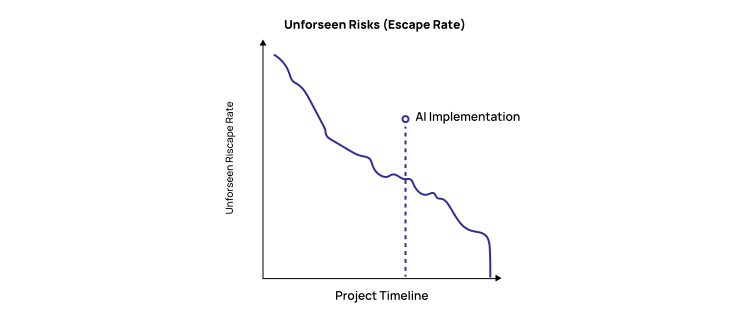
Hence, to measure the effectiveness of using or applying Gen AI, the project team can use Risk ‘Escape’ Rate (or Missed Risk Rate) metrics.
The team can calculate the Risk ‘Escape’ Rate by tracking how many significant risks that actually caused a project delay or cost overrun were not listed in the risk register beforehand. A low or decreasing escape rate post-GenAI demonstrates that the AI is effectively identifying subtle and emerging risks missed by human analysis.
For a software project, this means fewer unexpected issues—like a critical security vulnerability or an integration failure—disrupting the development schedule and budget.
- Impact: For any project, regardless of its type, there are always 3 main constraints: time, scope, and cost. Hence, as a project manager, it’s important to measure the impact that using generative AI can have on any of these constraints.
To measure it, we can use metrics such as Resource Cost. This metric focuses on the financial and human resource savings achieved by automating the labor-intensive aspects of risk management.
We can plot the resource cost before AI – This cost will be high due to extensive manual labor for data collection, risk generation, and risk analysis. But after applying the Gen AI – this cost will be lower. The lower resource cost can be experienced not only during the initial risk identification process, but even during the subsequent steps such as risk report generation, risk reporting.
Ethical considerations while applying the AI
There’s no doubt that using AI in risk management and other areas of project management will be common in the future. Generative AI can offer significant value, saving project managers a lot of time and money.
However, it’s important to consider the ethical implications when applying and using generative AI.
Below are few ethical considerations which should be kept in mind.
- Transparency and Explainability: In the earlier sections of this blog, we discussed how generative AI is capable of identifying project risk across multiple areas of the project. It may happen that the project manager may not be able to fully understand the reasoning behind why the generative AI is flagging some of the risks. The project manager may not be fully aware about the reasoning behind why the generative AI has marked some of those risks.
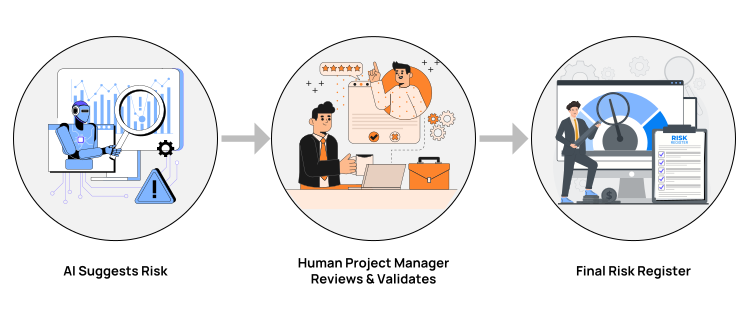
The project manager has an ethical duty to all stakeholders to justify critical risk decisions.
Blindly accepting a risk assessment or response from a Gen AI tool shifts that accountability away from the human decision-maker, a project manager in this case.
Hence, The PM must ensure the AI’s risk output is documented and explainable, allowing for human review and validation. The PM must use AI tools that offer Explainable AI capabilities or employ processes to validate the AI’s rationale, thereby retaining accountability for the final, human-vetted risk decisions.
- Bias and Fairness: AI models are trained on historical project data. If that data disproportionately ties project failures (risks) or resource challenges to specific demographics (e.g., location, gender, past projects with known cultural biases, or even certain vendors), the generative AI may learn and perpetuate those biases in its risk identification, qualitative risk analysis (e.g., probability/impact scoring), and resource-related risk responses.
The project manager must ensure the AI does not create or reinforce unfair discrimination. For example, a system biased against a particular vendor or region could unjustly increase the perceived probability of risks on projects involving them, leading to unfair resource allocation or response strategies.
The PM must actively audit the AI’s outputs for biased patterns, use diverse and representative data sets when possible, and apply human judgment to override or mitigate any discriminatory risk analyses or responses suggested by the AI.
Conclusion
The integration of generative AI into project risk management offers significant advantages in terms of efficiency, effectiveness, and compliance. It can automate tedious tasks, identify risks more comprehensively, and help navigate complex regulatory landscapes.
However, its implementation necessitates careful consideration of ethical implications, particularly regarding transparency, explainability, bias, and fairness. Project managers must actively engage with AI tools, ensuring human oversight and accountability to leverage the benefits of AI while mitigating its potential drawbacks.
The evolution of project management roles will involve translating AI’s technical capabilities into tangible business benefits, making it imperative to measure and quantify the outcomes of AI application in terms of efficiency, effectiveness, and impact on project constraints (time, scope, and cost).